
Enif: Redefining Autonomous Chemical Sensing in Complex Urban Environments
7568_Autonomous Chemical-Sensing Aerial Robot for UrbanSuburban Environmental Monitoring.
The paper presents "Enif," an autonomous aerial robotic system designed for chemical sensing and environmental monitoring in urban/suburban environments. It integrates a high-performance MPS (Molecular Property Spectrometer) sensor with a customized multirotor UAV, achieving nearly 40 minutes of flight time and featuring a novel Potential Field with Incorporated Past Actions (PF-IPA) algorithm for robust collision avoidance.
TL;DR
Researchers have developed Enif, an autonomous aerial robot that bridges the gap between laboratory gas sensing and real-world urban deployment. By combining an empirical design for 40-minute endurance, a MEMS-based MPS sensor for real-time gas identification, and a localized PF-IPA navigation algorithm, the system can map hazardous leaks in obstacle-rich environments where traditional drones fail.
Problem & Motivation: The Urban Barrier
Environmental monitoring after industrial accidents or natural disasters requires speed and precision. While UAVs offer superior mobility over ground robots, they face the "Urban Trifecta" of challenges:
- Life on a Clock: Most sensing drones run out of battery in under 20 minutes, limiting their range to the immediate vicinity of the operator.
- Obstacle Blindness: Standard navigation often fails in "canyons" created by buildings or dense foliage, where Potential Field algorithms get stuck in local minima (deadlocks).
- Sensor Latency: Conventional Metal-Oxide (MOX) sensors require long preheating times and struggle to identify which gas is leaking, only that something is there.
The authors' insight was to treat the drone not just as a carrier, but as a tightly integrated system where the physics of flight endurance and the logic of reactive navigation are co-optimized.
Methodology: Engineering Endurance and Intelligence
1. Empirical Flight Optimization
Instead of relying on theoretical momentum theory which often overestimates battery life, the team built a database of 500+ batteries and various motor/propeller combinations. They discovered that for a 3kg class UAV, the battery weight must be approximately 50% of the Gross Vehicle Weight (GVW) to reach the "Sweet Spot" of efficiency.
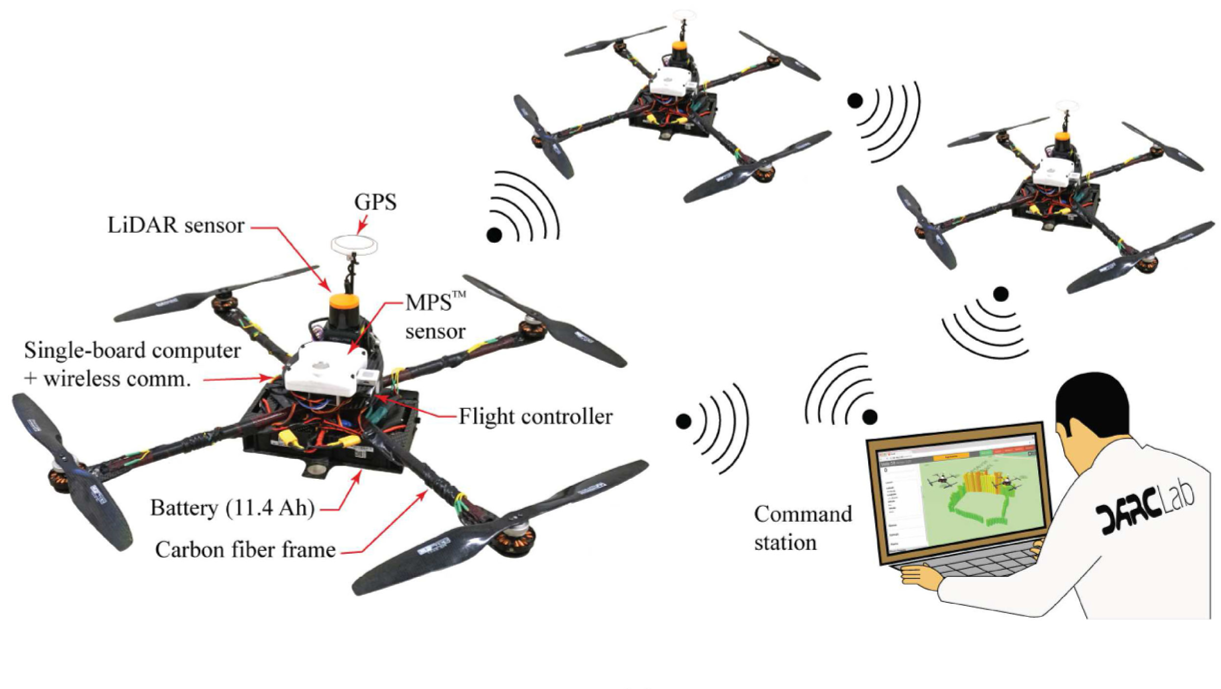 Figure: The optimization surface showing the relationship between robot weight, battery weight, and the 40-minute endurance threshold.
2. The MPS Advantage
Transitioning away from MOX sensors, Enif uses the Molecular Property Spectrometer (MPS). Unlike chemical-reaction sensors, it measures the thermal properties of the air/gas mixture.
- Zero Preheating: Instant deployment.
- Identification: It can distinguish between Propane, Methane, and Xylene in real-time.
- Poison Resistance: It doesn't "clog" when exposed to high concentrations.
3. PF-IPA: Navigation with a Memory
Traditional Potential Fields pull the drone toward a goal and push it away from obstacles. However, if these forces cancel out (e.g., a wall between the drone and the goal), the drone stops. The PF-IPA (Potential Field with Incorporated Past Actions) adds a "directional inertia" based on the last n movements. This "memory" pushes the drone to commit to a direction, allowing it to "slide" around obstacles instead of getting stuck.
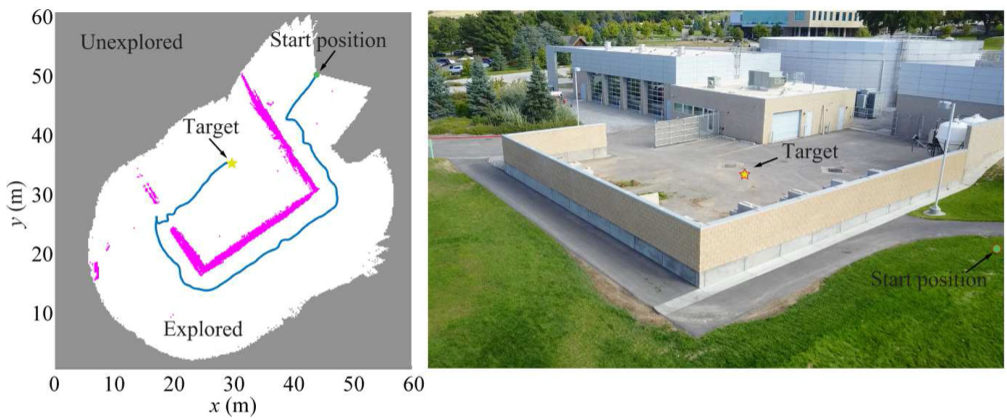 Figure: Simulation showing how PF-IPA (Green) avoids the local minimum trap that stops standard PF (Red).
Experimental Results: The Salt Flats Test
The Enif system was validated in the Utah salt flats, simulating a hazardous leak using six propane tanks.
- Mapping Precision: The robot generated high-resolution heat maps while flying a raster scan at 0.5 m/s.
- Real-world Navigation: In urban obstacle tests, the robot successfully navigated through narrow gateways at 1 m/s with a tracking error of only 0.13m.
- Endurance Match: The empirical model predicted 41 minutes; the actual flight lasted 39m 46s—a remarkable accuracy for field robotics.
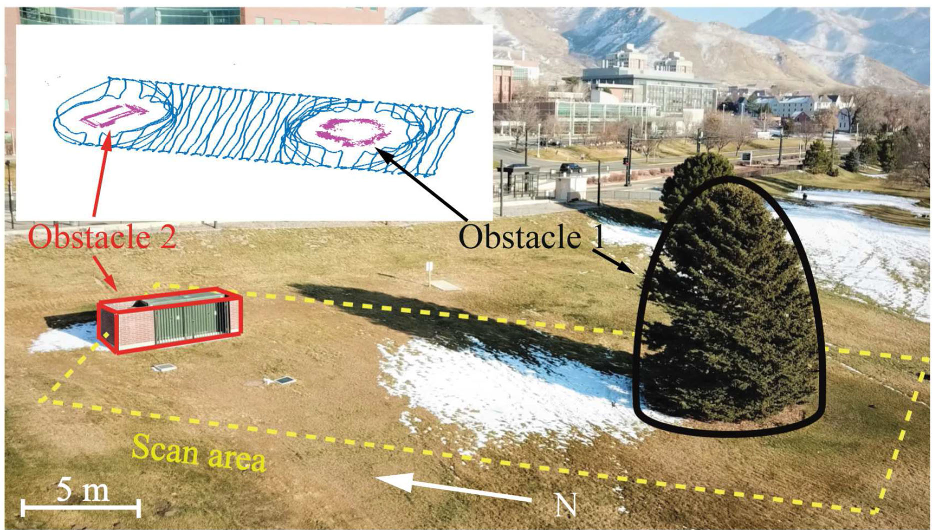 Figure: Real-time gas concentration maps generated during the propane leak experiment.
Critical Insight & Conclusion
The Enif system's primary contribution isn't just a "longer-lasting drone," but the demonstration of a complete autonomous loop: from empirical hardware sizing to reactive obstacle avoidance that accounts for historical state.
Limitations: The authors noted that rotor downwash (turbulence) can dilute gas concentrations, especially for small-scale leaks. Future iterations might require extending the sensor probe beyond the rotor's influence or using advanced fluid dynamics to "de-noise" the sensor readings.
Future Outlook: This architecture is a prime candidate for "swarm" deployments. With its 8km standoff distance and 40-minute airtime, a fleet of Enif robots could provide 24/7 autonomous monitoring of high-risk petrochemical facilities.