
Autonomous and Interdependent: The Shift Toward Collaborative Privacy Management
Autonomous and Interdependent: Collaborative Privacy Management on Social Network Sites
This paper introduces a theoretical and empirical framework for "Collaborative Privacy Management" (CPM) on Social Networking Sites (SNSs). It moves beyond individualistic privacy models to develop a validated 3-dimensional scale (Ownership, Access, and Extension) that quantifies how users collectively negotiate and protect shared information.
TL;DR
Privacy preservation is often viewed as a "solo sport"—an individual adjusting their settings in isolation. However, Jia and Xu argue in this seminal CHI paper that SNS privacy is fundamentally collaborative. By developing a multi-dimensional framework (Ownership, Access, Extension), they demonstrate that users don't just protect their own data; they navigate complex social interdependencies to protect "collective boundaries."
Problem & Motivation: The Individualistic Fallacy
Prior work in HCI and privacy has focused heavily on individual agency. But consider the "Group Photo" dilemma: If a friend posts a photo of you, you are a stakeholder in that data but have zero technical control over its privacy settings.
The authors identified that current SNS tools fail because they ignore interconnectedness. Privacy is not a static wall; it’s a dialectic boundary. The challenge lies in the fact that while users value their autonomy, they are inherently trapped in an interdependent social web where one person's disclosure affects the entire group's privacy.
Methodology: The Three Pillars of Collaboration
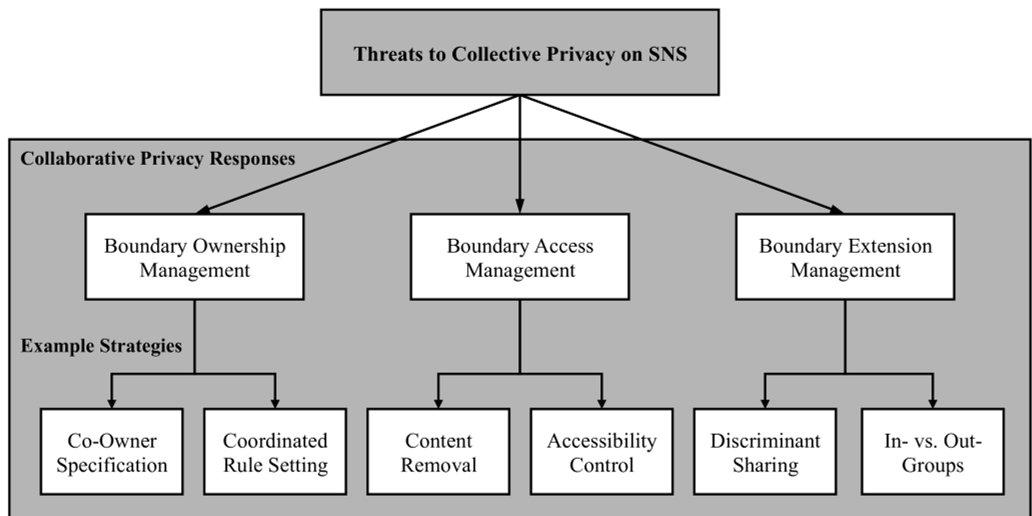
The core contribution of this work is the conceptualization of SNS Collaborative Privacy Management into three operational dimensions based on Petronio’s Communication Privacy Management (CPM) theory:
- Ownership Management: Negotiating who "owns" the shared info and who gets to decide on future disclosures.
- Access Management: Regulating the permeability of the boundary (e.g., hiding old "histories" or removing over-sharing posts).
- Extension Management: Deciding whether to allow the information to flow into new social linkages (preventing re-sharing).
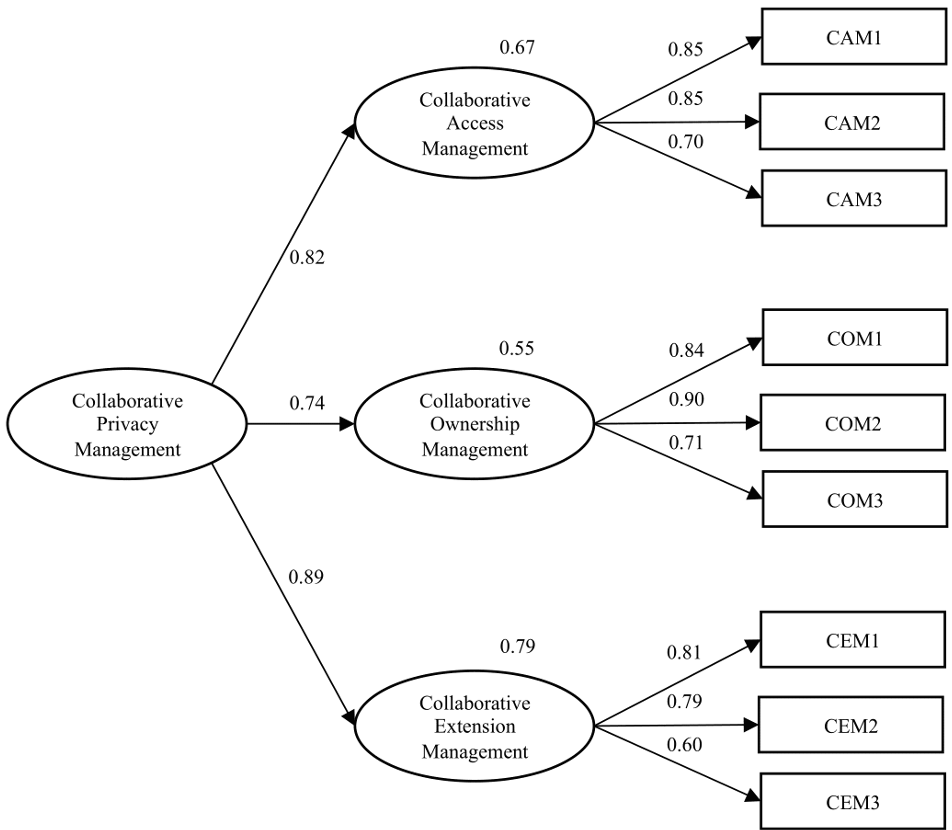
The authors conducted an iterative scale development process, starting with 12 items and refining them to a robust 9-item scale through Exploratory Factor Analysis (EFA) and Confirmatory Factor Analysis (CFA).
Experiments & Results: What Drives Us to Collaborate?
The study utilized two distinct samples: Amazon Mechanical Turk workers (diverse demographics) and undergraduate students. The structural model tested three antecedents: Perceived Risk, Information Disclosure, and Propensity to Value Privacy.
- Social Cohesion Matters: Increased in-group disclosure strengthens group bonds, which paradoxically leads to stronger collaborative privacy management.
- The "Reactive" Nature of Risk: Interestingly, perceived collective risk only predicted Access Management. When users feel threatened, they don't necessarily stop sharing or redefine ownership; they simply try to "lock down" the history of what has already been shared.
- Widespread Adoption: A majority of participants (over 50% in many categories) reported they were likely to adopt these collaborative strategies, particularly specifying who can view posts.
Critical Analysis & Conclusion
The Takeaway
The paper proves that "Collaborative Privacy Management" is not just a theoretical construct but a lived reality for SNS users. Users are willing to transition the locus of control from the self to the group when personal efforts are insufficient.
Design Implications: Moving Beyond the "Privacy Toggle"
The authors suggest that SNS interfaces must evolve. Instead of just a "Public/Private" switch, we need:
- Transparency Tools: Like Google+ "private share" details that show who exactly is in the "co-owner" circle.
- Conflict Resolution Mechanisms: Design features that facilitate "unalarming" expressions of disagreement between friends regarding a post.
- Retrospective Tools: Easier ways for groups to collectively "scrub" their shared history.
Limitations
While the study is robust, it relies on self-reported survey data rather than observed behavioral logs. Furthermore, the "Mechanical Turk" and "Student" populations, while diverse, both represent tech-literate cohorts. Future work should investigate how these dynamics play out in high-stakes environments like workplace collaboration or sensitive health-tracking groups.
In a "hyper-social" world, the most effective privacy settings might not be in our menus, but in our conversations with our friends.