
GLS: Orchestrating a Society of Agents for Autonomous Knowledge Discovery
An organized society of autonomous knowledge discovery agents
The paper introduces GLS (Global Learning Scheme), a multi-strategy and cooperative knowledge discovery system designed as an organized society of autonomous KDD agents. It leverages a three-level architecture (meta-meta, meta, and object levels) to automate data pre-processing, knowledge elicitation, and hypothesis refinement.
TL;DR
The paper presents GLS (Global Learning Scheme), a sophisticated framework that reimagines knowledge discovery not as a single algorithm, but as a distributed society of autonomous agents. By organizing specialized agents for pre-processing, elicitation, and refinement, GLS achieves high autonomy and versatility in extracting insights from complex, global data sources.
Background Positioning
In the landscape of the 1990s and early 2000s, as databases grew beyond human capacity for manual analysis, the field of Knowledge Discovery in Databases (KDD) faced a bottleneck: how to create "Softbots" that could independently plan and execute discovery tasks. GLS enters this space as a meta-architectural framework, moving beyond the "toolkit" approach (like INLEN) toward a truly autonomous, self-organizing system.
Problem & Motivation: The Limits of Static Mining
The authors identify two fatal flaws in contemporary discovery systems:
- Low Autonomy: Most systems require heavy human intervention for task decomposition and data cleaning.
- Lack of Refinement: Discovered knowledge is often treated as static. In reality, data changes, and "discovered" rules are merely hypotheses that need constant refinement and versioning.
Their Insight: Complex discovery is a "thinking process." Using Minsky's "Society of Mind" perspective, if one cannot build a single genius algorithm, one should build a society of simple agents that collaborate to solve the complex whole.
Methodology: The Three Levels of GLS
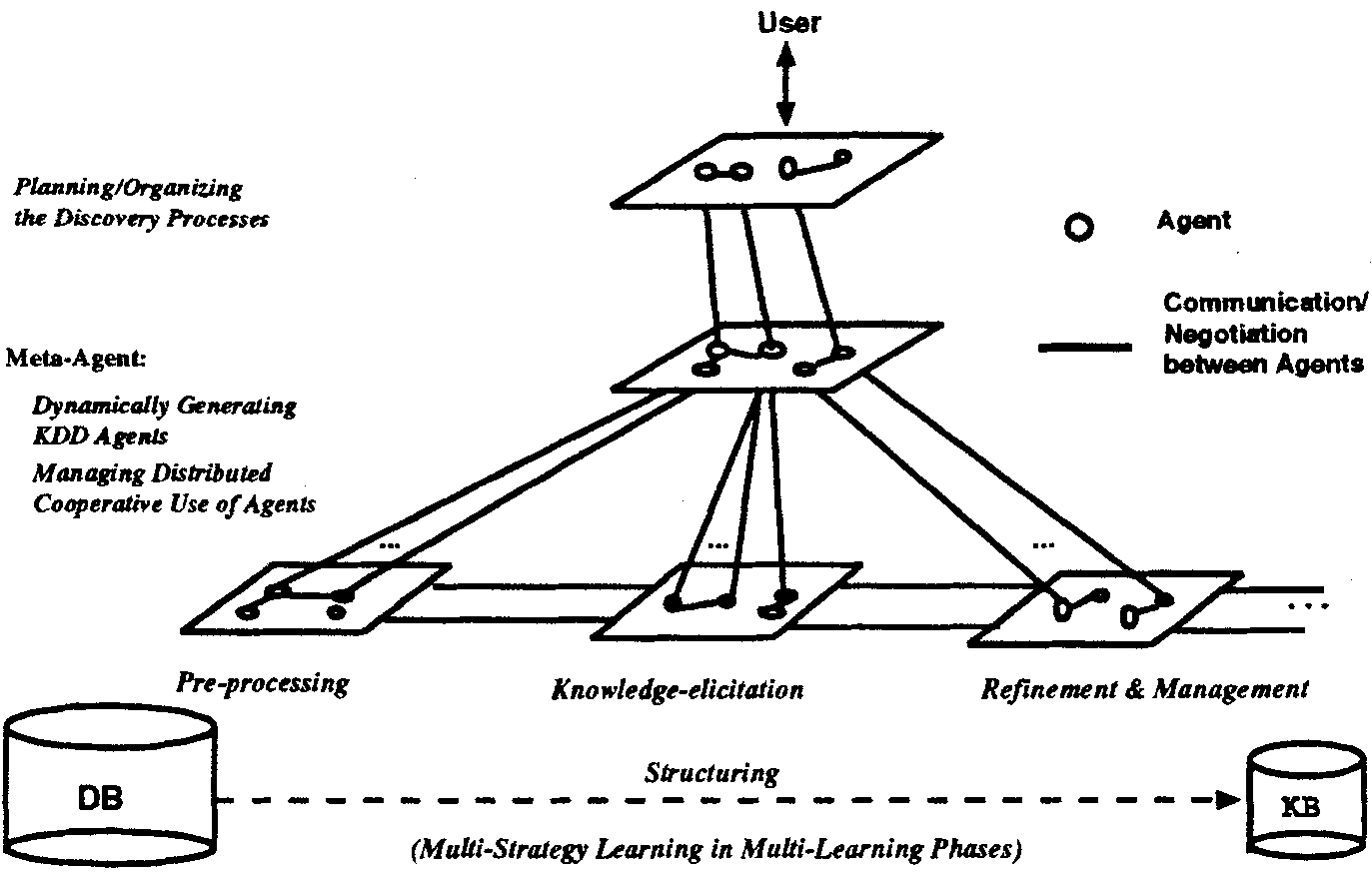
The power of GLS lies in its three-tier architecture that separates "doing" from "planning."
1. The Object Level (The Workers)
This level contains the KDD agents, divided into three phases:
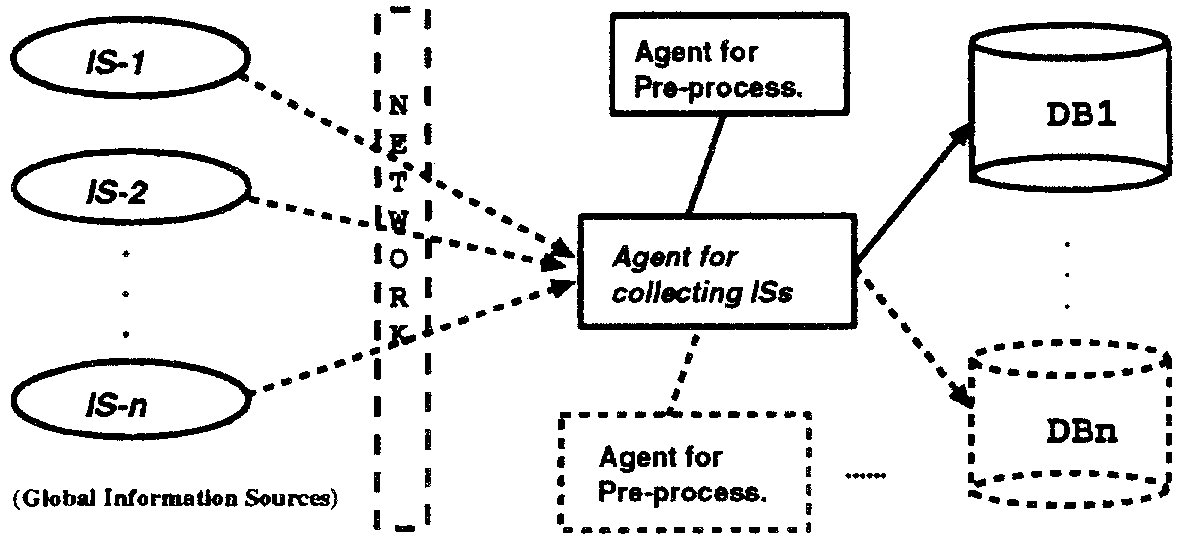
- Pre-processing: Agents for CBK (Clustering using Background Knowledge) and SCT (Stepwise Chow Test) transform raw data into manageable clusters.
- Knowledge Elicitation: Specialized engines like KOSI (regression analysis) and GDTG (probabilistic rules) extract patterns.
- Refinement: Modules like IIBR manage the history and evolution of discovered knowledge.
2. The Meta-Levels (The Managers & Coordinators)
- Meta Level: Responsible for the dynamic generation of agents and resource allocation. It uses Partial Global Planning (PGP) to ensure agents don't conflict.
- Meta-Meta Level: Interfaces with the user and the environment to organize the overall discovery strategy.
Core Engines and Experimental Logic
The authors showcase the versatility of GLS through several specialized agents:
- KOSI (Knowledge Oriented Statistic Inference): An extension of the famous BACON system, designed to handle uncertainty through multi-search heuristics and regression analysis.
- DBI (Decomposition Based Induction): Based on Simon and Ando's theory of near-complete decomposability, this agent breaks massive databases into nearly independent sub-clusters, significantly reducing computational complexity.
Critical Analysis & Conclusion
Takeaway
GLS proves that a multi-strategy, multi-agent approach is essential for "Global" learning. By treating KDD agents as dynamic components of an "Intelligent Mail Box," the system achieves high flexibility.
Limitations
While the architecture is robust, the paper notes that the Semantic Value of information (the "Why" behind the data relative to user intention) still requires heavy human interaction. Deep integration of large-scale background knowledge remains a frontier.
Future Outlook
The principles of GLS—specifically the Meta-Control of autonomous agents—parallel modern trends in Autonomous AI Agents (like AutoGPT or LangChain Agents). The emphasis on "Refinement and Management" as a core learning phase is a lesson still highly relevant for the long-term maintenance of Machine Learning models today.