
Agency vs. Autonomy: Why Efficiency Isn't Enough for Assistive Robots
How Autonomy Impacts Performance and Satisfaction: Results From a Study With Spinal Cord Injured Subjects Using an Assistive Robot
This paper presents a three-week user study evaluating the UCF-MANUS, a vision-guided 6DOF assistive robotic arm designed for individuals with Spinal Cord Injury (SCI). The study compares supervised autonomous mode (Auto) against manual operation (Cartesian), finding that while the Auto mode significantly reduces user effort (NOC), task completion times (TTC) become comparable over time due to a more pronounced learning effect in the manual mode.
TL;DR
A longitudinal study with Spinal Cord Injured (SCI) subjects reveals a fascinating paradox in assistive robotics: while vision-guided autonomous modes radically reduce physical effort, users often report higher satisfaction when operating robots manually. This research highlights that for the disabled community, a robot is a "tool for interaction" rather than just a "service agent."
The Productivity Gap in Assistive Tech
The market for assistive robots has historically lagged behind industrial or domestic service robots. The researchers behind the UCF-MANUS project identified a critical gap: we are building robots that are technically "smarter" (higher autonomy), but these systems often ignore the user's desire for participation and mastery. When a robot does everything for a user, it may feel like just another external caregiver rather than an extension of the user's own body.
Methodology: Decoupling Physical and Cognitive Effort
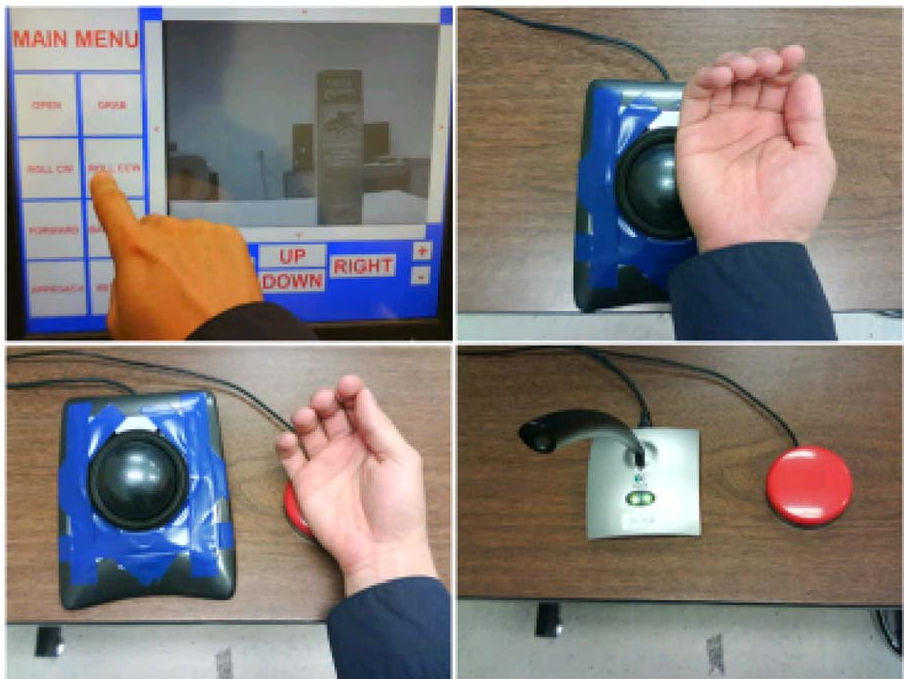
The study utilized the UCF-MANUS, a 6-degree-of-freedom (6DOF) arm. Ten SCI subjects were split into two cohorts to perform pick-and-place tasks using two distinct modes:
- Cartesian Mode (Manual): Users control every translation and rotation.
- Auto Mode (Supervised Autonomy): Users point to an object on a screen, and the robot’s "eye-in-hand" camera system handles the grasping trajectory.
To analyze performance, the authors moved beyond simple completion time. They introduced:
- Command Inefficiency (CI): Captures "extra" clicks caused by physical difficulty in maintaining a switch.
- Planning Inefficiency (PI): Captures "wrong" moves caused by cognitive confusion or poor spatial planning.
 The testing environment featuring the UCF-MANUS arm and bi-level shelf setup.
Key Findings: The Learning Effect and The Satisfaction Paradox
The results from the three-week period provided several "Academic Insights":
1. The Power of Learning
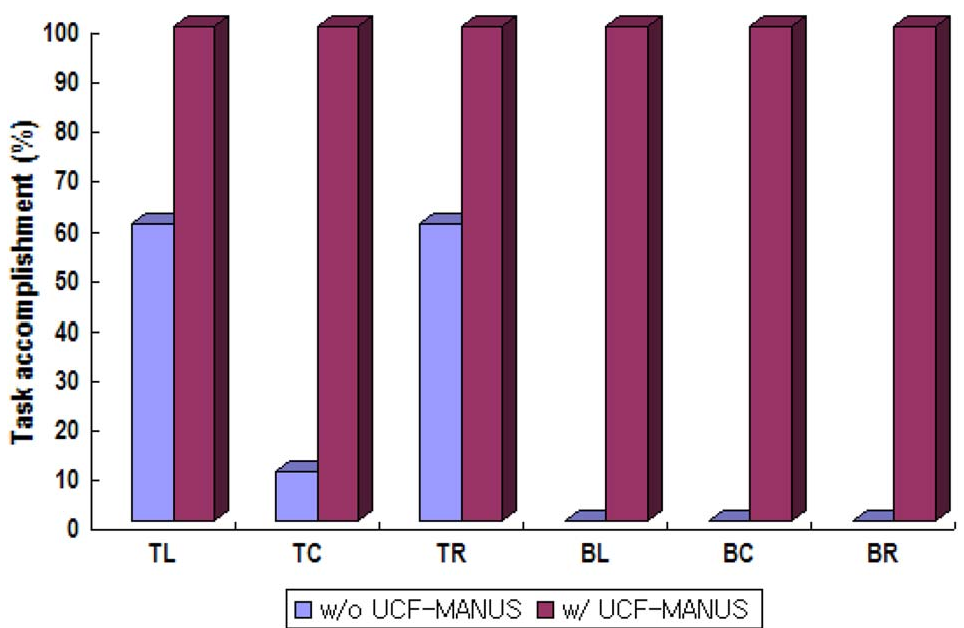
Initially, the Auto mode was significantly faster. However, by Week 3, the manual mode users had narrowed the gap via a "pronounced learning effect." Manual users became 4x more efficient at planning their movements, whereas Auto mode performance remained static because it was limited by the system's own vision-processing latency.
 Comparative plots show that while Number of Clicks (NOC) remained lower for Auto mode, Time to Task Completion (TTC) improved drastically for manual users.
2. High Tolerance for Own Mistakes
A striking finding was that satisfaction in the Auto mode was extremely sensitive to system performance. If the robot made a mistake, user satisfaction plummeted. Conversely, in Manual mode, users were much more forgiving of their own slowness or errors. This suggests that users view the robot's performance as a "service" they evaluate critically, whereas they view their manual performance as a "skill" they are developing.
3. Physical vs. Cognitive Impairment
Through the CI and PI metrics, the study proved that the "poor performance" of SCI users compared to able-bodied controls was strictly a physical bandwidth issue (Command Inefficiency) rather than a cognitive mapping issue (Planning Inefficiency). SCI users knew how to move the robot; they just struggled to hold the buttons down consistently.
Critical Analysis & Conclusion
This paper delivers a vital message for HRI (Human-Robot Interaction) researchers: Autonomy should be a spectrum, not a binary choice.
Takeaways:
- The User as Pilot: For this class of users, the robot serves as a "quintessential tool to reassert their domain of interaction."
- Hybrid Interfaces: Future systems should offer "Adjustable Autonomy," where the robot handles the complex spatial math of grasping (the "bottleneck") but allows the user to steer the general approach.
- Future Work: The authors suggest integrating the arm directly onto the powerchair control system (joystick) to reduce "interface switching" and increase the sense of embodiment.
In conclusion, the goal of assistive robotics isn't just to "get the cup to the table"—it's to empower the user to feel as if they were the ones who moved it.