
AVEC 2011: Setting the Stage for Real-World Multimodal Emotion Recognition
AVEC 2011–The First International Audio/Visual Emotion Challenge
AVEC 2011 is the inaugural competition for benchmarking multimedia processing in automatic audio, visual, and audiovisual emotion analysis using the SEMAINE corpus. It introduces a standardized evaluation framework across four affective dimensions—Activity, Expectation, Power, and Valence—using SVM-based baselines and open-source feature extraction toolkits like openSMILE and OpenCV.
TL;DR
The Audio/Visual Emotion Challenge (AVEC 2011) marks a historic shift in affective computing from curated, acted datasets to naturalistic human behavior. By leveraging the SEMAINE corpus, the authors provide a rigorous benchmark for predicting four emotional dimensions (Activity, Expectation, Power, and Valence). Despite using robust features like LBP and openSMILE, the baseline results reveal a stark reality: naturalistic emotion recognition is incredibly difficult, with multimodal fusion providing the only reliable path forward.
Problem & Motivation: Beyond "Laboratory" Emotions
Historically, emotion recognition research focused on "prototypical" expressions—think of an actor clearly portraying "Rage" or "Joy." However, real-world machines encounter subtle, non-preselected, and messy data. The authors identified a critical gap: the community lacked a strictly comparable benchmark to evaluate how audio and video modalities contribute to decoding these "natural" social signals.
The motivation was twofold:
- Standardization: Forcing all participants to use the same partitions (Train/Dev/Test) to eliminate "cherry-picked" results.
- Realism: Moving toward the Sensitive Artificial Listener (SAL) scenario, where agents respond to emotion rather than literal content.
Methodology: The Multimodal Pipeline
The challenge splits emotion into four continuous dimensions, later binarized (above/below mean) for classification tasks.
1. Audio Processing (The "How" of Sound)
The audio baseline utilizes the openSMILE toolkit, extracting a massive set of 1,941 features. This includes:
- Low-Level Descriptors (LLD): Energy, spectral roll-off, MFCCs, and voicing-related features like jitter and shimmer.
- Functionals: Applying statistics (mean, skewness, regression) over word-level segments to capture the temporal "shape" of the speech.
2. Video Processing (The "How" of Appearance)
The video pipeline focuses on facial dynamics:
- Face Registration: Using Viola-Jones and Haar-cascade eye detectors to normalize head pose.
- Local Binary Patterns (LBP): The team divided the face into a 10x10 grid, extracting local textures (5,900 features per frame). This captures micro-changes in facial muscle movements without the overhead of complex geometric models.
 Note: Table 1 illustrates the massive scale of the SEMAINE corpus, totaling over 1.3 million video frames.
3. Fusion Strategy
The "Audiovisual Sub-Challenge" uses Late Fusion. Predictions (posterior probabilities) from the separate audio and video SVMs are concatenated and fed into a final linear SVM.
Experiments & Results: A Reality Check
The baseline performance highlights the "Overfitting Trap" inherent in naturalistic data. While models performed respectably on the Development set (often >60% accuracy), performance on the hidden Test set was significantly lower.
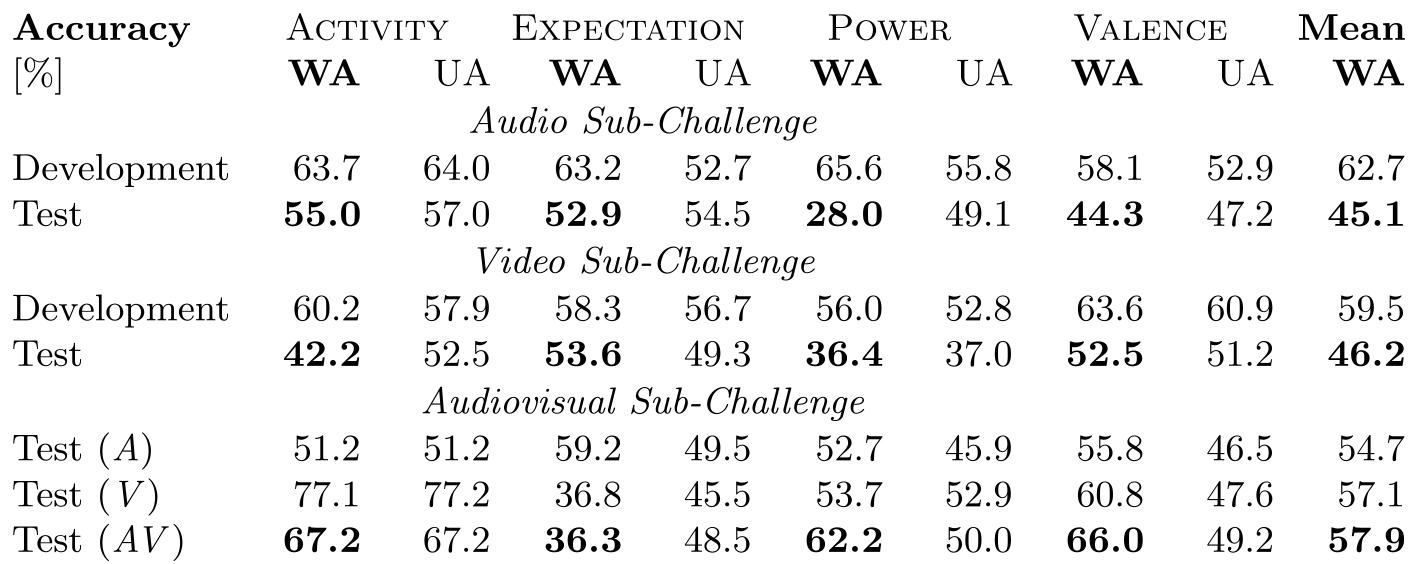 Table 6: Note the performance drop from Development to Test, highlighting the challenge of generalization.
Key Insights from the Results:
- Modality Strength: Video performed exceptionally well for Activity (77.1% on Test), likely due to visible head and body movement.
- The Fusion Advantage: For "Power" and "Valence," the combined AV model outperformed the unimodal counterparts, proving that different modalities provide complementary affective information.
- The Difficulty of "Expectation": This dimension remained largely elusive for both modalities, suggesting it may require deeper linguistic or contextual understanding.
Deep Insight & Conclusion
AVEC 2011 proved that naturalistic emotion recognition is not a solved problem. The Organizers' decision to refrain from "feature space optimization" provided a transparent, if humbling, baseline.
Takeaway: The "mean-split" binary classification serves as a starting point, but the low test scores (some below chance level) indicate that traditional SVMs and hand-crafted features struggle with the high variance of natural human dialogue. The future of the field, as hinted by this challenge, lies in more sophisticated temporal modeling and expert fusion strategies that can handle the asynchronous nature of audio and visual cues.
Limitations: The use of word-level binning for audio versus frame-level for video creates a temporal mismatch that late fusion only partially addresses. Future work likely requires "Middle Fusion" or Attention-based mechanisms to align these signals more effectively.