
AVEC 2016: Bridging the Gap in Multimodal Depression and Emotion Recognition
AVEC 2016 - Depression, Mood, and Emotion Recognition Workshop and Challenge
AVEC 2016 is a landmark competition paper establishing a multimodal benchmark for Depression Classification (DCC) and Multimodal Affect Recognition (MASC). It introduces the DAIC-WOZ and RECOLA datasets, employing baseline systems using SVMs and Random Forests to integrate audio, video, and physiological signals (ECG/EDA).
TL;DR
The Audio/Visual Emotion Challenge (AVEC) 2016 addresses the critical need for robust, multimodal benchmarks in affective computing. By introducing the DAIC-WOZ and RECOLA datasets, the challenge tasks participants with binary depression classification and continuous affect estimation (Arousal/Valence). The baseline highlights that while audio and video are primary drivers, physiological signals like Heart Rate Variability (HRV) provide essential latent information for understanding human distress.
The Motivation: From Prototypical to Naturalistic Behavior
Most early emotion recognition systems were trained on actors performing "prototypical" emotions (e.g., exaggerated happiness or anger). However, in behaviomedical contexts—such as diagnosing depression—emotions are subtle, non-prototypical, and context-dependent.
The core challenge identified by Valstar et al. is twofold:
- Clinical Utility: Moving AI toward supporting diagnosis for anxiety and PTSD.
- Standardization: Providing a strictly comparable evaluation framework so that researchers cannot "cherry-pick" results through favorable data splits or proprietary features.
Methodology: A Multimodal Deep Dive
The 2016 challenge is split into two primary tracks:
1. Depression Tracking (DAIC-WOZ)
Using a virtual interviewer named Ellie, human subjects were screened for depression. The ground truth was established via the PHQ-8 score.
- Video Features: Landmarks, HOG, and Action Units (AUs) via OpenFace.
- Audio Features: Voice quality (NAQ, H1H2) and prosody through COVAREP.
2. Affect Recognition (RECOLA)
This track focuses on continuous dimensions:
- Arousal: The intensity of the emotion.
- Valence: The positivity or negativity of the emotion.
 Figure: The workshop targets the convergence of speech, facial expressions, and physiological signal processing.
The Power of Physiological Data
One of the most profound insights of this paper is the role of Autonomic Nervous System (ANS) markers. While human observers mostly rely on audio-visual cues, the baseline shows that:
- HRV (Heart Rate Variability) is a better individual descriptor for Arousal than raw ECG.
- EDA (Electrodermal Activity), specifically Skin Conductance Level (SCL), plays a significant role in the fusion model for Valence, even when its standalone performance is statistically weak.
Multimodal Fusion Strategy
The authors employed Late Fusion via linear regression. The logic is simple yet effective: take the predictions from unimodal SVMs and regress them against the gold standard to find the optimal weighting for each source.
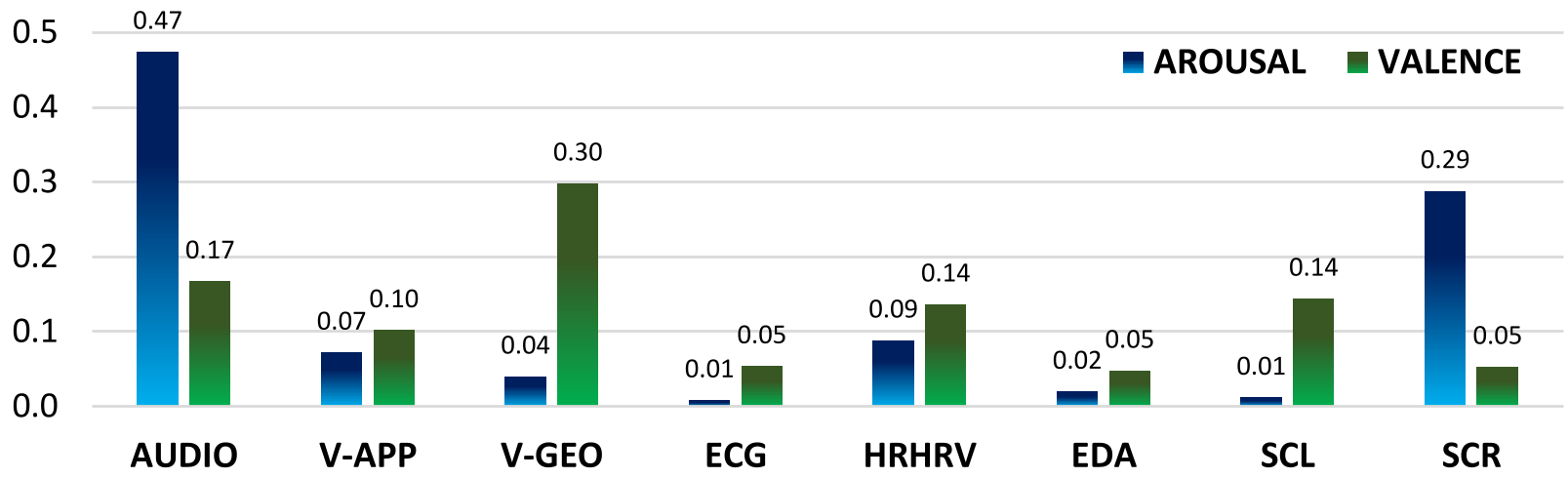 Figure 2: Relative contribution of each modality. Notice how audio dominates Arousal (bottom left), while video geometric features are crucial for Valence.
Experimental Results and Benchmarks
The competition established high-bar baselines:
- Arousal: Multimodal fusion achieved a 0.683 CCC, heavily weighted toward Audio (64.8%).
- Valence: Multimodal fusion achieved a 0.639 CCC, with Video Geometric features being the strongest contributor (50.7%).
- Depression: The combo of Audio and Video reached an F1 score of 0.583 on the test set, proving that human-agent interaction is a viable medium for screening psychological distress.
Critical Analysis & Conclusion
AVEC 2016 remains a foundational reference because it insists on reproducibility. By using open-source tools like COVAREP, OpenFace, and openSMILE, the authors ensured that the barrier to entry was scientific, not financial.
Limitations:
- The baseline relies on Linear SVMs, which may not capture complex temporal dynamics as well as modern Recurrent Neural Networks (RNNs) or Transformers.
- Reaction Time: The paper notes that Valence estimation requires a longer time delay (1.8s vs 1.2s for Arousal) to account for human rater lag, a variable that is difficult to perfectly model.
Future Outlook: The transition from these "hand-crafted" features to end-to-end deep learning (as hinted in the references like Trigeorgis et al.) signifies the next evolution of this field—moving from extracting features to learning representations of pain and emotion.