
Average Drift Analysis: When Does a Larger Population Actually Help Evolutionary Algorithms?
Average Drift Analysis and Population Scalability
This paper introduces "Population Scalability" and "Average Drift Analysis" as formal frameworks to quantify how population size affects the computation time of Evolutionary Algorithms (EAs). It rigorously analyzes whether increasing population size improves hitting time (generations) or running time (evaluations) across various fitness landscapes, including unimodal and deceptive functions.
Executive Summary
In the world of Evolutionary Algorithms (EAs), there is a long-standing intuition: "More individuals mean better search." However, when we move from empirical observation to rigorous mathematical theory, this intuition often crumbles. This seminal paper by Jun He and Xin Yao introduces Average Drift Analysis—a powerful mathematical framework to measure Population Scalability. The authors prove that increasing population size is often a double-edged sword, potentially increasing rather than decreasing the total computation time depending on the "Time-Fitness Landscape."
The Core Conflict: Hitting Time vs. Running Time
To understand the paper, we must distinguish between two metrics:
- Hitting Time (Generations): The number of iterations to find the optimum.
- Running Time (Evaluations): The total number of fitness function calls (typically ).
The paper introduces Population Scalability (PS), defined as the ratio of the expected hitting time of a (1+1) benchmark to a EA. If , the larger population actually reduces the total work; if , it only benefits parallel environments but increases total serial effort.
The Method: Average Drift Analysis
The authors shift away from the difficult-to-solve fundamental matrices of Markov chains. Instead, they use Average Drift.
- The Intuition: If you define a "distance" to the optimum based on the benchmark's performance, and you show that a larger population covers that distance times faster per generation, then your Scalability is exactly .
This allows the authors to analyze specific scenarios where traditional intuition fails.
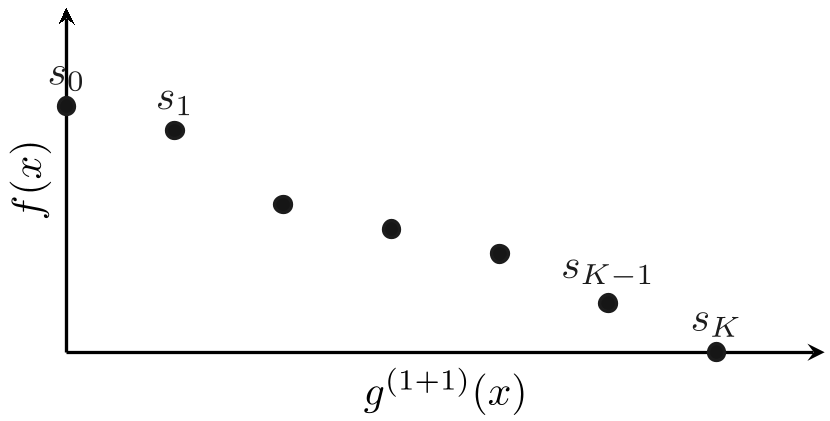 Figure 1: A unimodal time-fitness landscape where distance is measured by expected hitting time rather than physical distance.
Scenario 1: The "Two-Path" Trap (PS < 1)
One of the most striking findings is that a larger population can actually slow down an EA even in terms of generations.
- The Mechanism: Consider a landscape with two paths to the optimum: a Short/Hard path and a Long/Easy path.
- The Problem: A larger population is more likely to "catch" the Long/Easy path because it explores more broadly. However, once the population commits to this longer path, the expected hitting time increases compared to a (1+1) EA that might have stumbled upon the Short path.
Scenario 2: The Unimodal Speed Limit
The paper provides a rigorous proof for a bitter pill: On unimodal functions, a population cannot shorten the total running time. Specifically, for any elitist EA on a unimodal time-fitness landscape: This means if you have 10 processors, you might finish in slightly more than 1/10th of the generations, but you will always perform more total evaluations than a simple (1+1) EA.
 Table showing that while hitting time (generations) decreases with population, total running time (evaluations) increases.
Scenario 3: When Population Actually Wins (Deceptive Functions)
Where does the population-based EA shine? Deceptive functions. On these landscapes, the fitness rewards movements away from the global optimum. A (1+1) elitist EA gets stuck in local optima indefinitely. A population with Fitness Diversity selection can maintain "worse" individuals that eventually bridge the gap to the true optimum.
In these cases, is achievable. The population doesn't just provide parallel speedup; it provides an algorithmic breakthrough that reduces the total amount of work.
Critical Insight & Conclusion
The fundamental takeaway of this work is the Scalability Threshold. We should only increase up to the point where .
The paper concludes with a profound philosophical point:
- If a function is "easy" (unimodal) for a (1+1) EA, a population is a waste of resources.
- If a function is "hard" (deceptive) for a (1+1) EA, a population is essential.
Theoretical Significance: This work moves EA research from "it usually works" to "it works because the average drift satisfies these conditions," providing a rigorous blueprint for future algorithm design.