
Beyond the Text: Leveraging Social Dynamics for Political Sentiment Analysis
What Do the Average Twitterers Say: A Twitter Model for Public Opinion Analysis in the Face of Major Political Events
This paper introduces a novel subjectivity analysis framework tailored for Twitter during major political events, specifically focusing on the Tunisian uprising. By integrating social network features (Graph-based metrics) with traditional text analysis, the authors achieve a 83.3% classification accuracy in distinguishing subjective from objective tweets.
TL;DR
Researchers have developed a subjectivity analysis model that looks beyond what people say to how they interact on social media. By analyzing the social networking features of Twitter users during the Tunisian uprising—such as their conversation rates and follower ratios—this model achieves over 83% accuracy in identifying subjective opinions versus objective news dissemination.
Contextual Positioning
Within the academic landscape of Opinion Mining, this work shifts from the "Text-Only" paradigm toward "Social-Aware" analysis. It provides a rare look at the digital behavior of the developing world, positioning itself as a bridge between Social Network Analysis (SNA) and Natural Language Processing (NLP).
The Problem: When News and Emotion Blur
During a major political uprising, the line between "reporting a fact" and "expressing an emotion" vanishes. Conventional sentiment analysis tools—often built on Western, apolitical datasets—struggle with two things:
- Imbedded Subjectivity: A user may share a news link (fact) but do so as an act of solidarity (sentiment). 85% of survey respondents in this study admitted they attach sentiment even to shared news items.
- Scalability: Manual annotation and dictionary-based methods cannot keep up with the explosive volume of tweets generated during a revolution.
Methodology: The Power of Social Features
The core insight of the authors is that a user's identity and behavioral patterns on Twitter are highly predictive of their subjectivity. Traditional NLP treats every tweet as an isolated island; this model treats every tweet as a node in a social ecosystem.
The Core Features
- graph_conv_ratio: This calculates the Following/Follower ratio multiplied by the number of conversations. This helps distinguish between news bots (high followers, zero following, zero interaction) and political activists (high interaction, even if they have many followers).
- num_conv: A simple count of
@mentions in the last 30 tweets. High conversation rates are a strong proxy for subjective engagement. - num_lists: The "wisdom of the crowd." Being added to many lists combined with high conversation activity validates a user’s influence as an opinion leader rather than just a news aggregator.
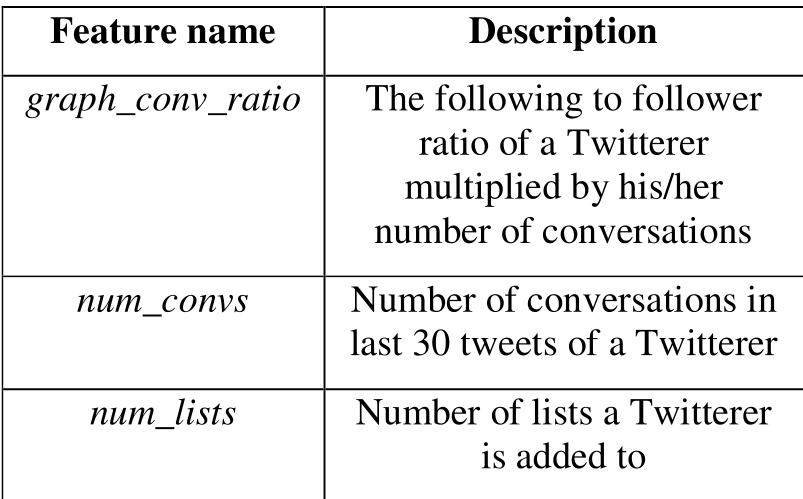 Table 1: The key social features used for subjectivity classification.
Experiments & Results
The researchers analyzed the "Twittersphere" during the Tunisian revolution (Jan 17 – Jan 29, 2011). Two major observations stood out:
- Information Diffusion: Retweet rates remained consistent despite the chaos, confirming that political hashtags possess a unique "persistence" compared to viral trends.
- Classification Performance: By applying a Naive Bayes classifier to these social features, they achieved a stable 83.3% accuracy across the entire period of the uprising.
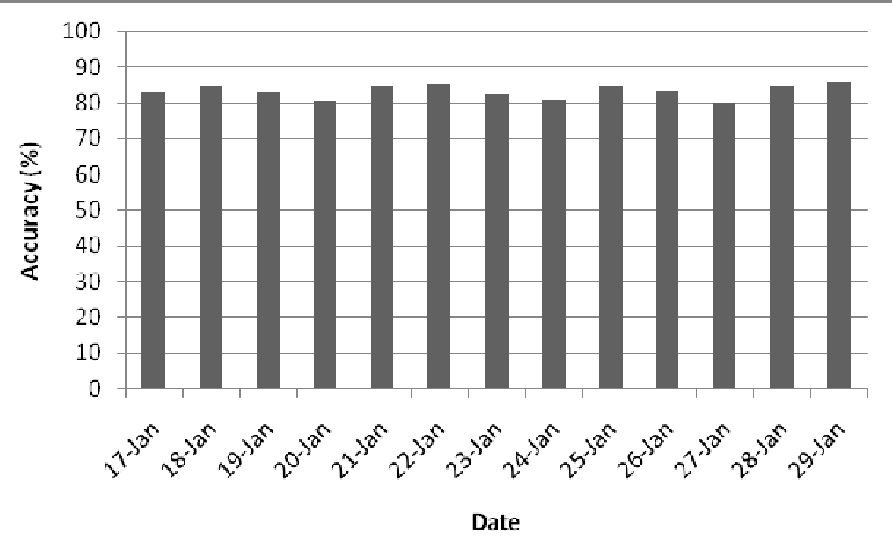 Figure: Subjectivity Classification Accuracy per Day during the Tunisian Revolution.
Critical Insight & Conclusion
The true value of this work lies in its Inductive Bias: the assumption that social structure dictates content types. While modern LLMs are vastly better at understanding nuance in text, they are computationally expensive. This social-feature-based approach provides a "lightweight" and "context-aware" alternative that scales effortlessly for real-time public opinion monitoring.
Limitations & Future Work
- Platform Dependency: The model relies on specific Twitter metadata (at the time) which may change with platform API updates (e.g., the transition to 'X').
- Domain Specificity: The features work best during "high-charged" political events; their efficacy on mundane topics like product reviews remains a question for further exploration.
Ultimately, this paper serves as a vital reminder that in the world of social media, the messenger and their connections are just as important as the message itself.