
Evolving Influence: Integrating Awareness Filters and Genetic Algorithms into Viral Marketing
Incorporating awareness and genetic-based viral marketing strategies to a consumer behavior model
This paper introduces an extended "Consumat" agent-based model (ABM) that incorporates an awareness filter and word-of-mouth (WOM) dynamics to simulate consumer behavior. By integrating Genetic Algorithms (GAs) to optimize viral marketing strategies, the study achieves high-performance "influential" targeting across different social network topologies like Scale-Free and Small-World networks.
TL;DR
This research bridges the gap between theoretical consumer behavior and practical viral marketing. By extending the Consumat agent-based model with an "Awareness" mechanism, the authors show that product adoption is a gradual process driven by Word-of-Mouth (WOM). They further demonstrate that Genetic Algorithms (GAs) can masterfully identify the perfect "seeding" strategy to maximize sales by analyzing the underlying social network topology.
Background Positioning
In the landscape of computational sociology, this work moves away from "perfect information" simulations toward Bounded Rationality. It treats the market not as a static pool of buyers, but as a dynamic graph where information is a currency that decays over time.
The Problem: The Myth of the Omniscient Consumer
Most traditional marketing models assume that if a product is high quality, consumers will find it. This ignores the Awareness Gap. In reality:
- Limited Knowledge: Consumers don't know every product exists.
- Social Filtering: We rely on our social circles (WOM) to discover new options.
- Information Decay: We forget about products if they aren't reinforced by our network.
Traditional Agent-Based Models (ABMs) often skip the "Awareness" phase, leading to unrealistic "flash-in-the-pan" adoption curves that don't match real-world data.
Methodology: Awareness & Evolution
1. The Extended Consumat Framework
The authors added two critical variables to the original model:
- Awareness Probability: The likelihood an agent discusses a product with neighbors.
- Awareness Decay: The probability an agent forgets a product, necessitating a "refresher" via social interaction.
2. Genetic-Based Viral Marketing (VM)
How do you pick the best people to give free samples to? The authors used a GA to evolve a weighting formula () based on three Social Network Analysis (SNA) metrics:
- Degree: Direct reach.
- 2-Step Degree: Secondary reach (friends of friends).
- Clustering Coefficient (CC): The "tightness" of an agent's social group.
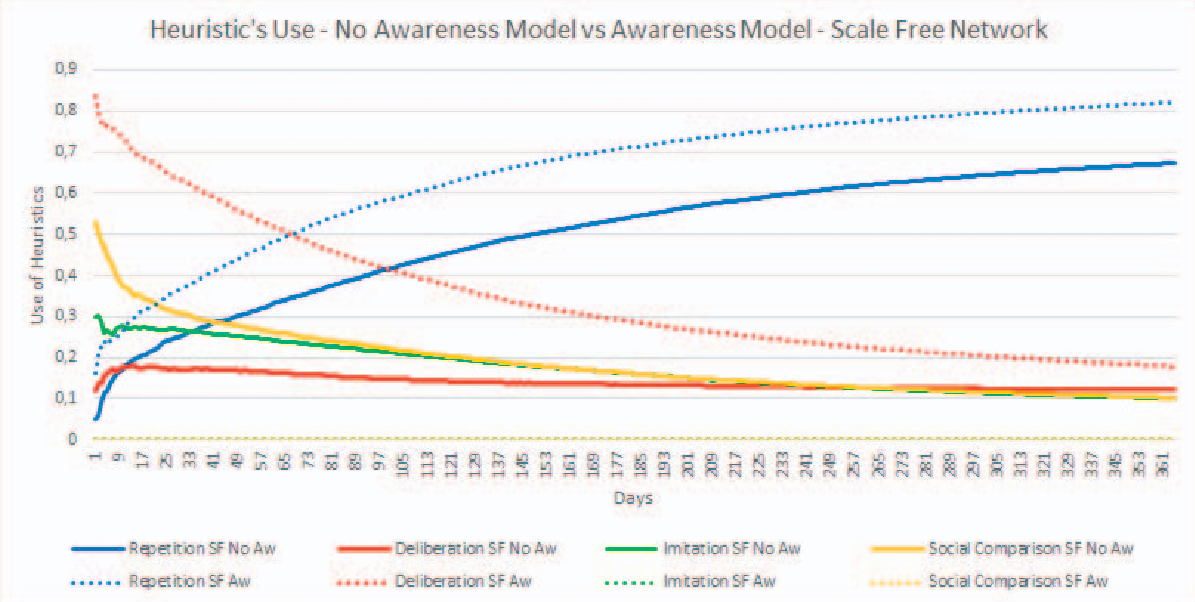 Fig 1: The heuristic shift—how agents move from "Deliberation" to "Repetition" as awareness spreads.
Experiments & Results: The Network Matters
The study compared two types of networks: Scale-Free (dominated by massive "hubs") and Small-World (clustered communities).
- Scale-Free Results: The GA quickly learned that "hubs" (high-degree nodes) are the ultimate diffusers. Targeting these hubs leads to rapid market dominance.
- Small-World Results: The strategy shifted. The GA found that a high Clustering Coefficient was often more valuable, as it allowed the product to saturate local communities before leaping to others.
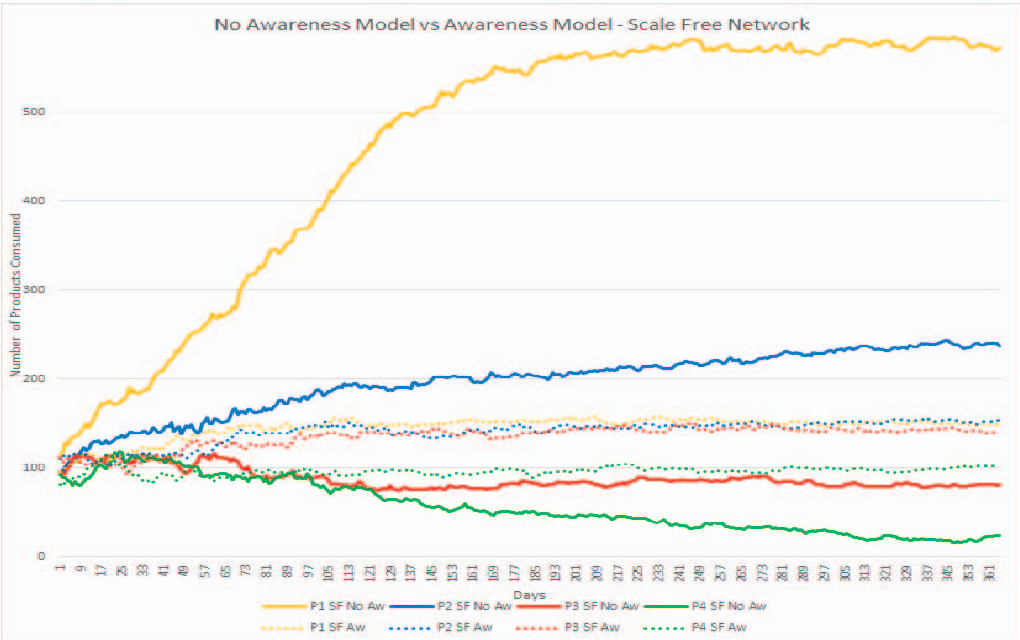 Fig 2: Comparison of sales evolution between the original (solid) and awareness-based (dashed) models. Note the more realistic, gradual rise in the extended model.
Key Quantification
| Network Type | Optimization Focus | Campaign Result |
|---|---|---|
| Scale-Free | High Degree (Hubs) | 621 High-Value Sales |
| Small-World | Clustering + Degree | 948 Distributed Sales |
Critical Insight & Conclusion
Takeaway
The most striking finding is that Awareness acts as a filter. In the original model, agents used "Imitation" (copying peers) almost immediately. In the extended model, agents are forced to "Deliberate" more because they only know about a subset of products. This makes the "start-up" phase of a marketing campaign much more critical.
Limitations & Future Work
While robust, the model currently treats "profit" as a static value. The authors suggest that future iterations should use Multi-Objective Optimization to simultaneously minimize the cost of acquiring influentials (who often demand high "symbolic prices") while maximizing total market penetration.
Final Prediction
As social media algorithms continue to fragment our "awareness," ABMs that incorporate these specific cognitive filters will become the standard for predictive marketing analytics.