
Balancing the Burden: Solving the Energy Crisis in Opportunistic Social Networks
On balancing the energy consumption of routing protocols for opportunistic social networks
The paper introduces an Energy Consumption Balanced Routing protocol for Opportunistic Social Networks (OSN) that accounts for Transient Connected Components (TCC). It proposes a novel "Memory Load-aware" metric and an energy-aware intra-TCC routing mechanism, significantly reducing energy imbalance compared to state-of-the-art social-based protocols.
TL;DR
Social-based routing in Opportunistic Social Networks (OSNs) often creates "energy black holes" by over-utilizing popular nodes. This paper introduces a balance-aware routing protocol that uses a Memory Load-aware metric and Energy-aware Intra-TCC routing to redistribute traffic. The result? A 31% improvement in energy balance with nearly zero loss in delivery performance.
The "Popularity" Trap in OSNs
In Opportunistic Social Networks, data travels via human-held mobile devices that meet sporadically. To ensure high delivery rates, most protocols identify "social celebrities"—nodes with high Betweenness or Centrality—and treat them as the primary carriers.
However, this creates a catastrophic imbalance. High-quality nodes become exhausted, running out of battery and memory, while peripheral nodes remain idle. The authors discover a counter-intuitive truth: TCC-aware routing (which utilizes multi-hop connections within temporary clusters) actually makes this imbalance worse because these hubs are forced to act as relays for everyone else in the cluster.
Methodology: The Shift to Load-Awareness
The paper moves beyond the simple "Compare and Forward" logic by introducing two key innovations:
1. The Memory Load-Aware Metric
Instead of just looking at social rank (), the protocol tracks a Memory Load Quota (). The routing decision is based on: This formula effectively "demotes" a popular node if it has already taken on too much traffic, allowing the network to use the "next best" available carrier.
2. Energy-Aware Intra-TCC Routing
Within a Transient Connected Component (TCC), the protocol doesn't just take the shortest path. It treats a node's consumed energy as a "cost" for the path. Messages are routed around nodes that are low on power, preventing "hot zones" from forming in the network topology.
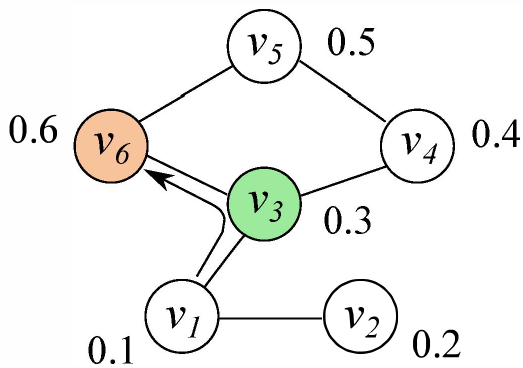 Fig 1: Illustration of TCC-aware routing where multi-hop paths are calculated within a transient cluster.
Proving Convergence
One of the paper's strongest contributions is the mathematical proof that under this protocol, the quota consumption rate of all nodes eventually converges. In simpler terms: given enough time, the "work" is distributed equally across the network regardless of a node's initial social standing.
Experimental Results: Real-World Evidence
The authors tested their protocol against state-of-the-art baselines like TccRoute and FairRoute using the MIT Reality and UCSD traces.
- Energy Balance: The "Top 10%" nodes in traditional protocols could consume up to 74% of the energy. The proposed protocol flattens this curve significantly.
- Performance Trade-offs: Unlike previous fairness attempts that crashed the Packet Delivery Ratio (PDR), this method maintains a PDR and latency profile almost identical to the top-performing protocols.
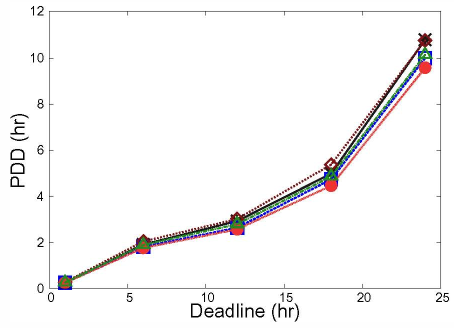 Fig 2: PDR results show that the Energy Consumption Balanced protocol (green line) keeps pace with existing high-performance methods.
Critical Insight & Future Outlook
While the protocol excels at balancing memory and transmission, it opens a discussion on the overhead of beaconing. Information exchange about energy levels and memory quotas adds "control traffic."
The true value of this work is the demonstration that Memory Load is a primary proxy for Energy Consumption in social networks. This insight allows protocol designers to build energy-efficient systems by monitoring local buffer states rather than needing complex, hardware-level power sensors.
Conclusion
The Energy Consumption Balanced Routing protocol marks a significant step toward making opportunistic networks sustainable. By treating network longevity as a primary metric alongside delivery success, the authors provide a blueprint for more resilient mobile ad-hoc systems.