
Digital Ownership: Solving the Privacy Crisis with Property Rights
Balancing internet marketing needs with consumer concerns: a property rights framework
This paper proposes a Property Rights Framework to resolve the conflict between Internet marketing data collection and consumer privacy concerns. It applies the economic theories of incomplete markets and transaction costs to argue that personal data should be treated as private property to restore consumer trust and market efficiency.
TL;DR
Internet marketing is facing a trust deficit. While marketers use sophisticated tools like cookies and data mining to build profiles, consumers feel violated. This paper argues that the solution isn't just "better ethics" or "more regulation," but a fundamental shift in economic perspective: treating personal data as Private Property. By establishing clear ownership, we can reduce market inefficiencies and build a sustainable digital economy.
The Collision: Marketing Efficiency vs. Consumer Privacy
We are at a crossroads. On one hand, data-driven marketing enables personalized experiences and efficient business transactions. On the other, it creates an environment of "Moral Hazard" where:
- Marketers collect data without consent, treating it as a free "public good."
- Consumers retaliate by providing false data or opting out entirely, destroying data quality.
The author notes a startling statistic: while 80% of consumers fear their data being resold, 72% would willingly provide it if they knew how it would be used. This gap represents a massive Transaction Cost in the current market.
Methodology: The Property Rights Framework
The paper moves away from purely normative/ethical arguments and adopts a positivist economic approach. It evaluates the market for personal data through three specific constraints required for an asset to be considered "Private Property":
- Exclusion Constraint: The owner must have the exclusive right to exclude others from using the data.
- Income Constraint: The owner has the exclusive right to the income generated by the data's use.
- Transfer Constraint: The owner has the right to transfer ownership or enter into contracts.
In the status quo, these constraints are violated. Marketers bypass the exclusion right via silent cookies and ignore the income right by selling profiles to third parties without compensating the consumer.
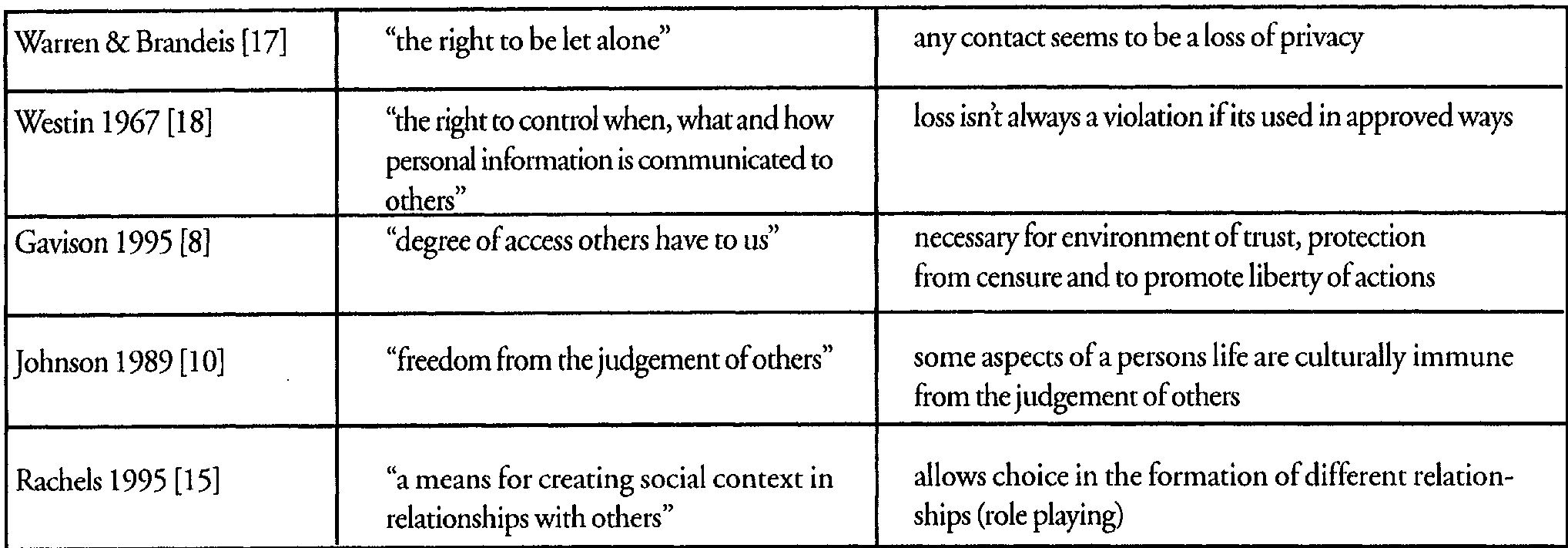 Table 1: Evolution of Privacy Definitions - From "The Right to be Let Alone" to "Relationship Context."
Why Self-Regulation Fails
Many businesses advocate for self-regulation, but the paper argues this is insufficient because:
- High Monitoring Costs: Consumers cannot easily police how companies use their data behind the scenes.
- Adverse Selection: Without enforceable rights, "honest" companies that spend money on privacy protections cannot distinguish themselves from "dishonest" ones, leading to a "market for lemons" where only untrustworthy firms remain.
The Proposed Solution: Internalizing Externalities
The core insight is derived from the Coase Theorem: if property rights are well-defined and transaction costs are low, parties will bargain to reach an efficient outcome.
The author suggests:
- Legal Recognition: Courts and governments must recognize personal data as property.
- Contractual Exchange: Instead of "taking" data, companies should "contract" for it.
- Transparency as Compensation: Interestingly, consumers often don't want cash; they want "non-pecuniary compensation" in the form of control and awareness of data flow.
Critical Insight & Conclusion
This work highlights a critical dichotomy: Marketers treat data as a "Public Good" (free to take) but sell it as a "Private Good" (valuable to own). This inconsistency is the root of consumer distrust.
Future Outlook: While this paper was written in the early 2000s, its principles are more relevant than ever in the age of Big Data. The shift toward regulations like GDPR essentially mirrors this property rights approach. For future systems, technologies like Self-Sovereign Identity (SSI) and Privacy-Preserving Computation may finally provide the "Exclusion" and "Transfer" mechanisms that the author envisioned, turning data into a legitimate asset for the consumer.
Limitations
The primary challenge remains the International Nature of the Internet. Property rights are typically enforced by national courts, but data flows globally. Establishing a unified international property right for data remains the "Holy Grail" of digital commerce.