
The Bang for the Buck: Ensuring Fairness in Competitive Viral Marketing
The Bang for the Buck: Fair Competitive Viral Marketing from the Host Perspective
This paper introduces the K-LT model for competitive viral marketing from the perspective of a platform host. It focuses on the Fair Seed Allocation (FSA) problem, utilizing the Needy Greedy algorithm and Dynamic Programming to balance the "bang for the buck" across multiple competing companies.
TL;DR
When giants like Microsoft and Sony compete for gamers' attention on a social platform, the platform owner (the Host) acts as the kingmaker. This paper shifts the focus from "how to win" for one player to "how to be fair" for the host. By introducing the K-LT model and the Needy Greedy algorithm, the authors provide a mathematical framework to maximize total network influence while ensuring every advertiser gets a fair return on their investment.
Problem & Motivation: The Host's Dilemma
In traditional viral marketing research, we ask: "If I have seeds, which users should I pick?" In the real world, Facebook or X (formerly Twitter) doesn't just have one client; they have thousands.
If Nikon and Canon both pay for a viral campaign, and Nikon’s seeds result in 20 adopters per seed while Canon’s result in only 10, Canon will feel cheated. The host must maximize the Amplification Factor (), or the "Bang for the Buck," defined as: The goal is to partition a set of seeds such that the difference in between companies is minimized.
Methodology: The K-LT Model and Adjusted Marginal Gain
The authors propose the K-LT (Competitive Linear Threshold) model. It operates in two phases:
- Influence Phase: A node becomes "influenced" when the total weight of its active neighbors exceeds its random threshold.
- Activation Phase: The influenced node decides which product to adopt based on which neighbors influenced it most recently.
Why K-LT?
Unlike previous models (like WPCLT), K-LT preserves monotonicity and submodularity. This means adding more seeds always increases (or maintains) the spread, a crucial property for business predictability.
The Secret Sauce: Adjusted Marginal Gain
To solve the allocation problem, the authors define the Adjusted Marginal Gain ():
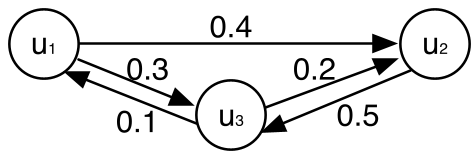
Key Insight: The expected spread for company is simply the sum of the adjusted marginal gains of its assigned seeds: This decoupling allows us to treat a complex network problem as a more manageable partition problem.
Algorithms: Needy Greedy
While the Fair Seed Allocation (FSA) problem is NP-hard (reducing from 3-PARTITION), the authors provide two solutions:
- Needy Greedy (NG): A greedy heuristic that assigns the next best seed to the company currently having the lowest amplification factor ("the neediest").
- Dynamic Programming (DP): An exact solution for companies, providing theoretical optimality by treating the spread as a state in a DP table.
Experiments & Results
The authors tested their approach on real-world graphs like Epinions and Flixster.
Fairness Benchmarks
Using Relative Error as a metric, the Needy Greedy algorithm kept unfairness below 5% in almost all scenarios.
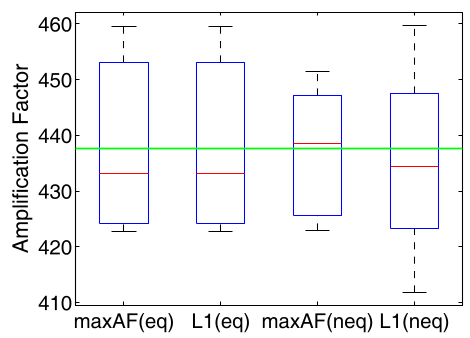 Figure: The "Box-and-whisker" plots show that the Needy Greedy algorithm (NG) keeps the amplification factors tightly clustered around the fair lower bound (the green line).
Performance
- Scalability: NG runs in time, making it suitable for massive social networks.
- Comparison: Random allocation often leads to errors exceeding 50%, which would be commercially disastrous for a platform host.
Critical Analysis & Conclusion
Takeaway
This work highlights that in the platform economy, fairness is a feature. By formalizing the host’s perspective, the paper bridges the gap between graph theory and digital advertising business models.
Limitations & Future Work
The model currently assumes that all products have the same "virality." In reality, a better product spreads more easily. Future research could explore how to balance seeds when one product is naturally "stickier" than its competitor. Additionally, game-theoretic analysis where companies strategically report their budgets could be a fascinating extension.
Final Thought: If you are building a multi-tenant recommendation or marketing engine, "fairness" isn't just about ethics—it's about the mathematical stability of your marketplace.