
Behind the Silence: Why the Global #MeToo Movement Stalled in Bangladesh
Nonparticipation of bangladeshi women in #MeToo movement
This paper investigates the non-participation of Bangladeshi women in the global #MeToo movement using a mixed-methods approach (survey n=180, interviews n=30). Despite high awareness and support for the movement’s goals, the study identifies systemic barriers rooted in transnational feminism that prevented a similar "viral" surge of public disclosures in Bangladesh.
TL;DR
In 2017, #MeToo became a global phenomenon, yet its resonance was uneven across the globe. This research explores why Bangladeshi women, despite suffering high rates of sexual harassment and being active social media users, largely chose not to participate. The study reveals that "online silence" is not a lack of agency, but a calculated survival strategy against cultural taboos, family surveillance, and a justified skepticism of the legal system.
The "Global" Movement Logic vs. Local Reality
The conventional wisdom of social media activism suggests that visibility equals power. If millions of women share their stories, the resulting "magnitude" forces social change. However, this logic assumes a level of social and legal protection that is often absent in the Global South.
The authors argue that the #MeToo movement’s reliance on public disclosure clashes with the socio-cultural fabric of countries like Bangladesh, where "sex" remains a deeply tabooed topic and patriarchal structures exert control over women’s digital footprints.
Methodology: Listening to the Unheard
The researchers combined a broad-scale anonymous survey (180 participants) with deep-dive, semi-structured interviews (30 participants). By using Transnational Feminism as a lens, they moved away from Western-centric "emancipation" rhetoric to understand the specific local pressures—what they call "Social Resistance."
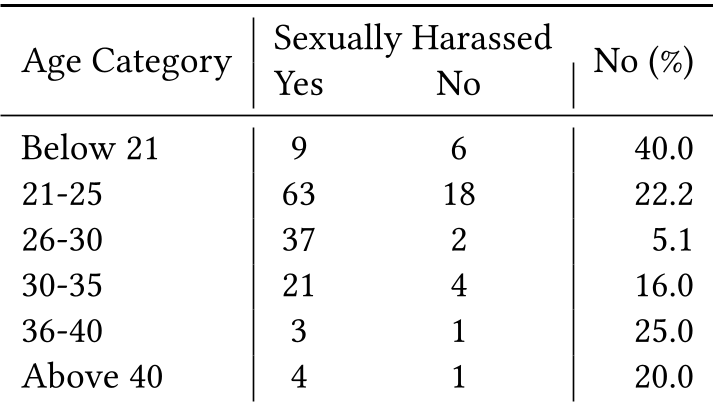 Table showing high rates of reported harassment across age groups, contrasting with the low rates of public sharing discovered in the study.
Why They Chose Silence: Three Core Barriers
1. The Cultural Mismatch
Participants repeatedly highlighted that "shouting in public" is perceived as counter-productive. In a society where even men do not discuss sexual experiences publicly, a woman sharing a story of assault is often viewed not as a victim seeking justice, but as someone "impure" or "shameless" for breaking the silence.
2. Digital Surveillance by the Family
For many Bangladeshi women, Facebook is not a private space but a shared family arena. One 25-year-old student shared how her father-in-law monitored her posts, signaling that "nasty" discussions (feminism and equality) would not be tolerated. In this context, a hashtag isn't just a post; it's a threat to domestic harmony.
3. Perceived Futility (The "Nobody Cares" Factor)
Perhaps the most heartbreaking finding is the lack of hope. While Western #MeToo participants saw Harvey Weinstein lose his empire, Bangladeshi women pointed to local rape cases where social media outcries led to zero legal consequences.
- "In Bangladesh... all you will bring for you is an additional shame if you share your harassment online."
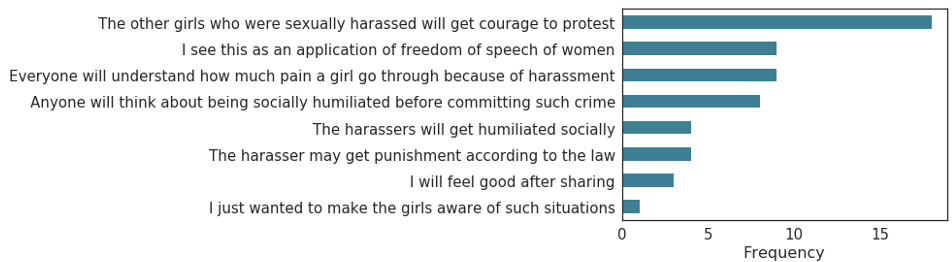 Analysis of survey responses highlighting that comfort and perceived lack of utility are the primary blockers to sharing.
Critical Analysis: Beyond Digital Universalism
This paper serves as a critical reminder that technology is never neutral. The architecture of Twitter and Facebook (one-to-many, public-by-default) is designed for a specific type of Western "outspoken" activism.
Key Takeaways for the Tech Community:
- Context Matters: A "successful" global movement might actually be an "exclusionary" one if it requires participants to take risks that lead to social ostracization.
- Anonymity as a Feature: The study suggests that if social movements are to succeed in the Global South, they may need to prioritize anonymous or aggregated reporting over the "brave face" public disclosure model favored in the West.
Conclusion
The non-participation of Bangladeshi women in #MeToo wasn't a failure of the women; it was a mismatch of the movement's mechanics with the lived reality of the participants. For digital activism to truly be "global," it must account for the "battlefields" that are not the same across borders.
Reference: Hassan, N., et al. (2019). Nonparticipation of Bangladeshi Women in #MeToo Movement. ICTD '19.