
Designing for the Ecosystem: Evaluating Cross-Channel UX in Digital Banking
Banking Cross-Channel System UX Evaluation
This paper evaluates the cross-channel user experience (UX) of "Banco Original," a 100% digital Brazilian bank, by applying a specialized framework of 9 UX heuristics. Using the Think-aloud Protocol, researchers mapped user journeys across WhatsApp, mobile apps, and desktop interfaces to identify systemic friction in multi-device ecosystems.
TL;DR
As we move into the "third wave of computing," our interactions are no longer localized to a single screen. This paper explores how Banco Original, a pioneer in digital banking, fares when its entire ecosystem—WhatsApp bots, mobile apps, and desktop sites—is put to the test. By using a specialized set of 9 UX Heuristics, the authors reveal that the biggest hurdles aren't in the interfaces themselves, but in the "gaps" between them.
Context: From Products to Ecosystems
The traditional view of Human-Computer Interaction (HCI) is shifting toward Human-Information Interaction. We no longer just use a "system"; we inhabit an "ecosystem." In a cross-channel environment, a user might start a task on a smartphone while walking, check details via a voice assistant, and finalize the transaction on a laptop.
The core challenge is Pervasive Information Architecture: ensuring the experience feels like "one whole story" rather than a fragmented series of technical hurdles.
The Methodology: 9 Heuristics for a Multi-Device World
To evaluate this, the researchers adopted a framework of 9 heuristics specifically designed for cross-channel journeys:
- Place-making: Helping users know where they are in the journey.
- Consistency: Uniform rules across all devices.
- Resilience: Flexibility for different user strategies.
- Reduction: Minimizing cognitive workload.
- Correlation: Connecting data across different touchpoints.
- Equivalency to Cultural Conventions: Matching real-world expectations.
- Visual Intuitive Content: Making pathways obvious.
- Natural Interactions: Direct and simple commands (voice/gesture).
- Contextual Ergonomics: Accounting for physical limitations and environments.
The Experiment: The "Cash Deposit" Journey
The authors used the Think-aloud Protocol, asking four users to complete a complex task:
- Ask a WhatsApp bot how to deposit cash.
- Use the mobile app to generate a deposit slip.
- Use a desktop to verify the transaction in the account statement.
- Use the desktop Virtual Assistant to confirm the status.
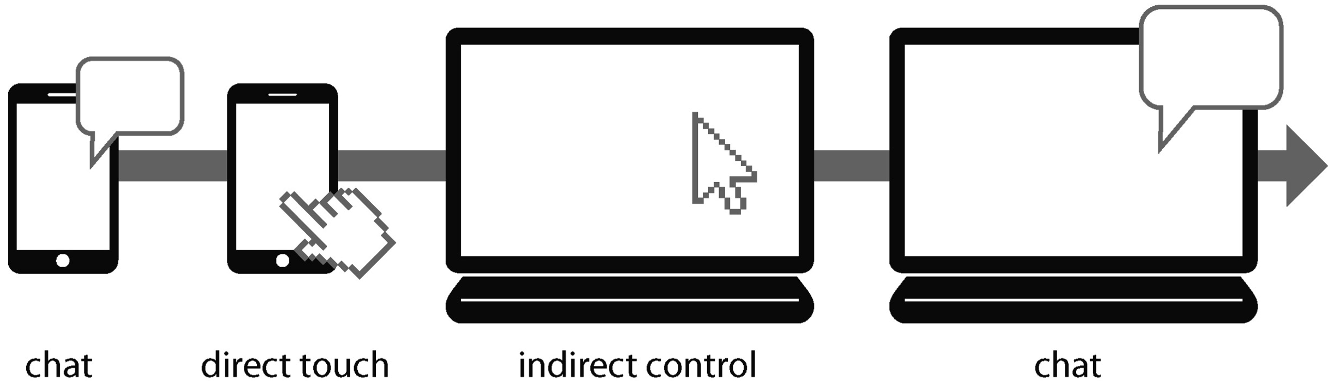 Figure: The sequential cross-channel path used during the evaluation.
Key Findings: Where the Journey Breaks
The results highlighted significant "glitches" in the pervasive experience:
- The "Correlation" Gap: The Virtual Assistant provided instructions that didn't match the App's UI. One missing step in the bot's advice led to total confusion within the mobile app.
- The "Cultural Convention" Conflict: Users struggled to understand why they needed to generate a "bank invoice" to deposit "cash." The digital process didn't align with their mental model of physical banking.
- The Virtual Assistant Paradox: While intended to bridge gaps, the chatbots often increased frustration. Users found the bot's language redundant and its inability to "remember" context from other channels a major violation of the Correlation heuristic.
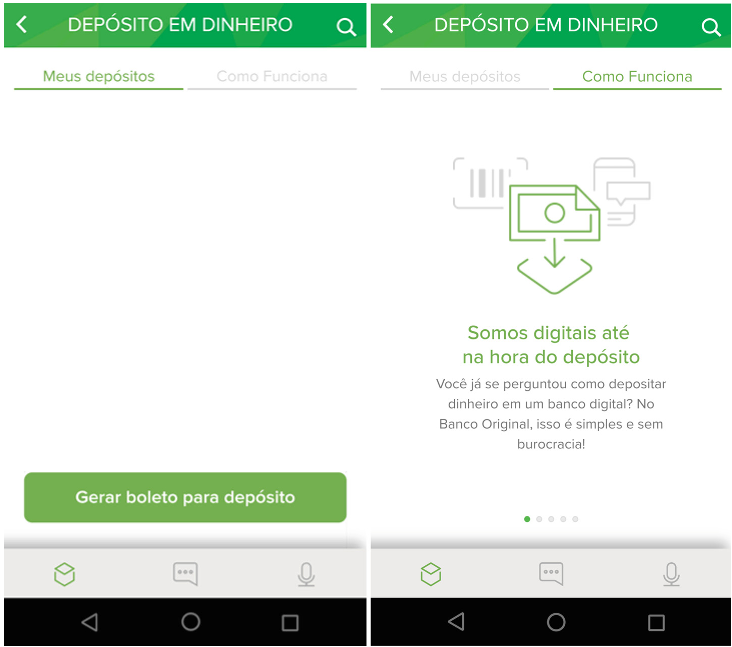 Figure: Point of failure where users had to navigate between instructions and execution.
Critical Insight: Agile vs. Expert Evaluation
A fascinating take-away from this paper is the comparison of methods. The authors previously tested these heuristics using Expert Heuristic Evaluation (on Airbnb) and found it captured more problems (83 issues) but was slow and expensive.
The Think-aloud Protocol used here was "leaner" and more "agile." It allowed the bank's internal teams to see real-time frustration. However, the authors note that while users identify symptoms, experts are better at identifying systemic causes.
Conclusion & Future Outlook
The study concludes that as technology becomes more integrated, the "horizontal" journey matters more than the "vertical" depth of a single app.
The Takeaway for Devs and Designers: Don't just optimize your app's checkout button. Optimize the transition from the email notification to the app, and from the app to the support chat. If the "Correlation" between these points fails, the user experience collapses, no matter how beautiful your UI is. The future of UX is not in the screens, but in the spaces between them.