
Banking Availability: Sustaining Trust in the Age of DDoS Extortion
252_Banking on Availability.
This article examines the critical importance of service availability in the banking sector, specifically addressing the surge of Distributed Denial-of-Service (DDoS) attacks. It outlines the socioeconomic impacts of outages and presents a multi-layered defense framework encompassing technical mitigation, regulatory compliance, and cross-industry information sharing.
TL;DR
Financial institutions are increasingly targeted by sophisticated DDoS attacks that prioritize service disruption over data theft to extort ransoms. This paper explores the "Availability" crisis in banking, detailing how regulatory mandates (like Singapore's 4x4 rule) and collective intelligence platforms (like FS-ISAC) are becoming as essential as traditional firewalls in maintaining social stability and consumer trust.
The Anatomy of an Industry Under Attack
The nancial crisis in Greece served as a stark reminder: separating people from their money causes immediate social panic. While that crisis was political, cyber-attacks—specifically Distributed Denial-of-Service (DDoS)—can achieve the same disruptive effect.
The motivation for these attacks has shifted. Beyond "hacktivism," groups like DD4BC (DDoS for Bitcoin) have turned service disruption into a profitable extortion business. Banks are uniquely vulnerable because their "product" is trust, and trust is built on 24/7 availability.
Why Conventional Defenses Fail
The authors identify several reasons why banks remain "attractive yet soft" targets:
- Legacy Systems: Continued reliance on aging IT infrastructure that cannot handle modern traffic volume.
- M&A Complexity: The integration of disparate systems during mergers creates unforeseen security gaps.
- Diverse Adversaries: Threats range from basement-dwelling script kiddies to state-sponsored actors conducting cyber-espionage.
Methodology: A Multi-Layered Defense Framework
The researchers outline four core strategies currently employed by the global banking elite to ensure uptime:
1. Resilience through Multi-Channel Redundancy
If the web portal goes down, the bank must remain "open." This involves shifting customers to text banking or offline processes.
2. Specialized Technical Mitigation
Large banks now outsource traffic scrubbing to specialized providers capable of absorbing massive network loads.
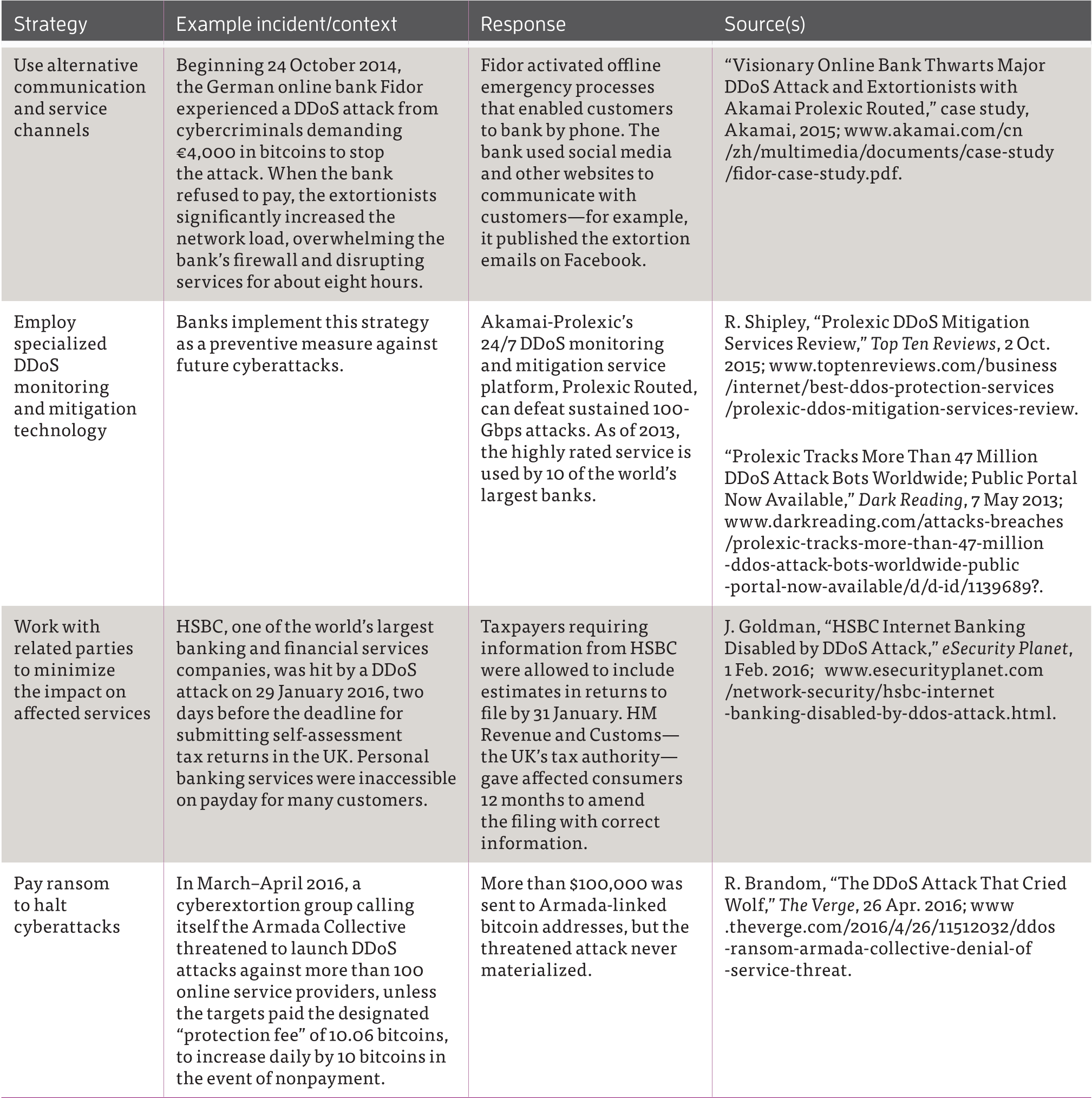 Table 1: Strategic responses to DDoS incidents ranging from alternative channels to technical monitoring.
3. Regulatory Pressure (The "Stick" Approach)
Regulators are no longer treating cyber-attacks as "acts of God."
- Singapore (MAS): The "4x4" rule—outages must be fixed in <4 hours; no more than 4 outages per year.
- New York (DFS): Mandates a designated CISO and a written cybersecurity policy for all chartered institutions.
4. Information Sharing: Breaking the Culture of Secrecy
The Financial Services Information Sharing and Analysis Center (FS-ISAC) has launched the Critical Infrastructure Notification System (CINS). This platform allows banks to share threat intelligence almost simultaneously, ensuring that if one bank is hit, others can preemptively block the same malicious signatures.
Financial and Social Impact
The cost of failure is astronomical. Research indicates an average loss of 100,000 per hour during a DDoS-induced outage.
 While detection speeds are improving—with 88% of banks detecting attacks within 2 hours—the sheer frequency of attacks remains a significant drain on resources.
Critical Insight & Conclusion
The paper's most profound takeaway is that security is no longer a private matter. In an interconnected financial ecosystem, a successful attack on one mid-sized bank can trigger a "run" on others.
Limitations
The study notes a persistent "dark figure" in reporting—reliable statistics on paid ransoms are not publicly available, as banks often hide these costs to protect their brand.
Future Outlook
We are moving toward a "Technological Arms Race." Future defenses will likely rely on AI-driven traffic analysis and blockchain-based identity verification to filter out botnets before they reach the network edge. For now, the best defense remains a combination of proactive regulation and aggressive information sharing.