
Deep Sentiment Mining: Predicting Bankruptcy from the Nuances of Corporate Jargon
Towards Bankruptcy Prediction: Deep Sentiment Mining to Detect Financial Distress from Business Management Reports
This paper introduces a deep learning framework for bankruptcy prediction using sentiment mining from German business management reports. By employing Dependency Sensitive Convolutional Neural Networks (DSCNNs) and a novel correlated pattern-based sentence filtering method, the authors achieve a state-of-the-art F1-score of 0.876 on a large-scale corpus of over 400,000 reports.
TL;DR
Predicting a company's downfall is no longer just about the numbers on a balance sheet. This research demonstrates that by applying Dependency Sensitive Convolutional Neural Networks (DSCNNs) to the qualitative text of business reports, we can detect "financial distress signals" with high accuracy. The key innovation lies in a statistical filtering layer that extracts the most "distress-correlated" sentences from thousands of words of corporate filler.
Problem & Motivation: Why Numbers Aren't Enough
For decades, the Altman Z-score has been the gold standard for predicting insolvency. However, quantitative data is inherently backward-looking. A company on the brink of collapse might "manage" its earnings to hide the truth.
The authors argue that the language used in management reports—the specific choice of phrases used to describe opportunities or risks—contains latent sentiment that "hard" figures miss. The challenge? These reports are massive, written in dense legal jargon, and vary wildly in structure. Standard Recurrent Neural Networks (RNNs) often "forget" the beginning of a document by the time they reach the end, making global sentiment analysis of long texts notoriously difficult.
Methodology: The DSCNN Architecture
To solve the long-text problem, the authors moved beyond simple flat models to a hierarchical approach.
1. The Filtering Gate
Before the neural network even sees the text, the authors apply Multi-Class Correlated Pattern Mining. Using a Chi-squared test, they identify "n-grams" (phrases) that statistically appear more often in "distressed" vs "safe" companies. If a sentence doesn't contain these discriminative markers, it’s discarded. This reduces noise and computational overhead.
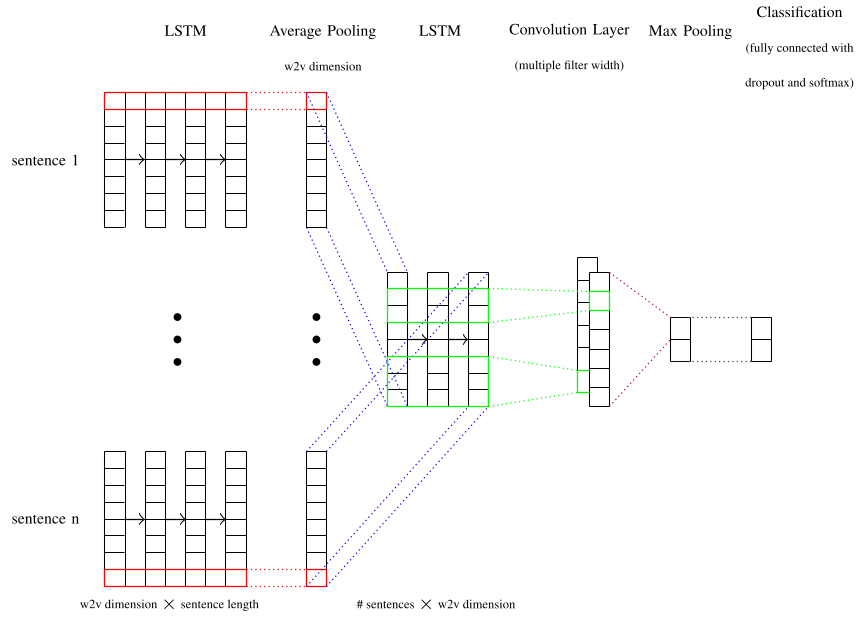
2. Dependency Sensitive CNN (DSCNN)
The model processes text in three specialized stages:
- Intra-sentence (LSTM): Understands the word order and local context of each sentence.
- Inter-sentence (LSTM): Captures how the narrative flows from one sentence to the next across the document.
- Feature Extraction (CNN): Uses convolutional filters to identify high-level "sentiment features" from the processed sequences.
Experiments and Industry-Leading Results
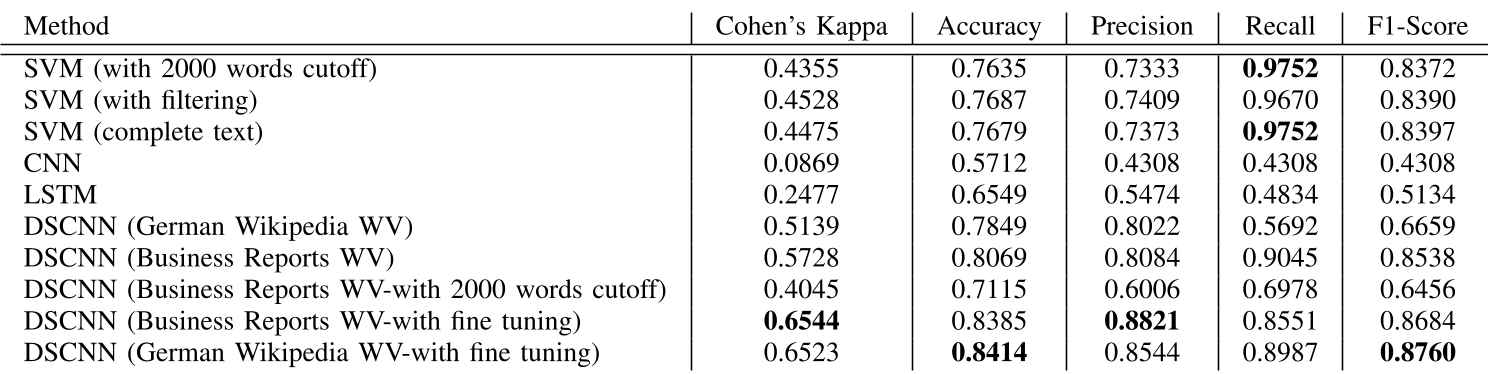
The researchers tested their framework on a massive dataset of German corporate reports. The results were clear: Context matters.
- The Power of Fine-tuning: Using generic Wikipedia word vectors was helpful, but training word embeddings specifically on 156,000 business reports and "fine-tuning" them during training provided the ultimate performance boost.
- Deep Learning vs. Classic ML: While SVMs performed admirably, the DSCNN’s ability to "understand" dependencies allowed it to reach an F1-score of 0.876, crushing standard LSTMs which struggled with the document length (F1: 0.513).
Explainability: Opening the Black Box
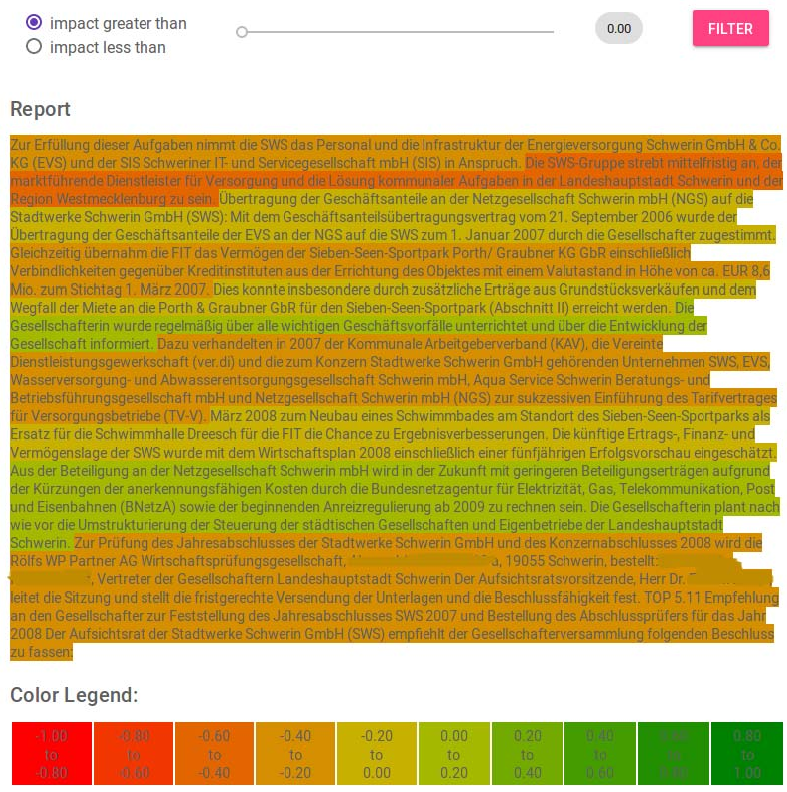
One of the most impressive parts of this work is the Visualization Tool. Deep learning is often criticized for being a "black box." The authors implemented a leave-one-out sensitivity analysis to highlight which sentences actually triggered the "Distress" classification. This allows financial analysts to see why the AI is worried about a specific firm.
Critical Analysis & Conclusion
Takeaway: This paper successfully bridge the gap between "bag-of-words" sentiment analysis and structural financial modeling. It proves that statistical pattern mining is a powerful pre-processor for deep learning on long-form documents.
Limitations: The target variable (Altman Z-score) is itself a proxy for bankruptcy, not a 1:1 replacement for actual legal insolvency proceedings. Future work could benefit from integrating multi-modal data (combining the text AND the raw balance sheet numbers) into a single transformer-based architecture.
For credit bureaus like SCHUFA, this tech offers a "forward-looking" radar that can detect corporate trouble months before the final bank payment fails.