
BAPO: Stabilizing Off-Policy RL for LLMs with Adaptive Clipping and Entropy-Aware Policy Balancing
BAPO: Stabilizing Off-Policy Reinforcement Learning for LLMs via Balanced Policy Optimization with Adaptive Clipping
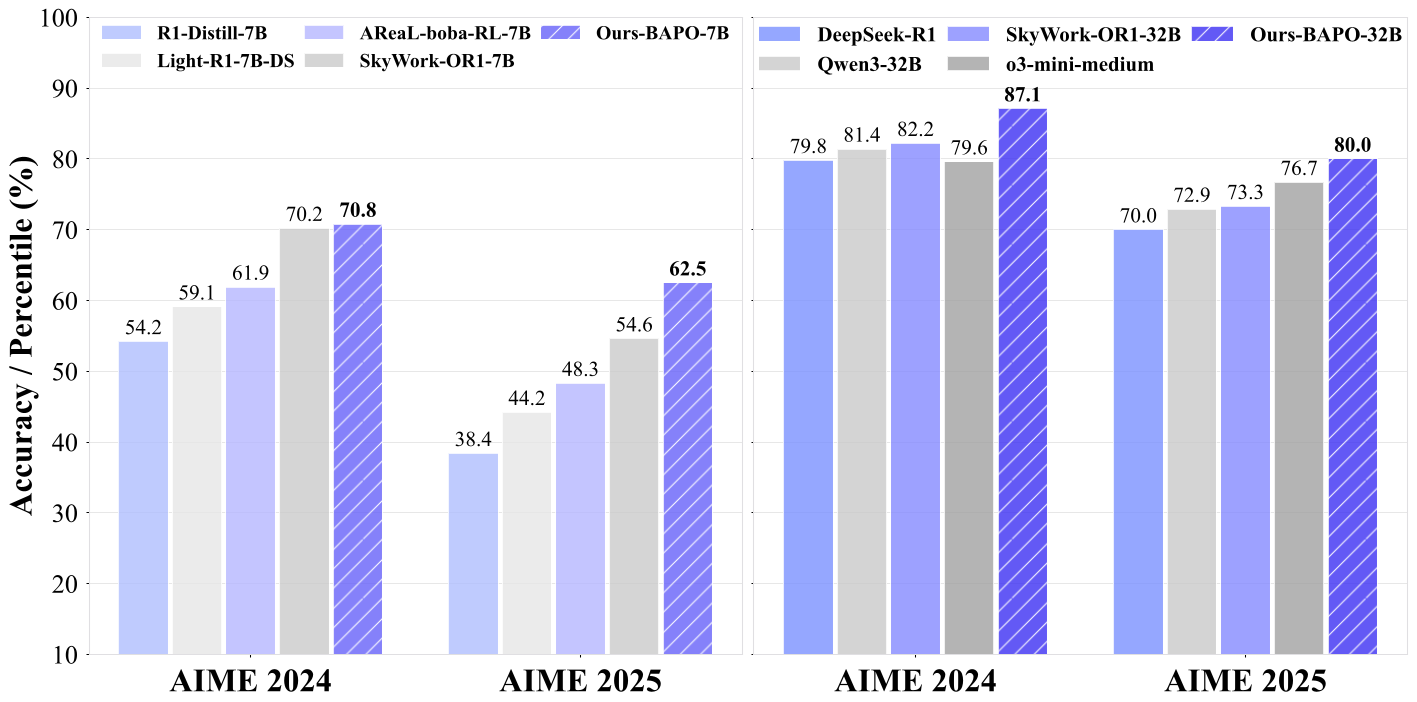
BAPO studies off-policy reinforcement learning for LLM reasoning, where stale rollouts improve sample efficiency but often destabilize PPO/GRPO training. The paper introduces Balanced Policy Optimization with Adaptive Clipping, which dynamically adjusts clipping bounds to rebalance positive versus negative token updates while preserving policy entropy. On AIME 2024/2025, the method reaches 70.8/62.5 with a 7B model and 87.1/80.0 with a 32B model, setting SOTA among comparable open models and surpassing several proprietary systems.
Executive Summary
TL;DR
Off-policy RL is attractive for LLM training because it reuses stale trajectories and fits modern infrastructures such as replay and partial rollout, but it is notoriously unstable. This paper argues that the failure mode is more specific than “distribution shift”: PPO-style clipping overweights negative-advantage tokens and systematically suppresses entropy-increasing updates. BAPO fixes this with an adaptive clipping rule that dynamically adjusts lower and upper clipping bounds until positive-token contribution reaches a target ratio. The result is faster, more stable training and strong reasoning gains, including 87.1/80.0 on AIME 2024/2025 with a 32B model.
Background Positioning
This is not just a benchmark-chasing paper. Its real contribution is diagnostic: it identifies a concrete mechanism behind off-policy instability in LLM RL, then turns that diagnosis into a lightweight algorithmic intervention. In the current landscape of PPO/GRPO variants, BAPO is best understood as a theory-backed stability repair for stale-data RL rather than a wholly new RL paradigm.
Problem & Motivation
Why does off-policy RL for LLMs so often collapse?
The standard answer is: stale rollouts create mismatch between the behavior policy and the target policy. That is true, but incomplete. The paper claims the deeper issue lies in how PPO-like clipping interacts with token probabilities and token-level advantages.
Two observations drive the paper:
- Optimization imbalance: negative-advantage tokens dominate both by count and by loss contribution.
- Entropy collapse from clipping: fixed symmetric clipping removes many low-probability positive tokens from learning, even though those tokens are often exactly the ones that would preserve exploration.
This matters more in LLM RL than in classical control for at least three reasons:
- Responses are long, so difficult examples generate many more tokens, often many more negative tokens.
- Early-stage reasoning models are weak, so negative samples are abundant.
- Importance weights under stale rollouts create a heavy-tail regime where some low-probability tokens produce unstable gradients.
The empirical symptom is visible immediately: as staleness rises, entropy drops, clipping frequency rises, gradients become unstable, and training can collapse.
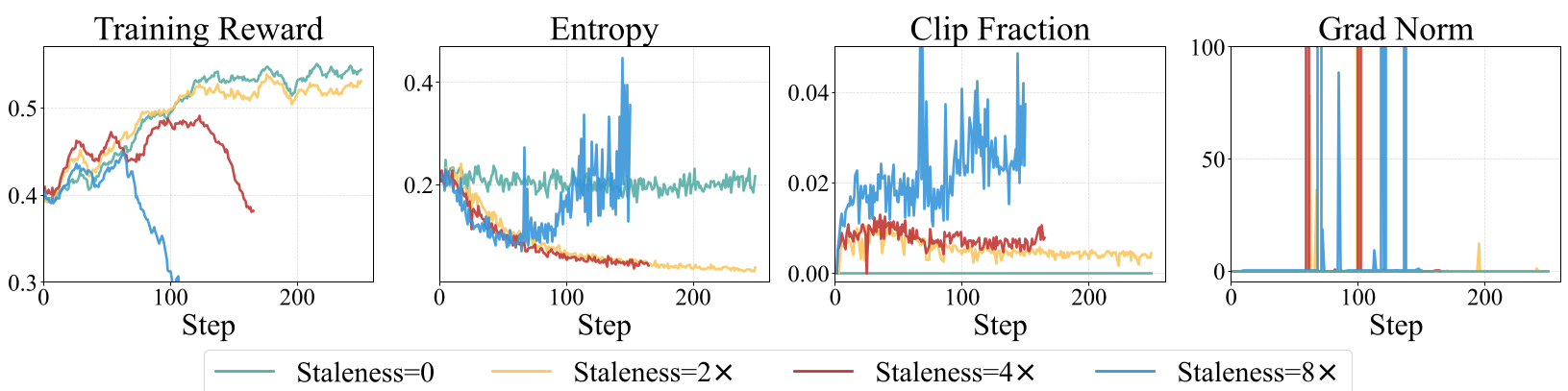
The useful conceptual move in this paper is that it separates two failure channels that are usually mixed together:
- Too much punishment from negative tokens.
- Too little exploration because entropy-increasing updates are clipped away.
That framing is what makes the proposed fix more principled than “just tune epsilon.”
Methodology - The Core
From PPO Clipping to the Real Failure Mode
The paper starts from the PPO surrogate objective: [ J^{\mathrm{PPO}}( heta)=\mathbb{E}\sum_t \min(r_t A_t,\operatorname{clip}(r_t,1-\varepsilon,1+\varepsilon)A_t), ] where (r_t) is the importance ratio between target and rollout policies.
The key decomposition is simple but important:
- For positive-advantage tokens, gradients flow only if (r_t < 1+\varepsilon).
- For negative-advantage tokens, gradients flow only if (r_t > 1-\varepsilon).
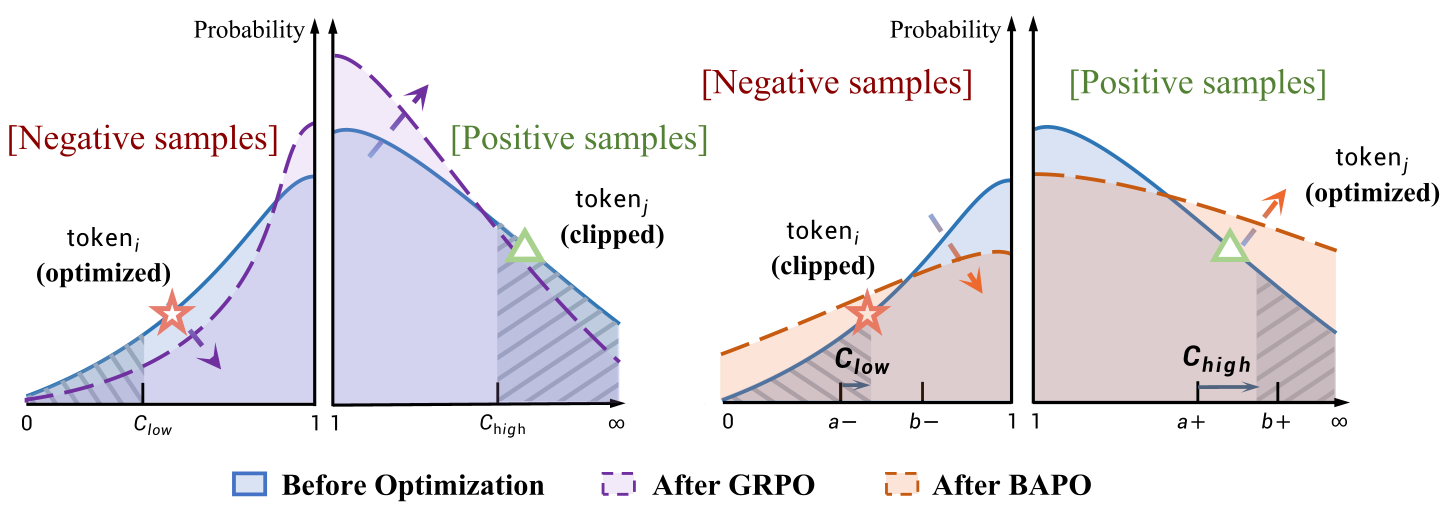
This creates an asymmetry. Under stale data, many low-probability positive tokens have large importance ratios and get clipped out. Meanwhile, many low-probability negative tokens remain active long enough to contribute strong penalization. So PPO is not merely conservative; it is selectively conservative in the wrong direction.
The Entropy-Clip Rule
The paper’s theoretical centerpiece is the approximate entropy change formula: [ \Delta \mathcal{H}(\pi_ heta)\approx -\eta \cdot \operatorname{Cov}\left[\log \pi_ heta(y_t), A_t \cdot \mathcal{X}(y_t)+C\right], ] where (\mathcal{X}(y_t)) indicates whether a token survives clipping.
Interpretation:
- Only unclipped tokens shape entropy.
- Some tokens sharpen the distribution and reduce entropy.
- Others flatten the distribution and increase entropy.
The paper’s token taxonomy is the real intuition:
- High-probability positive tokens reduce entropy.
- Low-probability negative tokens reduce entropy.
- Low-probability positive tokens increase entropy.
- High-probability negative tokens increase entropy.
Now the core issue becomes obvious: symmetric clipping tends to exclude many low-probability positive tokens, i.e. entropy-promoting updates, while still letting too many entropy-reducing negatives through. That creates a systematic bias toward over-exploitation.
Why Adaptive Clipping Helps
The authors first validate a simple idea: asymmetric clipping matters.
- Raising the upper clip bound (c_{ ext{high}}) includes more low-probability positive tokens and improves entropy behavior.
- Relaxing the lower bound (c_{ ext{low}}) includes more low-probability negative tokens and hurts both stability and entropy.
That experiment is important because it shows the directionality of the fix before introducing the adaptive controller.
BAPO: Balanced Policy Optimization with Adaptive Clipping
BAPO dynamically adjusts clipping bounds per update step. The target is not a fixed trust region width, but a target contribution ratio from positive tokens: [ \frac{ ext{positive clipped loss contribution}}{ ext{total clipped loss contribution}} \ge \rho_0. ]
Operationally:
- Initialize (c_{ ext{low}}) and (c_{ ext{high}}) from preset ranges.
- Measure current positive-token contribution.
- If positive contribution is below threshold (\rho_0):
- first increase (c_{ ext{high}}) to admit more positive tokens,
- then, if needed, adjust (c_{ ext{low}}).
- Update the policy with the resulting clipped surrogate.
This is a subtle but meaningful change in control philosophy:
- PPO fixes the clip interval and hopes the data distribution behaves.
- BAPO fixes a desired optimization balance and lets the clip interval adapt.
That makes BAPO closer to a feedback controller than a static regularizer.
Why This Should Work
At a high level, BAPO does three things simultaneously:
- Rebalances gradients by preventing negative tokens from dominating the update.
- Preserves entropy by reintroducing low-probability positive tokens.
- Limits runaway optimism through the positive-contribution threshold, rather than simply maximizing positive reinforcement.
That last point is important. A naive fix would be “always clip higher.” BAPO instead says: admit enough positive signal to restore balance, but do not let it overwhelm training.
Experiments & Results
Main Benchmark Results
The reported benchmark story is strong, especially because vanilla GRPO provides only marginal gains over SFT for already strong models, whereas BAPO still improves them.
For BP-Math-32B:
- SFT: 84.4 / 78.1 on AIME 2024 / 2025
- GRPO: 84.6 / 78.8
- BAPO: 87.1 / 80.0
So BAPO gains:
- over SFT: +2.7 / +1.9
- over GRPO: +2.5 / +1.2
For BP-Math-7B:
- SFT: 66.9 / 59.0
- GRPO: 69.2 / 59.2
- BAPO: 70.8 / 62.5
So BAPO gains:
- over SFT: +3.9 / +3.5
- over GRPO: +1.6 / +3.3
The stronger claim is relative competitiveness:
- BP-Math-32B-BAPO beats Qwen3-32B by +5.7 / +7.1
- beats SkyWork-OR1-32B by +4.9 / +6.7
- surpasses o3-mini-medium average
- surpasses Gemini-2.5-Flash-Thinking average
That is an unusually strong result for a method paper centered on optimization stability rather than architecture scale.
Stability Under Staleness
The most convincing experimental section is not the leaderboard table, but the staleness analysis.
BAPO is explicitly tested under:
- replay-induced off-policy training,
- varying stale-data levels,
- partial rollout infrastructure.
Across these settings, BAPO consistently shows:
- smoother reward growth,
- healthier entropy trajectories,
- more stable gradient norms,
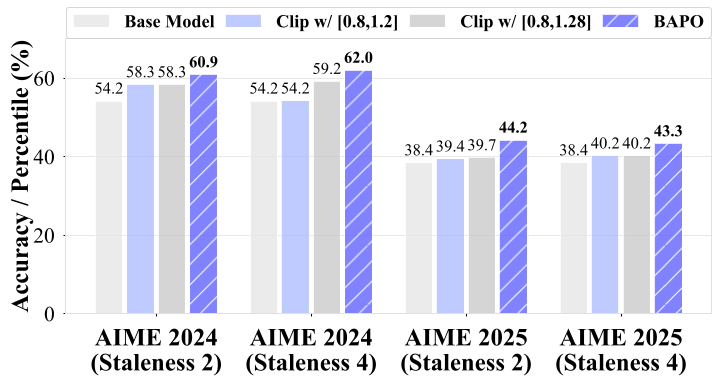
- better robustness than GRPO and clip-higher baselines.
This directly supports the paper’s thesis: the method is solving the intended systems problem, not just opportunistically improving one benchmark.
Ablation Study and Mechanistic Evidence
The paper includes several useful ablations:
- Asymmetric clipping validation: increasing (c_{ ext{high}}) helps; loosening (c_{ ext{low}}) hurts.
- Hyperparameter robustness:
- (\rho_0) around 0.4 is stable,
- broad clipping ranges still work,
- step sizes (\delta_1,\delta_2) are not highly sensitive.
- Algorithm comparison:
- BAPO beats DAPO, TOPR, and DCPO on the BP-Math-7B backbone.
That comparison is especially relevant because those baselines share nearby motivations:
- DAPO emphasizes Clip-Higher and systems scaling.
- DCPO uses dynamic clipping conditioned on token priors.
- TOPR targets stable off-policy RL.
BAPO’s advantage is that it optimizes clipping from a global loss-balance perspective, not just token-local heuristics.
Critical Analysis & Conclusion
Takeaway
BAPO’s key contribution is not merely “adaptive clipping works.” The deeper contribution is the identification of a structural flaw in PPO-style off-policy LLM RL:
- negative tokens dominate optimization,
- clipping removes many exploration-preserving updates,
- entropy collapse is therefore a built-in consequence of the objective under staleness.
BAPO turns that diagnosis into a simple control rule: adapt clipping to maintain a target proportion of positive learning signal.
Why the Paper Is Interesting
Three reasons stand out:
- It connects theory to systems reality. Replay and partial rollout are practical necessities for long-horizon LLM RL.
- It reinterprets clipping as entropy control. That is more insightful than viewing clipping only as trust-region enforcement.
- It explains why several recent heuristics work. Clip-Higher, high-entropy token selection, and target entropy methods all become special cases of the same entropy-balancing story.
Limitations
The paper is strong, but some caveats remain:
- Theory uses simplified assumptions. The entropy derivation relies on a tabular softmax framing, which is useful for intuition but far from transformer-scale training reality.
- Benchmark scope is reasoning-heavy. The evidence is strongest for math and related reasoning tasks; broader language alignment or open-ended instruction following is not deeply explored.
- Clipping remains heuristic control. BAPO is adaptive, but still hand-designed. The target ratio (\rho_0) and bound ranges are not learned from first principles.
- Interaction with reward noise is underexplored. If the advantage estimates are noisy or biased, pushing positive contribution upward may occasionally amplify spurious learning signals.
Future Work
The most promising directions are clear:
- Learned clipping controllers instead of rule-based bound adjustment.
- Joint entropy and advantage calibration, where the system adapts not only clipping but also reward normalization or token weighting.
- Extension beyond reasoning LLMs, especially multimodal agents and asynchronous long-horizon systems.
- A more unified off-policy theory for LLM RL, combining staleness, importance weights, entropy, and sequence-length effects.
Final Verdict
BAPO is one of those papers whose practical value comes from understanding a training pathology precisely enough to fix it with a minimal intervention. It does not replace PPO/GRPO; it exposes where they fail in off-policy LLM training and patches that failure mode elegantly. If off-policy RL becomes standard for scalable reasoning models, ideas like adaptive clipping and entropy-aware balance will likely become default components rather than optional tricks.