
Beyond IQ: Boosting Personality Classification via Ensemble Learning and the Baron-Cohen Model
Baron-Cohen Model Based Personality Classification Using Ensemble Learning
This paper introduces an ensemble learning approach to classify human personality types based on the Baron-Cohen Model, specifically utilizing Emotional Quotient (EQ) and Systemizing Quotient (SQ) scores. By combining Decision Trees, Random Forests, Support Vector Machines (SVM), and Linear Models, the authors achieve a peak personality classification accuracy of 86.42%.
TL;DR
Researchers have moved beyond traditional IQ-centric personality analysis by leveraging the Baron-Cohen Model (EQ/SQ). By applying an Ensemble Learning strategy that combines Decision Trees, Random Forests, SVM, and Linear Models, they achieved an impressive 86.42% accuracy in classifying personality types into categories like "Influencers" and "Practical" individuals.
Background: This work resides at the intersection of psychology and machine learning, iterating on existing psychometric theories by replacing manual assessment with robust, multi-algorithm predictive modeling.
Problem & Motivation: The Limitation of Single-Quotient Thinking
For decades, human personality was often simplified into narrow metrics. Simon Baron-Cohen’s E-S (Empathizing-Systemizing) theory revolutionized this by suggesting that our brains are balanced between two axes:
- Emotional Quotient (EQ): Our ability to identify and respond to others' mental states.
- Systemizing Quotient (SQ): Our drive to analyze, explore, and construct rule-based systems.
While individual machine learning models (like a single SVM or Decision Tree) can process these quotients, they often capture only specific patterns in the data, leading to a "ceiling" in prediction accuracy (around 60-75%). The authors set out to break this ceiling using Ensemble Learning.
Methodology: The Power of the "Team" Approach
The researchers followed a systematic workflow: Data Refining -> Hypothesis Building -> Machine Learning -> 10-Fold Validation -> Ensemble Permutations.
1. The Classification Framework
The data (from 13,256 participants) was categorized into four quadrants based on a mid-value threshold of 40:
- Amateurish: Low EQ, Low SQ
- Practical: Low EQ, High SQ
- Emotional: High EQ, Low SQ
- Influencers: High EQ, High SQ
2. Model Architecture
The core innovation lies in the ensemble. The authors didn't just pick the best model; they tested every permutation of the following:
- Decision Tree: For segmented, branch-like logic.
- Random Forest: To reduce variance via multiple trees.
- SVM: For high-dimensional plane separation.
- Linear Model: For establishing fundamental relationships between variables.
 Figure 1: Conceptual mapping of the AI-driven personality classification pipeline.
Experiments & Results: Synergy in Action
The results confirm a fundamental ML principle: The whole is greater than the sum of its parts.
- Standalone Performance: SVM was the strongest single player at 75.31%.
- Ensemble Performance: By combining all four models, the accuracy jumped to 86.42%.
The consistency of these models was rigorously tested using 10-Fold Cross-Validation, ensuring that the results weren't just a byproduct of "lucky" data splitting.
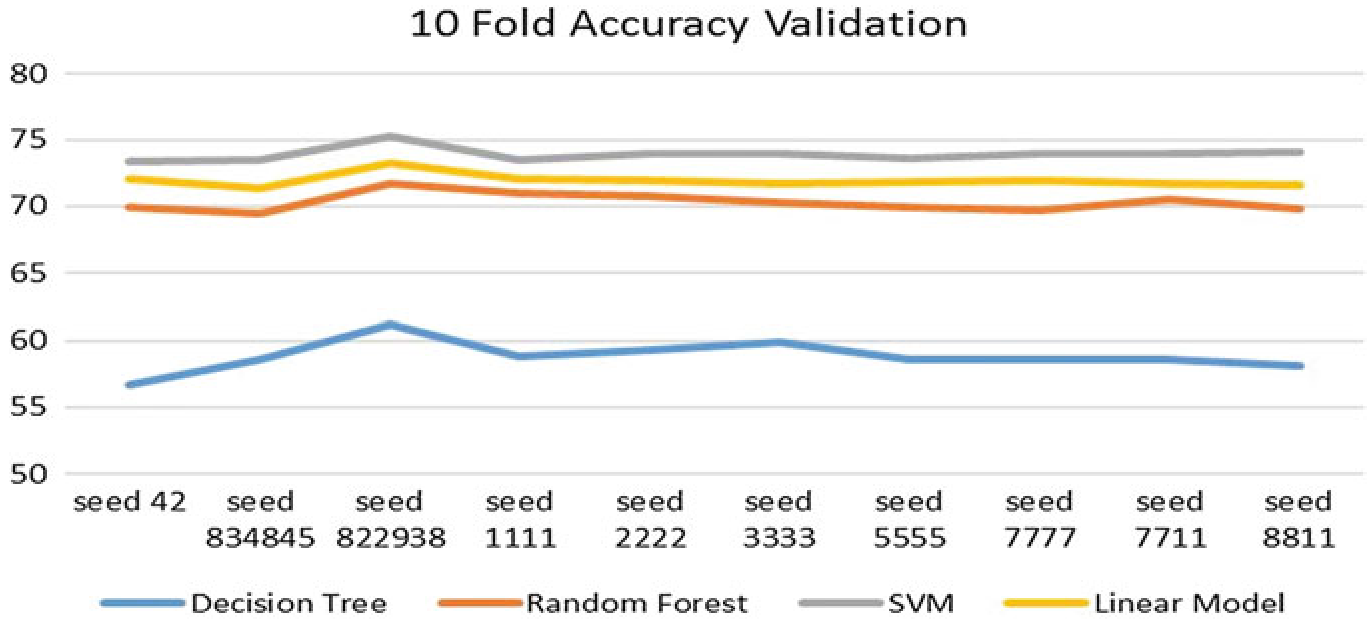 Figure 2: Performance consistency across different seed values, justifying the inclusion of all models in the ensemble.
The Winning Permutation
The study provides a detailed breakdown of how adding more models generally trends toward higher accuracy:
| Model Combination | Accuracy (%) |
|---|---|
| SVM (Single Best) | 75.31% |
| DT + SVM | 83.00% |
| DT + RF + SVM | 84.51% |
| DT + RF + SVM + LM | 86.42% |
Critical Analysis & Conclusion
Takeaway
The Baron-Cohen model is more than a psychological theory; it is a viable feature set for high-accuracy personality classification. This research demonstrates that ensemble learning effectively mitigates the inductive bias of individual classifiers when dealing with subjective psychological traits.
Limitations
- Feature Depth: The model relies on secondary survey data. Real-world personality is often more nuanced than a four-category quadrant.
- Interpretability: While accuracy is higher, ensemble models (especially those involving Random Forests and SVMs) are harder to interpret than a single Decision Tree.
Future Outlook
The authors suggest this framework can be integrated into HR systems for workforce placement, leadership identification, and even clinical settings to assist in diagnosing social-emotional disorders where EQ/SQ imbalances are prevalent.