
Bridging the Gap: A Modular Educational Kit for DNN-Powered Robotics
9956_Development of a Basic Educational Kit for Robot Development Using Deep Neural Networks.
This paper introduces a basic educational kit designed for beginners to develop robotic systems using Deep Neural Networks (DNNs). The kit features a hierarchical architecture and a practical implementation for a robotic grasping task, integrating RT-Middleware and Keras to streamline the robotics-AI workflow.
TL;DR
Developing robots that "see" and "act" usually requires a daunting mix of mechanical expertise and AI knowledge. This paper presents a beginner-friendly educational kit that simplifies this by breaking the process into three logical steps: Data Collecting, Machine Learning, and Task Execution. By using a modular architecture, the authors enabled a physical robot arm to learn grasping tasks in just a few hours, proving that AI-robotics research doesn't have to be inaccessible.
The Motivation: A Tale of Two Worlds
Currently, a massive friction exists between Robotics (grounded in mechanical engineering) and DNNs (situated in info-tech). Beginners often find themselves lost in a "no-man's land" where they might understand a neural network but can't control a motor, or vice versa.
Existing literature often provides pre-trained models or specific datasets, but rarely a reproducible end-to-end pipeline. The authors identified three core requirements for a solution:
- Easy to understand: Clear, simplified design.
- Experience-based: Learning by operating physical hardware.
- Applicable: A foundation that users can adapt to their own specific projects.
The Core Concept: The DC-ML-TE Hierarchy
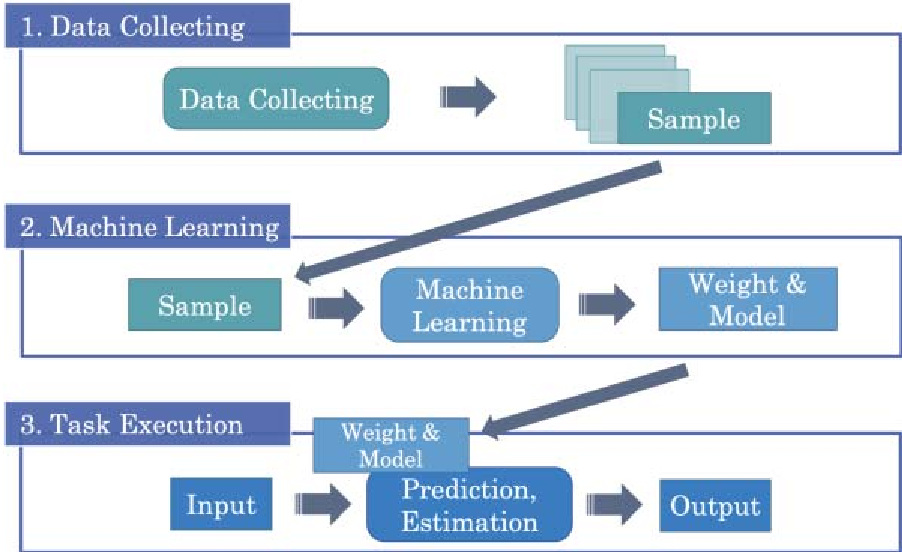
To make the R&D process intuitive, the authors dismantled the complex workflow into a hierarchical model:
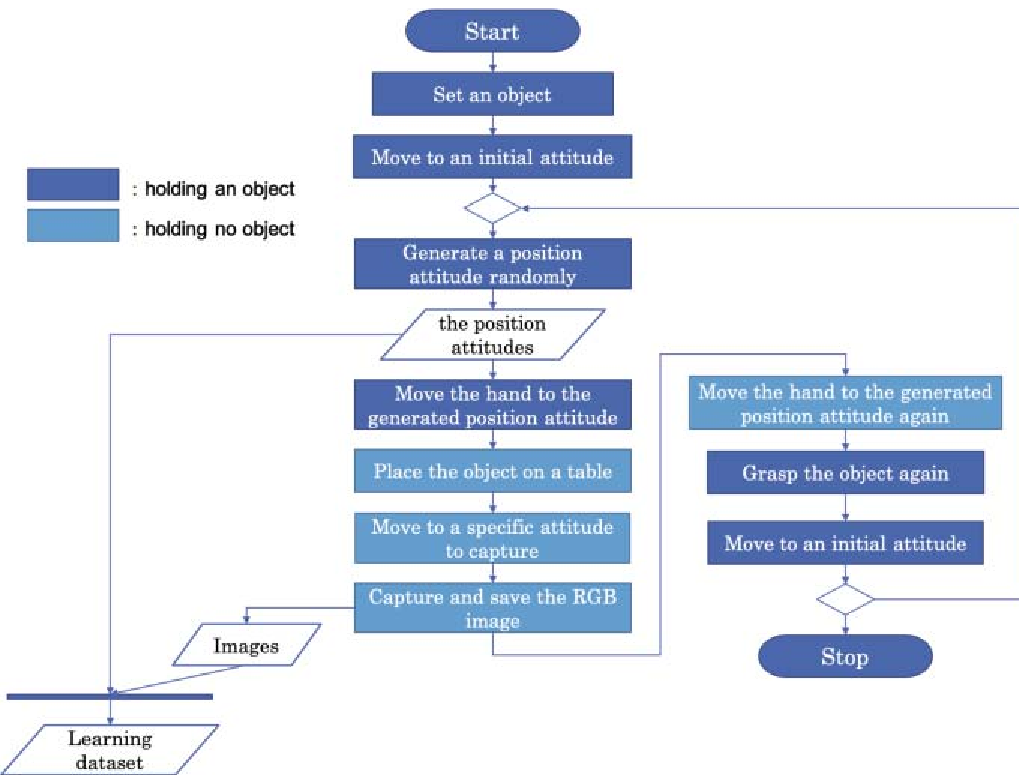
- Data Collecting (DC): Automating the gathering of RGB images and corresponding robot coordinates.
- Machine Learning (ML): Training a Convolutional Neural Network (CNN) to map those images to "graspable" coordinates.
- Task Execution (TE): Deploying the trained model back onto the robot to perform real-time grasping.
Methodology: Putting It Together
The technical "secret sauce" of this kit is the use of RT-Middleware (RTM). RTM allows the robot's hardware (arms, cameras) to be treated as "components." This means you can swap a small robot arm for a giant industrial one without rewriting your AI logic—a concept known as hardware independence.
For the "brain," the authors chose Keras (running on TensorFlow). Its user-centric API allows beginners to stack neural network layers like LEGO bricks, making the ML step far less intimidating for those without a computer science background.
Experiments: Real-World Results
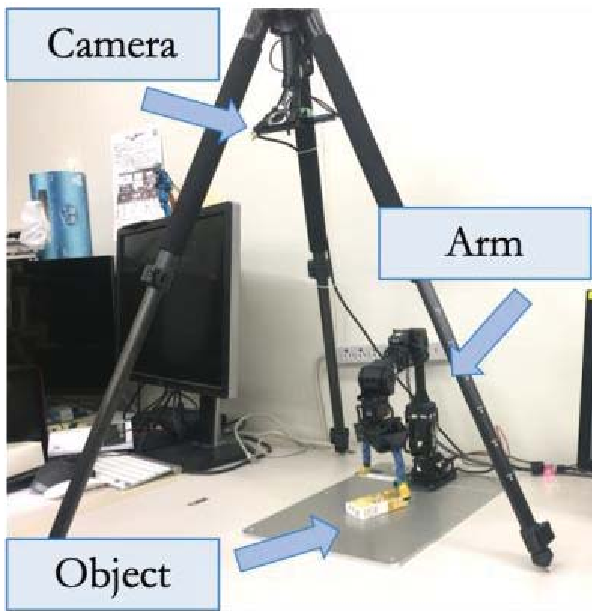
The authors put their kit to the test with a robotic grasping task. The goal: pick up a box of sweets placed anywhere on a table.
- Speed: They collected 500 datasets in just 2 hours.
- Efficiency: The training process (incorporating 4 convolutional layers and 3 fully connected layers) took less than 3 hours.
- Versatility: To prove the system wasn't "hard-coded" for one setup, they successfully:
- Replaced the Mikata Arm with a significantly larger OROCHI robot.
- Enhanced the sensor from a standard RGB camera to an RGB-D (Depth) camera to handle objects that blended into the background texture.
Critical Analysis & Future Outlook
The beauty of this work lies in its systematic integration. While the grasping accuracy wasn't the primary metric, the workflow's success is undeniable.
Takeaways:
- Modularity is Power: By decoupling data collection from task execution, the kit becomes a versatile "template" for any sensor-to-action task.
- Low Barrier to Entry: The choice of RTM and Keras prioritizes human time over raw computational performance, which is the correct trade-off for education.
Limitations: The current system relies on supervised learning with relatively small datasets. In more "wild" or dynamic environments, the 500-sample approach might struggle with generalization. Future iterations could benefit from integrating Sim-to-Real techniques to augment the DC step further.
Conclusion
This educational kit represents a vital step toward democratizing AI-driven robotics. By providing a clear manual and a modular software stack, the authors have turned a complex "Black Box" into a manageable, three-step journey for the next generation of engineers.