
Batman or the Joker? The Dual Nature of Urban Computing and its Ethical Crossroads
Batman or the joker?: the powerful urban computing and its ethics issues
This paper examines the ethical landscape of urban computing, specifically across urban safety analysis, transportation prediction, and social media event detection. It categorizes "big urban data" as a double-edged sword and identifies critical vulnerabilities in current SOTA spatial data mining methodologies.
TL;DR
As our cities become "smarter" through a deluge of sensor and social media data, we face a critical choice. This paper argues that urban computing is currently a "double-bladed sword": while it offers SOTA capabilities in crime prediction and traffic management, it simultaneously risks becoming a tool for discriminatory surveillance and privacy infringement. The authors advocate for a transition toward ethically-conscious AI frameworks that prioritize data representativeness and privacy-preserving algorithms.
Context: The Rise of Big Urban Data
Urban computing has moved from a niche field to a global powerhouse. Driven by urban sensors, government reports, and crowdsourced streams, researchers can now predict traffic accidents before they appear on news sites or forecast civil unrest. However, the field has largely been "accuracy-obsessed," ignoring the ethical debt accumulated by using biased or invasive data.
Critical Pain Points: Why Your Model Might Be Biased
The authors identify three primary research pillars that suffer from ethical vulnerabilities:
- Urban Safety (Predictive Policing): Models often rely on police department reports. If historical policing was biased against specific demographics, the model simply "inherits the prejudices" of past decisions.
- Intelligent Transportation Systems (ITS): Using GPS and transit logs for optimization often creates a "Goldfish Bowl" effect, where individual identities can be reconstructed through record linkage with startling accuracy.
- Social Media Event Detection: Relying on Twitter or Foursquare data introduces a "Digital Literacy" bias; lower-income or elderly populations are often underrepresented, leading to urban policies that overlook their needs.
Methodology: Analyzing the Ethical Vulnerabilities
The paper deconstructs SOTA models to reveal their "Joker" side.
1. The Trap of Biased Data Sources
Take, for instance, the use of CNNs to predict crime scores from Google Street View images.
 Figure: A Deep CNN structure used for quantifying urban safety attributes based on physical environment images.
While technically impressive, if the training scores come from incomplete criminal records (where victims etc. may not report crimes), the model learns a warped version of reality. The paper cites the "StreetBump" app in Boston, which recorded potholes via GPS; because it relied on smartphones, it effectively ignored potholes in low-income neighborhoods where smartphone penetration was lower.
2. The Erosion of Privacy in Mobility
In the transportation domain, the paper highlights that "anonymized" transit data is a myth. By combining two datasets (e.g., mobile logs and transit trips), researchers could identify 95% of users.
 Figure: Timeline showing metro disruptions. While useful for agencies, the underlying tracking data is highly sensitive.
The Vision: Towards Ethical Urban AI
The authors do not just complain; they offer a roadmap for "Batman" (the helpful hero) to prevail:
- Differential Privacy (DP): By injecting calibrated noise into datasets (Noise Injection), researchers can derive global insights without ever being able to pinpoint an individual user's path.
- Oversampling for Fairness: To fix "Garbage In," we must compensate for bias by oversampling underrepresented communities in the data collection phase.
- Transparency & Legislation: Moving beyond technical fixes, the paper calls for GDPR-like strictness where users have the right to withdraw from experiments and must be informed of how their "digital exhaust" is processed.
Experimental Insights & Results
The paper reviews SOTA successes—such as the Metro Disruption Detection Model (MDDM) and Steds (a social media traffic monitor)—but warns that their utility is undermined if they are manipulated by "Shilling Attacks" (fake accounts feeding content to favor certain recommendations).
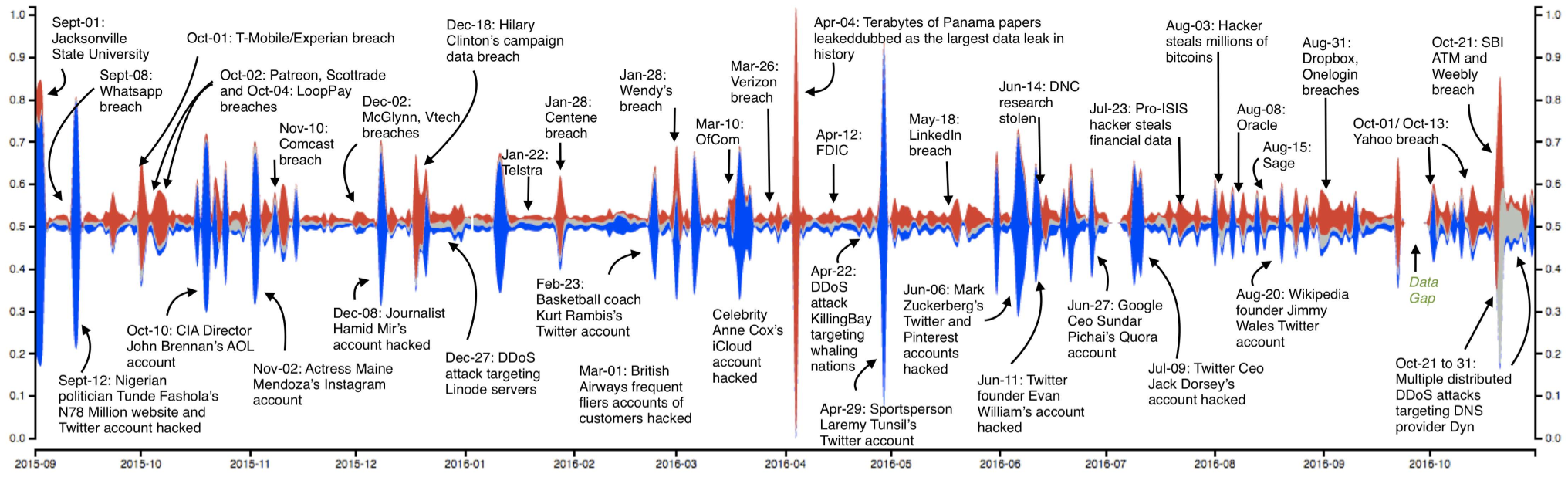 Figure: Streamgraph of cyber-security events detected via social media. This demonstrates the power of urban sensors, provided they aren't weaponized for discriminatory surveillance.
Conclusion and Core Takeaway
The evolution of Urban Computing has reached a plateau where technical performance is no longer the only metric of success. The "Urban Computing Batman" must be armed not just with deep learning, but with Differential Privacy, Fairness-aware preprocessing, and Algorithmic Transparency. Without these, the very systems designed to protect urban safety risk becoming the greatest threats to our social fabric.