
Bayesian Inference Graphs: Quantifying the Probabilistic Nature of Healthcare Actions
Building Bayesian Inference Graphs for Healthcare Statistic Evidence
This paper introduces a Bayesian Inference Graph for healthcare, leveraging Dirichlet distributions and multinomial state transitions to model physiological changes. The method maps human health conditions to discrete states and healthcare interventions to actions, establishing a probabilistic framework for personalized strategy evaluation.
TL;DR
Healthcare isn't just about diagnosis; it's about controlling a complex dynamic system. This paper proposes a Bayesian Inference Graph that treats the human body as a state-machine. By using Dirichlet-Multinomial distributions, the model merges expert knowledge with real-world statistical evidence, allowing for a scalable, data-driven approach to predicting how specific medical actions change a patient's health state.
Background & Motivation: Beyond Static Diagnosis
Current machine learning in medicine often treats the problem as a classification task: features in, diagnosis out. However, the actual "healthcare process"—the sequence of actions taken and their subsequent results—is rarely modeled.
The authors identify a critical gap: physicians often ask, "What effect will this specific therapy have on this specific patient?" Traditional models like continuous-time Markov Chains exist but are mathematically cumbersome and difficult to infer. There is a need for a model that is:
- Evidence-based: Gains confidence as data grows.
- Fragment-tolerant: Can learn from incomplete medical records.
- Generative: Can simulate potential patient trajectories for strategy evaluation.
Methodology: The State-Action Tensor
The core innovation lies in discretizing the "infinities" of the human body into a finite set of States () and intervention Actions ().
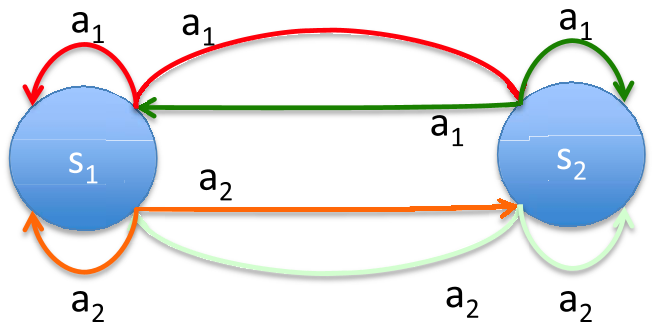
1. The Graphical Framework
A graph is constructed where vertices represent physiological states (e.g., BMI categories) and edges represent actions (e.g., a specific drug or exercise regimen). This is represented mathematically as a Transition Tensor ().
2. The Bayesian Engine
To handle the uncertainty of healthcare outcomes, the authors use:
- Multinomial Distribution: To model the probability of moving from state to state given action .
- Dirichlet Distribution: Used as the conjugate prior. This is the "secret sauce" that allows the model to start with a "doctor's intuition" (prior) and update it into "statistical truth" (posterior) as new patient data arrives.
The updating rule is elegant and computationally efficient: In simple terms, you simply add the count of new observations to your prior parameters to get your new knowledge base.
A Practical Case: Body Weight Control
The authors validated the logic using a BMI toy example. They mapped BMI into 6 states (Underweight to Morbid Obesity) and 6 actions (Diet and Exercise).
Starting from Intuition to Evidence
They initialized the graph with prior parameters (representing hypothetical historical observations). When 16 new instances of action (diet) were observed, the model updated the transition probability for state from a prior estimate to a refined .
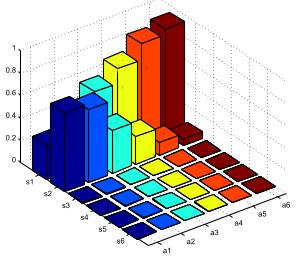 Figure: Visualization of transition probabilities for different start states. Each sub-figure represents how different actions influence the likelihood of reaching a new health state.
Critical Analysis & Future Outlook
Strengths:
- Interpretability: Unlike deep black-box models, the transition graph is explicitly visualized and follows human-understandable logic.
- Sequential Learning: The model doesn't need to be "re-trained" from scratch; it evolves naturally as data flows in.
Limitations:
- Discretization Bias: Converting continuous variables (like exact blood pressure) into discrete states can lead to information loss (the "boundary problem").
- State Explosion: If we include too many variables, the number of states grows exponentially, requiring massive amounts of data to fill the transition tensor.
Conclusion
This paper provides a robust blueprint for Evidence-Based Medicine. By framing healthcare as a probabilistic state-transition problem, it opens the door for using Reinforcement Learning to find the "optimal path" to health—effectively turning a medical problem into a pathfinding mission.