
[ICLR 2024] Laplace-LoRA: Turning LoRA Fine-Tuned LLMs into Better-Calibrated Bayesian Models with Almost No Pipeline Changes
Bayesian Low-Rank Adaptation for Large Language Models
This paper studies Bayesian parameter-efficient fine-tuning for large language models and introduces Laplace-LoRA, a post-hoc Laplace approximation over LoRA parameters. The key claim is that Bayesian uncertainty can be added to standard LoRA pipelines without changing training, yielding state-of-the-art calibration improvements on fine-tuned LLaMA2-7B while largely preserving accuracy and efficiency.
Executive Summary
TL;DR
Fine-tuned LLMs are often not just wrong, but confidently wrong. This paper introduces Laplace-LoRA, a post-hoc Bayesian method that places a Laplace approximation over LoRA parameters only, making uncertainty estimation practical for large models such as LLaMA2-7B.
The main technical move is elegant: keep standard LoRA fine-tuning unchanged, then fit a structured Gaussian posterior around the LoRA MAP solution using KFAC Fisher approximations and a linearized predictive posterior. Empirically, this sharply improves Expected Calibration Error (ECE) and Negative Log-Likelihood (NLL) across in-domain and OOD tasks, while preserving accuracy and adding only modest overhead.
Background Positioning
This is not a new base model architecture, nor a raw benchmark-chasing paper. It is better understood as a high-value reliability upgrade for the PEFT era: a method that plugs into existing LoRA workflows and addresses one of the most practically important but under-served problems in LLM deployment—uncertainty calibration after fine-tuning.
Problem & Motivation
Why is this problem important?
The modern LLM stack has a strange asymmetry:
- Pretraining is huge, expensive, and often already produces reasonably calibrated models.
- Fine-tuning is relatively cheap, but often happens on much smaller datasets.
- That small-data adaptation step is exactly where models become overconfident.
This matters because many downstream uses of fine-tuned LLMs are not pure generative entertainment tasks. They include:
- medical reasoning,
- finance,
- decision support,
- scientific assistance,
- domain transfer settings with limited supervision.
In these settings, confidence is not decorative metadata. It is a core part of the system’s trustworthiness.
What is wrong with prior work?
The paper makes a sharp and important distinction: Bayesian pretraining is not the same problem as Bayesian fine-tuning.
Prior Bayesian language model work often focused on:
- pretraining-scale models,
- uncertainty over attention weights,
- methods too expensive to scale,
- or last-layer-only approximations on relatively small encoders.
Those directions miss the real deployment bottleneck:
- The calibration failure shows up strongly after fine-tuning, not necessarily during pretraining.
- Full Bayesian inference over all LLM weights is intractable.
- Even Bayesian inference over attention weights can explode in dimensionality because attention uncertainty is indexed by layers, heads, positions, and datapoints.
The paper gives a particularly useful back-of-the-envelope comparison:
- reasoning over attention weights in LLaMA-7B on a modest fine-tuning set can involve on the order of one billion attention weights,
- while LoRA fine-tuning here uses only around 6 million trainable parameters.
That is the key scaling insight: if Bayesian inference is to be practical for LLM fine-tuning, it should live where adaptation already lives—inside PEFT modules.
Core intuition
LoRA is already the bottleneck through which task-specific adaptation enters the model. So if downstream uncertainty mostly comes from task adaptation, then uncertainty should also be concentrated there.
That is the conceptual bet behind Laplace-LoRA.
Methodology - The Core
From LoRA to Bayesian LoRA
Recall the standard LoRA parameterization for a frozen pretrained weight matrix ( W_0 ):
[ \mathbf{h} = \mathbf{W}_0 \mathbf{a} + \Delta \mathbf{W}\mathbf{a} = \mathbf{W}_0 \mathbf{a} + \mathbf{B}\mathbf{A}\mathbf{a}. ]
Here:
- (W_0) is frozen,
- (A) and (B) are trainable low-rank adapters,
- (\Delta W = BA) is low-rank.
This is already computationally attractive because the number of optimized parameters becomes:
[ n_{lr}(n_{in} + n_{out}) ]
instead of (n_{in}n_{out}).
Laplace-LoRA asks: after standard LoRA fine-tuning reaches a MAP solution, can we place a local Gaussian posterior over those LoRA weights?
The answer is yes—if we approximate carefully.
Step 1: Post-hoc Laplace approximation
The exact posterior over parameters is:
[ P( heta \mid X, y) \propto P(y \mid X, heta) P( heta), ]
with an isotropic Gaussian prior:
[ P( heta) = \mathcal{N}(0, \lambda^{-1} I). ]
Instead of doing full Bayesian inference, the method:
- finds the MAP solution ( heta_{MAP} ),
- performs a second-order expansion of the log posterior around it,
- obtains a Gaussian approximation:
[ P( heta \mid \mathcal{D}) \approx \mathcal{N}( heta_{MAP}, \Sigma). ]
where covariance is approximately the inverse Hessian or Fisher-plus-prior term.
This is classical Laplace. The cleverness is not the idea itself, but where and how it is applied.
Step 2: Only place the posterior over LoRA parameters
Instead of Bayesian inference over all LLM weights, Laplace-LoRA restricts uncertainty to LoRA adapters.
That gives two advantages:
- scalability: only a few million parameters instead of billions,
- compatibility: standard LoRA fine-tuning code remains untouched.
This is why the method is post-hoc in the strongest practical sense:
- train with existing PEFT tooling,
- save checkpoint,
- run Laplace inference afterward.
No custom Bayesian training loop is required.
Step 3: KFAC structure for tractable curvature
A naive covariance over even 6M parameters is still impossible to store or invert directly.
So the paper uses a Kronecker-factored approximation to the Fisher. For each linear layer, the Fisher block is approximated via input and output-gradient second moments:
[ F_\ell = \sum_{n=1}^N \mathbb{E}{P(y \mid f heta(x_n))} \left[ (a_{\ell-1}a_{\ell-1}^T) \otimes (g_\ell g_\ell^T) \right]. ]
This is the standard KFAC idea: the curvature of a matrix-shaped parameter can be factorized into statistics of activations and backpropagated gradients.
The LoRA-specific engineering problem
Here is the subtle systems issue the paper solves.
If a LoRA adapter is treated as two linear layers (A) and (B), then one Kronecker factor is small, but the other can be very large, around (d imes d), with (d=4096) in LLaMA2-7B attention layers.
That large factor is almost as bad as storing the original full weight matrix statistics. So the authors introduce a second low-rank approximation inside the KFAC factor itself.
This is the real technical heart of the paper:
- LoRA gives low-rank task adaptation,
- KFAC gives structured curvature,
- an additional low-rank compression preserves memory efficiency for the large Kronecker factor.
They then show how to do three operations without materializing full matrices:
- incremental low-rank estimation of curvature factors,
- marginal likelihood optimization using the matrix determinant lemma,
- predictive covariance computation using Woodbury identities.
This is what turns the method from “Bayesian but elegant on paper” into something that can actually run on LLM-scale adapters.
Step 4: Linearized prediction instead of weight sampling
Once the posterior over LoRA weights is available, predictions are made through a linearized network around ( heta_{MAP} ):
[ f_ heta(x_) \approx f_{ heta_{MAP}}(x_) + abla_ heta f_ heta(x_*)|{ heta{MAP}}^T( heta - heta_{MAP}). ]
Integrating over the Gaussian weight posterior gives a Gaussian posterior over logits:
[ f_ heta(x_) \sim \mathcal{N}(f_{ heta_{MAP}}(x_), \Lambda), ]
with
[ \Lambda = J^T \Sigma J. ]
This matters because uncertainty is pushed forward into logit space, where classification confidence actually lives.
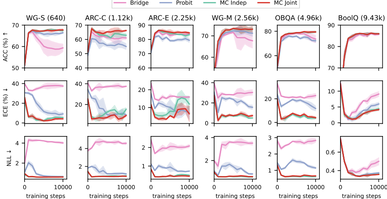
The paper further compares several approximations for Bayesian model averaging and finds that naive Monte Carlo using the full covariance works better than simplified approximations such as:
- generalized probit,
- Laplace bridge,
- diagonal-only MC.
The reason is intuitive: those cheaper approximations ignore covariance between logits, but calibration is often precisely about those correlated uncertainty directions.
Why should this work?
The deepest intuition is this:
- Fine-tuning on small datasets creates sharp, data-poor updates.
- MAP optimization collapses uncertainty into a point estimate.
- Overconfidence is often the symptom of pretending that this point estimate is exact.
- A local posterior over LoRA weights restores a notion of epistemic uncertainty exactly where the task adaptation happened.
This is also why full LA should beat last-layer-only LA: in LLM fine-tuning, uncertainty is not only in the classifier head. Much of it lives in the adapted internal feature transformations. The appendix’s logit-variance analysis supports exactly this claim.
Experiments & Results
Experimental setup
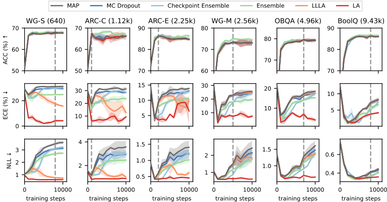
The main experiments fine-tune LLaMA2-7B with LoRA on six commonsense reasoning tasks:
- WG-S,
- WG-M,
- ARC-C,
- ARC-E,
- OBQA,
- BoolQ.
LoRA is applied to:
- query projections,
- value projections,
- output layers.
The paper compares:
- MAP fine-tuning,
- MC Dropout,
- checkpoint ensemble,
- deep ensemble of LoRA models,
- temperature scaling,
- LLLA: last-layer Laplace-LoRA,
- LA: full Laplace-LoRA on all LoRA weights.
Metrics:
- ACC
- ECE
- NLL
These are the right metrics for the paper’s goal. Accuracy alone would miss the entire point.
In-distribution results: calibration gains are dramatic
The central empirical pattern is extremely consistent:
- accuracy changes little,
- ECE and NLL improve a lot,
- full LA is much stronger than LLLA.
Table 1 highlights
At 5000 steps, without a validation set:
-
WG-S:
- MAP ECE: 31.2
- LA ECE: 2.1
- MAP NLL: 3.15
- LA NLL: 0.60
-
ARC-C:
- MAP ECE: 31.0
- LA ECE: 7.4
- MAP NLL: 3.28
- LA NLL: 0.88
-
WG-M:
- MAP ECE: 23.0
- LA ECE: 7.4
- MAP NLL: 1.51
- LA NLL: 0.63
-
OBQA:
- MAP ECE: 16.1
- LA ECE: 6.4
- MAP NLL: 0.99
- LA NLL: 0.65
Accuracy stays almost unchanged. That is crucial. The method is not just making the model timid; it is making confidence more aligned with actual correctness.
A notable practical point: no validation set required
One underappreciated benefit is that Laplace prior precision can be tuned using the Laplace model evidence on the training set, rather than a held-out validation split.
That matters because small-data fine-tuning is exactly the setting where carving out a validation set is most painful. Temperature scaling, by contrast, usually needs held-out validation data.
This makes Laplace-LoRA attractive for low-resource adaptation pipelines.
Validation-set setting: still competitive against temperature scaling
When the authors do use an 80/20 train-validation split, temperature scaling becomes a meaningful baseline.
The result is nuanced:
- temperature scaling is strong,
- but LA usually still gives slightly better NLL and often better ECE.
For example in Table 2:
-
WG-S NLL:
- Temp: 0.68
- LA: 0.66
-
ARC-C NLL:
- Temp: 0.90
- LA: 0.86
-
OBQA NLL:
- Temp: 0.67
- LA: 0.62
This is important because temperature scaling is hard to beat as a post-hoc calibration baseline. If LA is competitive or better, while also producing a more principled Bayesian posterior, that is a meaningful result.
OOD results: the method’s value becomes even clearer
The strongest practical case for uncertainty methods is not in-domain performance but distribution shift.
The paper fine-tunes on OBQA and evaluates on:
- smaller shifts: ARC-C, ARC-E,
- larger shifts: MMLU subsets in CS, Engineering, Law, Health.
The gains are again substantial.
Examples from the no-validation setting:
-
ID OBQA:
- MAP ECE 16.1 → LA 6.4
- MAP NLL 0.99 → LA 0.65
-
ARC-C:
- ECE 22.2 → 8.8
- NLL 1.30 → 0.90
-
ARC-E:
- ECE 15.8 → 6.2
- NLL 1.04 → 0.70
-
MMLU-CS:
- ECE 34.2 → 15.8
- NLL 1.90 → 1.35
-
Health:
- ECE 34.2 → 17.9
- NLL 2.09 → 1.50
These are not tiny cosmetic wins. They indicate that the Bayesian posterior over LoRA weights is capturing something real about epistemic uncertainty under shift.
Ablation and analysis: what actually matters?
1. Full LA beats LLLA
This is one of the most informative findings in the paper.
LLLA helps sometimes, but often much less than full LA. The appendix explains why: most of the uncertainty in logits often comes from earlier adapted layers, not just the final output layer.
That is a strong conceptual point. In LLM fine-tuning, the uncertainty is not purely “classifier uncertainty”; it is also representation uncertainty induced by internal task-specific perturbations.
2. KFAC matters more than diagonal Fisher
The diagonal Laplace approximation gives inconsistent results and can even hurt on some tasks. That strongly suggests that correlations among adapter weights matter.
This is fully aligned with Bayesian deep learning intuition:
- diagonal approximations are often too crude,
- calibration is sensitive to the geometry of uncertainty,
- KFAC captures enough structure to make the posterior useful.
3. Full-covariance MC beats bridge/probit approximations
The paper compares:
- full-covariance Monte Carlo,
- diagonal MC,
- probit,
- Laplace bridge.
Full-covariance MC performs best overall. Again, covariance matters.
This is a recurring theme throughout the work: good calibration requires modeling dependencies, not just marginal variances.
Efficiency: does this break LoRA’s main advantage?
The authors directly address the obvious objection: if LoRA is popular because it is cheap, does Bayesianizing it destroy the benefit?
The answer appears to be no.
From Table 4:
- memory overhead: roughly 1% to 5%
- time overhead in the reported setup: around 10%
And the authors note that this 10% is pessimistic because they accumulated low-rank KFAC statistics 10 times during training for analysis. In a practical post-hoc deployment setting, they estimate the real overhead should be closer to 1%.
That is perhaps one of the most commercially relevant numbers in the paper.
Critical Analysis & Conclusion
What is the real contribution?
The real contribution is not merely “apply Laplace to LoRA.” That sounds simple but undersells the work.
The actual contribution is a coherent recipe for Bayesian PEFT at LLM scale:
- restrict posterior inference to LoRA parameters,
- use structured curvature via KFAC,
- compress the large Kronecker factor with another low-rank approximation,
- perform linearized predictive inference in logit space,
- optimize prior precision without requiring a validation set.
This makes Bayesian uncertainty practical in a part of the LLM stack where it is actually needed.
Why does it matter?
Because many calibration papers improve confidence scores in ways that are either:
- too expensive,
- too architecture-specific,
- or too detached from standard production fine-tuning workflows.
Laplace-LoRA is the opposite:
- it is post-hoc,
- PEFT-compatible,
- scalable,
- and empirically strongest where reliability matters most: small data and OOD.
Limitations
The paper is strong, but several limitations remain.
1. It is still a local posterior approximation
Laplace approximates the posterior around one MAP basin. If the true posterior is highly multimodal, this approximation can miss major uncertainty structure.
For LLMs, that is not a theoretical nitpick. Fine-tuning landscapes can be complex, especially with nontrivial prompt and task formats.
2. The gains are mostly in calibration, not accuracy
This is by design, but it means the method is best viewed as a reliability layer rather than a capability booster. Teams seeking raw benchmark gains may undervalue it unless calibration is part of their objective.
3. Experiments focus on classification-style token selection tasks
The main benchmarks are multiple-choice or binary classification framed as next-token prediction. That is a clean setting for calibration metrics, but it leaves open harder questions about:
- open-ended generation,
- long-form reasoning,
- tool use,
- agentic decision pipelines.
4. KFAC implementation complexity is nontrivial
While the method is post-hoc from a user perspective, the actual systems machinery is sophisticated. The incremental low-rank KFAC and efficient posterior computations are not trivial engineering.
5. OOD improvement is strong but not universal perfection
Even after LA, OOD ECE on some larger-shift domains remains substantial. So the method improves trustworthiness, but does not solve the full robustness problem.
Future Work
Several extensions look especially promising.
Bayesian PEFT beyond LoRA
This paper suggests a larger agenda:
- Bayesian QLoRA,
- Bayesian prefix tuning,
- Bayesian adapters,
- Bayesian multimodal PEFT.
Once PEFT defines the adaptation subspace, Bayesian inference can target that subspace.
Use in RLHF or reward modeling
The paper cites fine-tuning reliability as important for downstream alignment. One obvious next step is uncertainty-aware reward models or preference models using Bayesian LoRA-style posteriors.
Generation-time uncertainty
A major open question is how Laplace-LoRA uncertainty should be exposed during free-form decoding:
- token-level abstention,
- confidence-aware beam search,
- safe refusal policies,
- uncertainty-guided retrieval or tool use.
Better posterior approximations
Laplace is a strong baseline because it is efficient. But this work may motivate richer PEFT-scale posteriors:
- low-rank variational families,
- subnetwork inference,
- structured ensembles over PEFT modules.
Final Takeaway
Laplace-LoRA is one of those papers whose importance is larger than its apparent simplicity. It does not propose a flashy new LLM architecture. Instead, it identifies a real deployment failure mode—overconfidence after fine-tuning—and offers a practical Bayesian fix that fits the existing PEFT ecosystem.
The main lesson is powerful:
- if fine-tuning lives in low-rank adapters,
- then uncertainty should live there too.
That idea is technically sound, empirically validated, and likely to remain relevant as LLM deployment becomes increasingly constrained not by raw capability, but by how much we can trust the model when it claims to know something.