
BayesOWL: Leveraging Bayesian Networks for Probabilistic Ontology Mapping
A Bayesian Network Approach to Ontology Mapping
The paper introduces a principled methodology for automatic ontology mapping by extending the BayesOWL framework. It translates source and target OWL ontologies into Bayesian Networks (BNs) and treats concept mapping as evidential reasoning between these BNs, achieving semantic integration under uncertainty.
TL;DR
Ontology mapping is the backbone of the Semantic Web, yet it often struggles with the "gray areas" where concepts partially overlap. This paper presents a Bayesian approach that translates ontologies into Bayesian Networks (BNs), using Jeffrey’s Rule and IPFP to transform mapping into a process of probabilistic evidential reasoning.
Problem & Motivation: The Failure of Discrete Matches
In the real world, a concept in Ontology A rarely has an exact twin in Ontology B. Current State-of-the-Art (SOTA) methods often:
- Force a "Best Fit" match, discarding other relevant similarities.
- Fail to account for the degree of overlap in future reasoning.
- Cannot handle composite mappings (e.g., mapping one concept to an intersection of two others).
The authors argue that since semantic similarity is naturally probabilistic, our mapping frameworks should be too.
Methodology: The Core Architecture
The proposed framework consists of three pillars:
- Structural Translation: Converting OWL constructs into a Directed Acyclic Graph (DAG). Regular nodes represent classes, while "Control Nodes" handle logical operators like
unionOforintersectionOf. - Learning from the Web: Since experts rarely provide Conditional Probability Tables (CPTs), the system uses Google to find "exemplars" (text documents) for each concept to calculate joint probabilities via text classification.
- BN Mapping via Jeffrey’s Rule: When mapping concept from to , the framework treats the belief in as soft evidence.
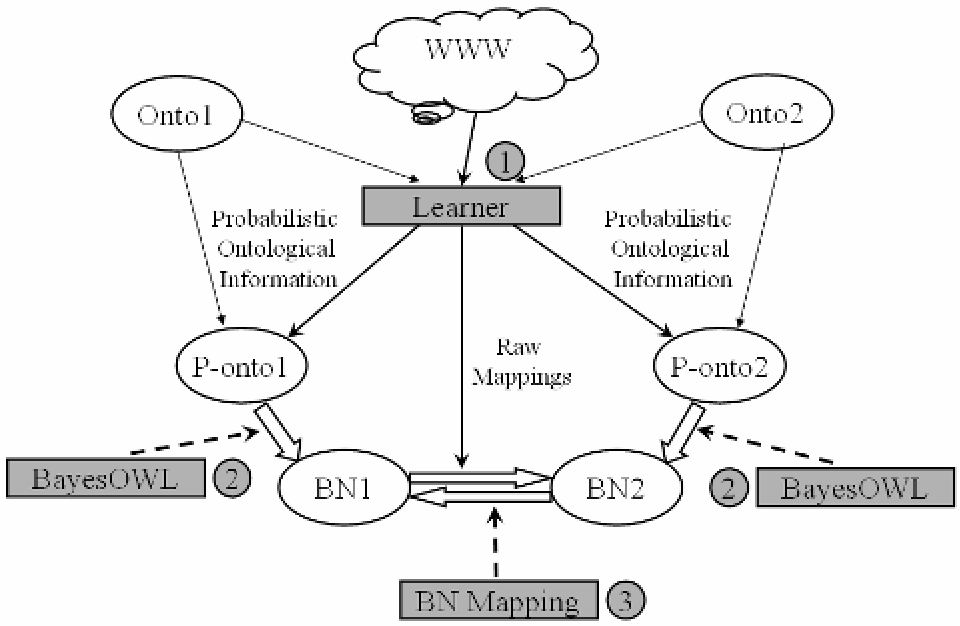 Figure 1: The Three-Component Framework for Probabilistic Mapping.
The Secret Sauce: Semantic Linkages
A Probabilistic Semantic Linkage is defined as . To handle "1 to n" mappings, the authors use a modified IPFP process that iterates through these linkages until the distribution of the target BN converges to a state consistent with all similarities.
Experiments: ACM vs. DMOZ
The authors tested their system on the Artificial Intelligence sub-domains of the ACM Topic Taxonomy and DMOZ.
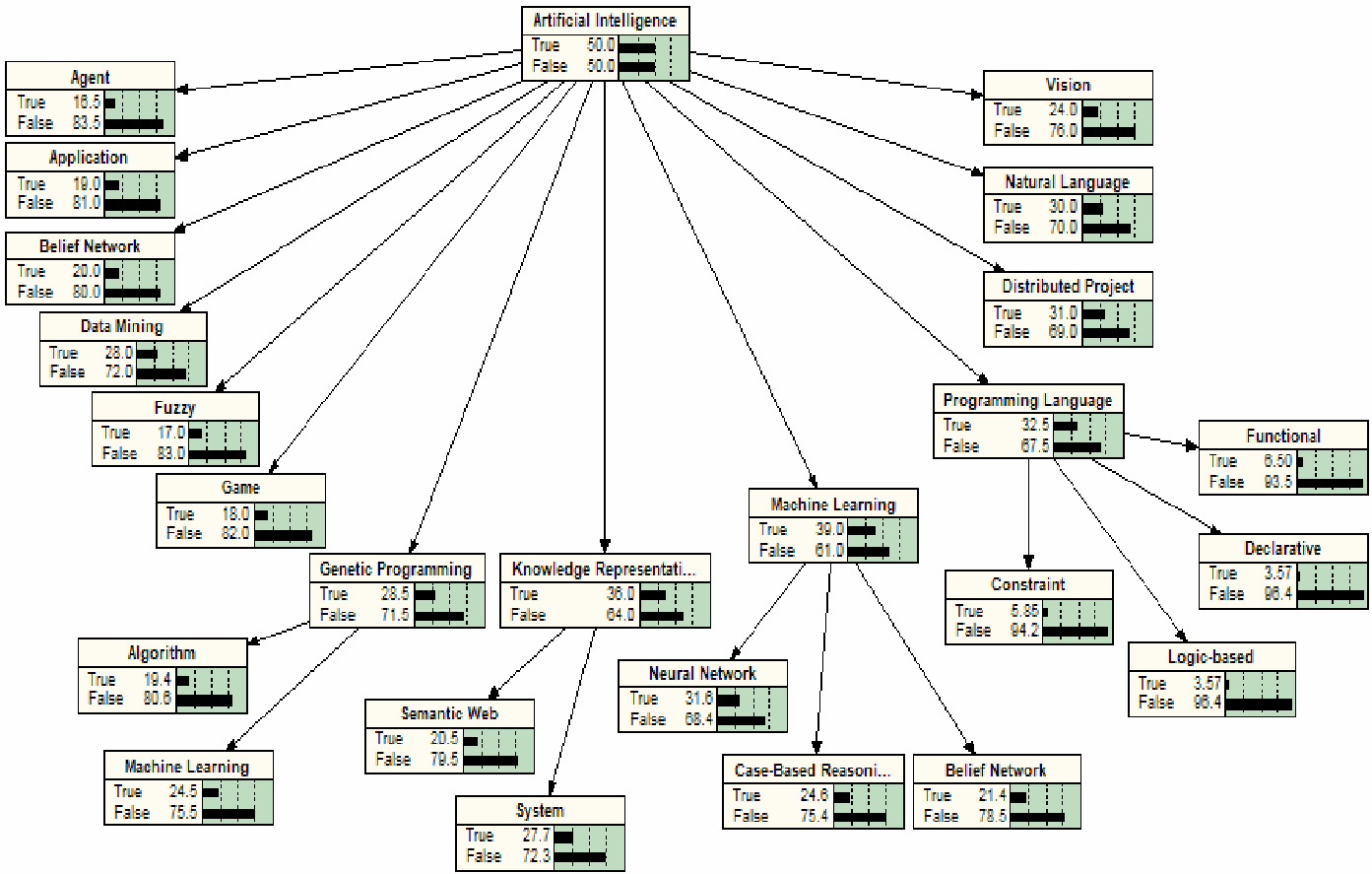 Figure 2: Translated BNs for ACM and DMOZ AI sub-domains.
Insightful Results
Beyond simple identity matching (e.g., Natural Language = Natural Language Processing), the system discovered that the DMOZ concept for Semantic Web didn't have a single match in ACM. Instead, by setting a semantic linkage and performing inference, they found that: This proves that the "Semantic Web" is effectively the intersection of "Relation Systems" and "Semantic Networks" in the ACM view.
Critical Analysis & Conclusion
Takeaway
By moving from "Is equal to ?" to "How likely is given ?", this framework enables more robust reasoning in heterogeneous environments.
Limitations
- Scalability: BN inference is NP-hard. While the authors proposed "Linkage Reduction," large-scale ontologies with thousands of classes remain a challenge.
- Data Dependency: The quality of mapping is heavily tied to the quality of web-mined text documents.
Future Work
The next frontier involves handling inconsistent probability constraints (when different sources provide conflicting probabilities) and scaling the D-IPFP algorithm to handle property-heavy ontologies beyond simple taxonomies.