
[Theoretical Insight] Toward Bayesian AI: Overcoming Over-reliance by Modeling Base Rate Neglect
Bayesian reasoning for overcoming over-reliance in AI-assisted decision making
This paper identifies "over-reliance" in AI-assisted decision-making as a cognitive bias equivalent to "base rate neglect" within a Bayesian framework. It proposes a novel interaction model that uses probability estimation and explicit Bayesian updates to mitigate the tendency of users to blindly follow AI suggestions.
TL;DR
Blindly following AI advice is not just a "trust" issue—it's a mathematical failure in human reasoning. This paper argues that over-reliance is actually base rate neglect. By redesigning AI interfaces to force users to provide "priors" and then explicitly calculating "posteriors" using Bayes' Theorem, we can turn passive AI-users into rational Bayesian agents.
Positioning: This work moves beyond common "explainable AI" (XAI) tropes. It is a theoretical bridge between Cognitive Science (Kahneman's heuristics) and HCI, proposing a normative mathematical framework for human-AI collaboration.
The Problem: The "Trust" Trap
In high-stakes fields like medicine or law, we want AI to assist, not replace. However, humans often exhibit automation bias: they follow the machine even when their eyes tell them otherwise.
Current HCI research tries to fix this by "calibrating trust." The logic is: "If the AI is 80% accurate, the human should trust it 80% of the time." The authors argue this is insufficient. Even if trust is calibrated, users often fail to synthesize the AI's output with external information (the "base rate"). When a hiring manager ignores that 90% of employees in a sector leave within a year because a specific AI says this candidate is a "star," they are committing a classic cognitive error.
The Insight: Over-reliance = Base Rate Neglect
The authors propose that over-reliance is a deviation from Bayesian Rationality.
In a rational world, when you see AI evidence (), your belief in a hypothesis () should follow Bayes' Rule:
eg H)}$$ **The failure occurs in two ways:** 1. **Uniform Prior Assumption**: The user acts as if $p(H) = 0.5$, ignoring the actual prevalence of the event. 2. **Inverse Fallacy**: The user confuses the AI's reliability (e.g., "The AI is 90% accurate") with the probability that the hypothesis is true given the AI said so. ## Methodology: The "AI-Follow" Interface To fix this, the authors suggest a prototype interaction flow designed to "force" Bayesian thinking: 1. **Step 1 (The Prior)**: The user reviews the case *without* AI and provides a preliminary prediction and a probability estimate ($p(H)$). 2. **Step 2 (The Evidence)**: The AI provides its suggestion, explicitly showing its reliability metrics (Recall and False Positive Rate). 3. **Step 3 (The Synthesis)**: The system computes the posterior probability and provides a slider for the user to see how sensitive the result is to their original prior. 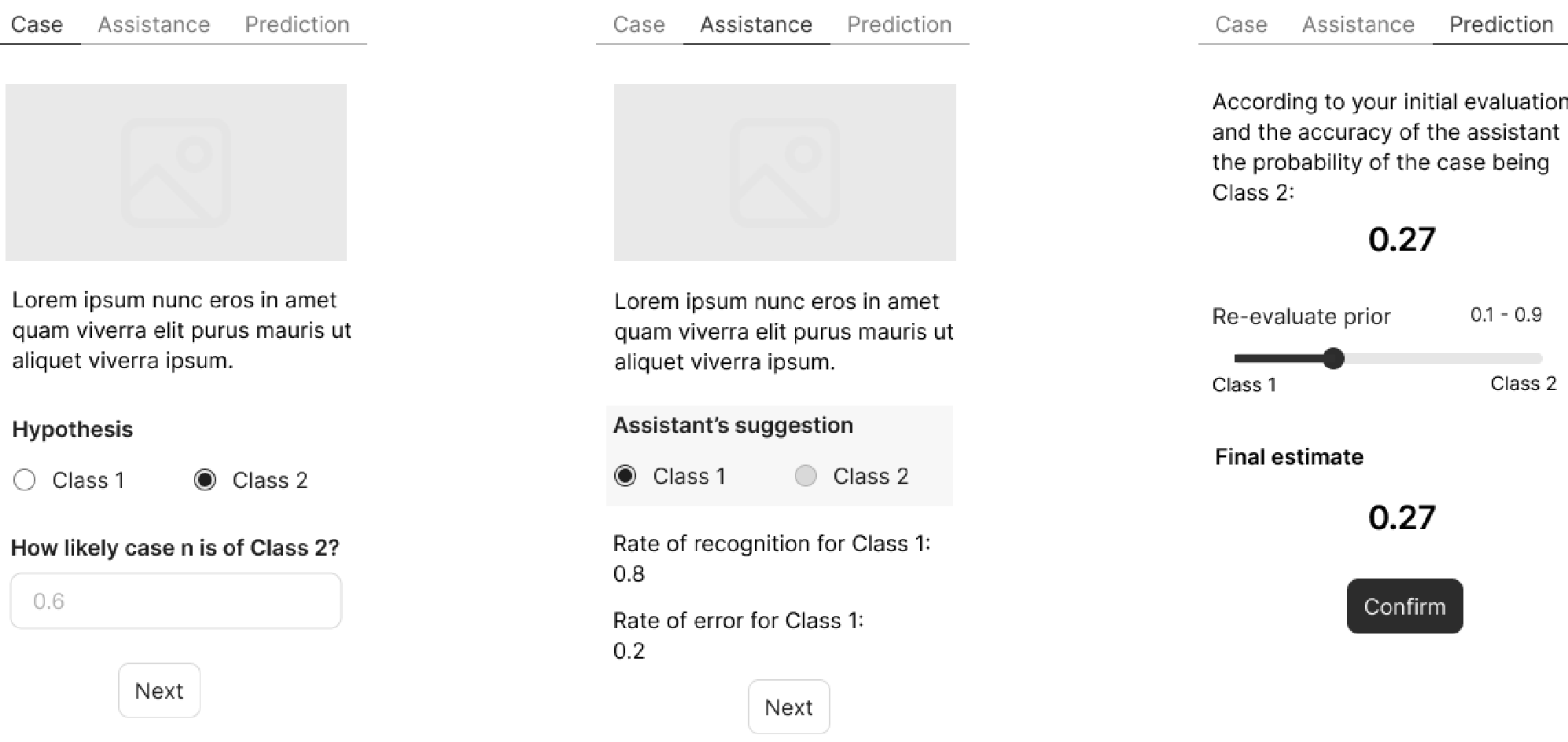 *Figure 1: The proposed interface. Left: User sets the prior. Middle: AI provides evidence + reliability. Right: The Bayesian posterior calculation.* ## Why This Works (and Where it Fails) By making the math explicit, the interface serves as a **Cognitive Forcing Function**. It stops the user from using the AI suggestion as a mental shortcut (heuristic) and instead forces a "System 2" (slow, analytical) reasoning process. **Key Results & Expectations:** * **Mitigation of Bias**: By asking for "probability" instead of "confidence," the system avoids the "alignment" trap where human confidence simply mimics AI confidence. * **Robustness Check**: The interactive slider (Figure 1, Right) allows the user to see: "Even if I think the prior is low, how strong must the AI be to change my mind?"  *The core mathematical driver for the interaction: Integrating Recall and FPR with Human Priors.* ## Critical Perspective The primary **limitation** is the cognitive load. Requiring experts to provide numerical probabilities for every case is time-consuming and difficult for humans who aren't trained in statistical thinking. While the paper suggests "Frequency Trees" as a potential solution, the friction of this interaction might lead to different types of user fatigue. ## Future Outlook This paper is a call to action for AI developers to stop treating AI as a "black-box truth teller" and start treating it as "probabilistic evidence." As the **EU AI Act** begins requiring "meaningful human oversight," frameworks like this will be essential to prove that the human is actually *thinking*, not just clicking "Approve."