
Shrinkage-Based Coding: Mastering the Chaos of Noisy Medical Text
Combining Bayesian Text Classification and Shrinkage to Automate Healthcare Coding: A Data Quality Analysis
This paper presents a robust automated healthcare coding system for ICD-9-CM using a shrinkage-based variation of Multinomial Naive Bayes. By leveraging the hierarchical structure of medical codes, the method significantly outperforms standard text classifiers, particularly when training data is sparse or noisy.
TL;DR
Automating the translation of physician notes into ICD-9-CM codes is notoriously difficult due to "noisy" data and complex code hierarchies. This paper demonstrates that Shrinkage-based Bayesian classifiers can navigate this complexity by using the ICD hierarchy to smooth out data gaps, maintaining high accuracy even when 75% of the training text is intentionally corrupted.
Context & Motivation: The "Ragged" Hierarchy Problem
Healthcare coding is a multi-billion dollar bottleneck. Manual coding is expensive, and though rule-based NLP helps, it fails to scale across languages (like Spanish) or handle the messy reality of clinical shorthand.
The root challenge is the Sparsity-Hierarchy Trade-off. The ICD-9-CM system is a "ragged" tree; some specific codes have very few training examples. A traditional "flat" classifier treats each code as an isolated island, leading to poor generalization. The authors hypothesize that the hierarchy itself contains the solution: if you don't have enough data for a specific "leaf" code, you should look at its "parent" category to refine your statistical estimates.
Methodology: The Power of Shrinkage
The core innovation is the application of Shrinkage Estimators to a Multinomial Naive Bayes framework.
1. Hierarchical Smoothing
Instead of calculating the probability of a word given a code solely from the samples of that specific code, the shrinkage algorithm calculates a "shrunk" estimate as a weighted average of likelihoods along the path from the root of the ICD tree to the leaf.
2. The Intuition
If a leaf node has sparse data, the weights () shift to emphasize the parent or grandparent nodes, which have more aggregated (and thus more stable) data. This acts as a sophisticated form of Laplacian smoothing.
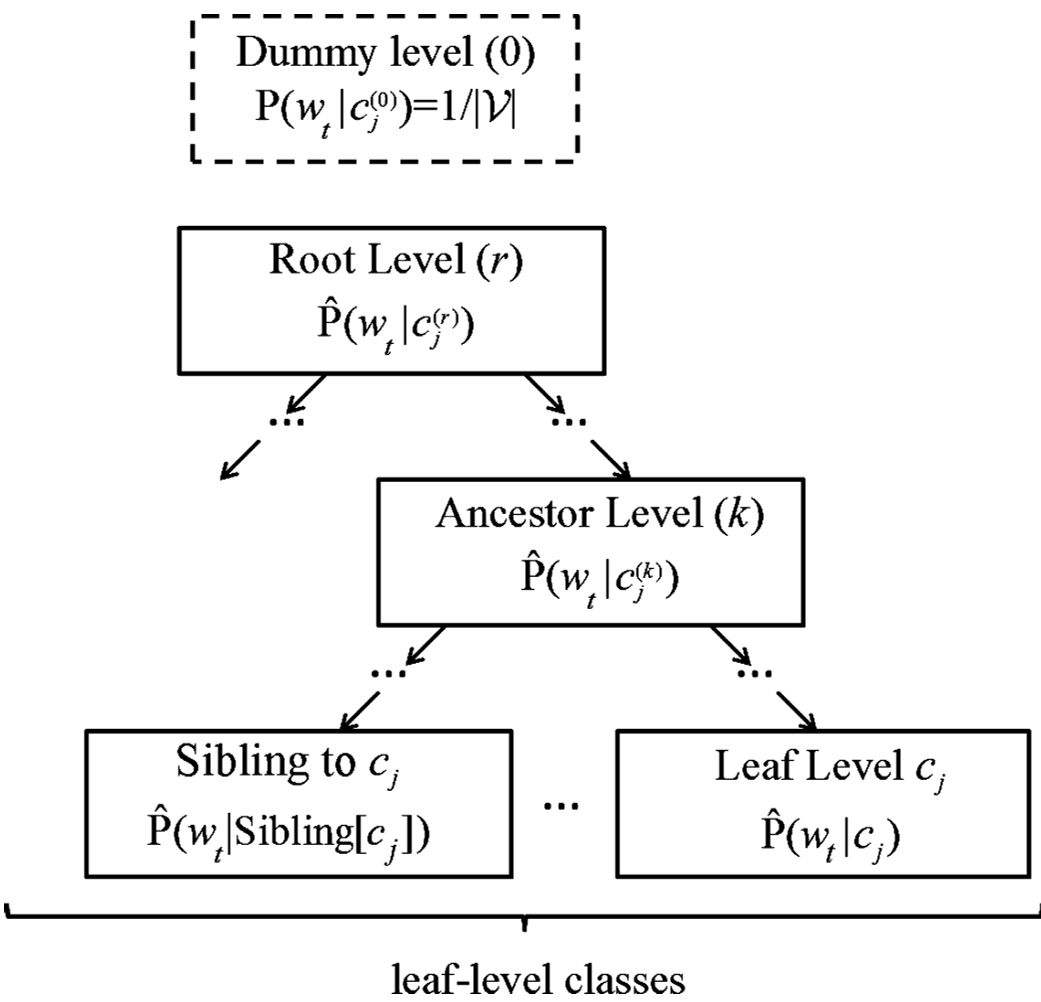 Figure overhead: The hierarchical structure of the ICD system allows for information propagation from coarser to finer levels.
Experiments: Testing Robustness Against "Noise"
The authors didn't just test on clean data; they systematically "deteriorated" the training set by simulating common Spanish typographical errors at rates of 25%, 50%, and 75%.
| Algorithm | 0% Noise (Accuracy) | 75% Noise (Accuracy) |
|---|---|---|
| Shrinkage (SH) | 84.98% | 79.62% |
| SVM (Linear) | 80.46% | 73.26% |
| Naive Bayes | 78.12% | 68.36% |
Key Result: Graceful Degradation
The shrinkage classifier exhibited remarkable resilience. While standard Naive Bayes collapsed as noise increased, the Shrinkage model’s accuracy remained nearly constant up to 25% noise and only dropped slightly at 75%. This suggests that the abundance of relevant words in the higher levels of the hierarchy acts as a buffer against feature-level noise.
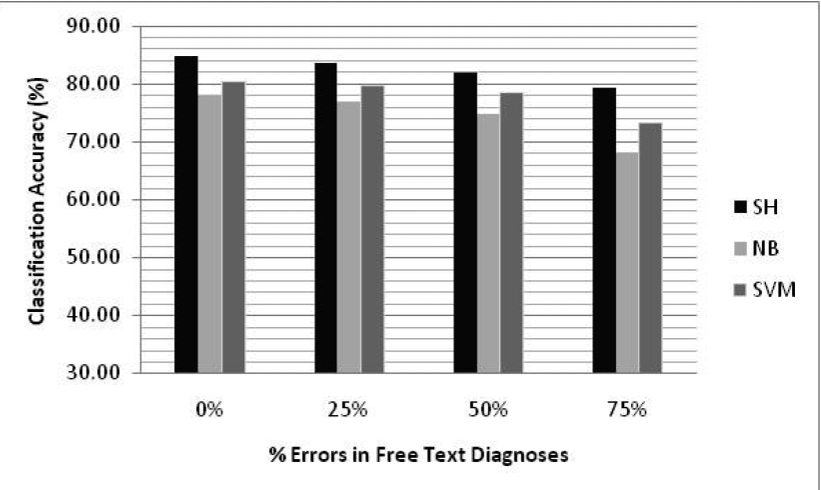 Performance comparison: Shrinkage consistently maintains a lead over SVM and NB as data quality declines.
Critical Insight: Why Does It Work?
The robustness stems from the fact that medical terminology is redundant. Even if "diabetes" is misspelled as "diabtes," other high-frequency terms in the ancestor nodes (like "endocrine system") guide the classifier toward the correct neighborhood in the hierarchy. The shrinkage parameters automatically learn which levels of the tree are "trustworthy" for specific classification tasks.
Conclusion & Limitations
This work proves that we don't always need "perfect" data to build effective medical AI. By using the structural inductive bias inherent in medical taxonomies, we can build models that are cheaper to train and more resilient to real-world errors.
Limitations for Future Work:
- Label Noise: The study assumes the codes provided by humans were 100% correct, which is rarely true in practice.
- Contextual Semantics: The model currently struggles with modifiers (e.g., "tumor of ____"). Future iterations might benefit from "superterms" or BERT-based embeddings to capture pharmaceutical and anatomical relationships better.
Final Takeaway: For any task where your labels are organized in a hierarchy, Shrinkage is a must-have tool in your statistical arsenal.