
BeFair: Bridging the Gap Between Ethical AI Theory and Banking Reality
BeFair: Addressing Fairness in the Banking Sector
The paper introduces BeFair, a specialized framework and toolkit for identifying and mitigating algorithmic bias in the banking sector. Applied to a credit lending use case, it demonstrates how standard Machine Learning (ML) models can exacerbate discrimination and evaluates diverse mitigation strategies ranging from pre-processing to causal counterfactual models.
TL;DR
In the high-stakes world of credit lending, "unbiased" models are a myth. Using a dataset of 10^5 loan applications, the BeFair project reveals that standard ML models often amplify historical biases. This paper provides a comprehensive industrial toolkit and a 5-step roadmap to detect and neutralize discrimination using techniques ranging from adversarial training to causal inference, proving we can achieve ethical banking without sacrificing predictive accuracy.
The "Fairness Paradox" in Banking
Financial institutions are caught in a technical and ethical conundrum. On one hand, they must maximize predictive performance for risk assessment; on the other, they face increasing regulatory pressure to ensure non-discrimination.
The authors identify a critical "Prior Work" failure: Fairness Through Unawareness (FTU). Simply deleting a protected attribute (like citizenship) from a dataset does not solve the problem. Because other features—like income or residence—are often highly correlated with protected traits, the model "learns" the bias through these proxies, sometimes even exacerbating it during training.
Methodology: The BeFair Roadmap
The core of the paper is the Roadmap to Fairness, which emphasizes that fairness is a process, not just a metric.
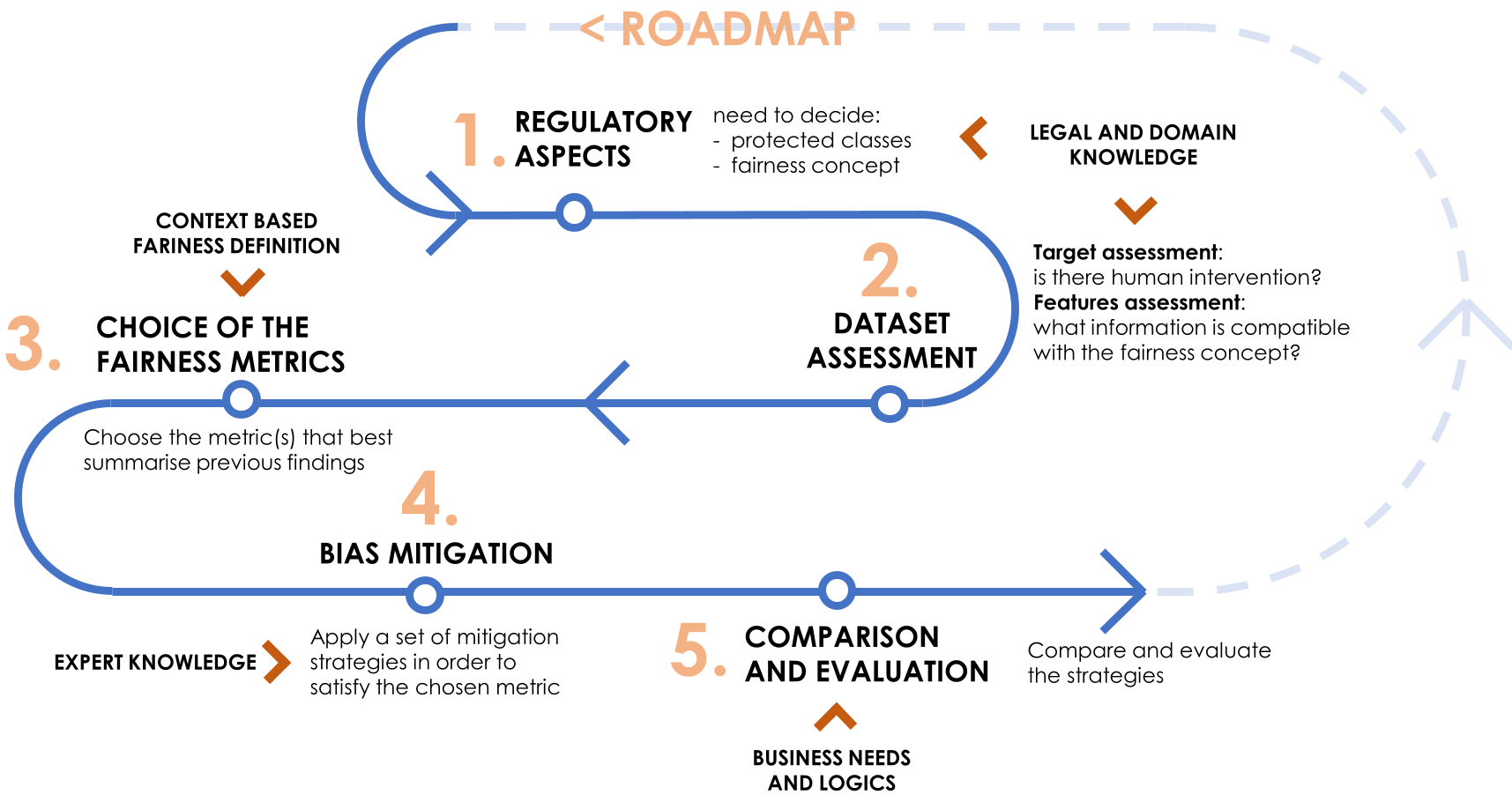
The authors break mitigation down into four technical families:
- Pre-processing: Relabeling or resampling data (e.g., "Massaging") before the model ever sees it.
- In-processing: Changing the loss function. Using Adversarial Debiasing, a "Predictor" tries to guess the loan outcome while an "Adversary" tries to guess the protected attribute from the predictor's output. The goal is to maximize the Predictor's accuracy while minimizing the Adversary's success.
- Post-processing: Adjusting the final decision thresholds for different groups after the model is trained.
- Causal Counterfactuals: This is the most advanced approach. It builds a Directed Acyclic Graph (DAG) to model how variables actually influence each other.
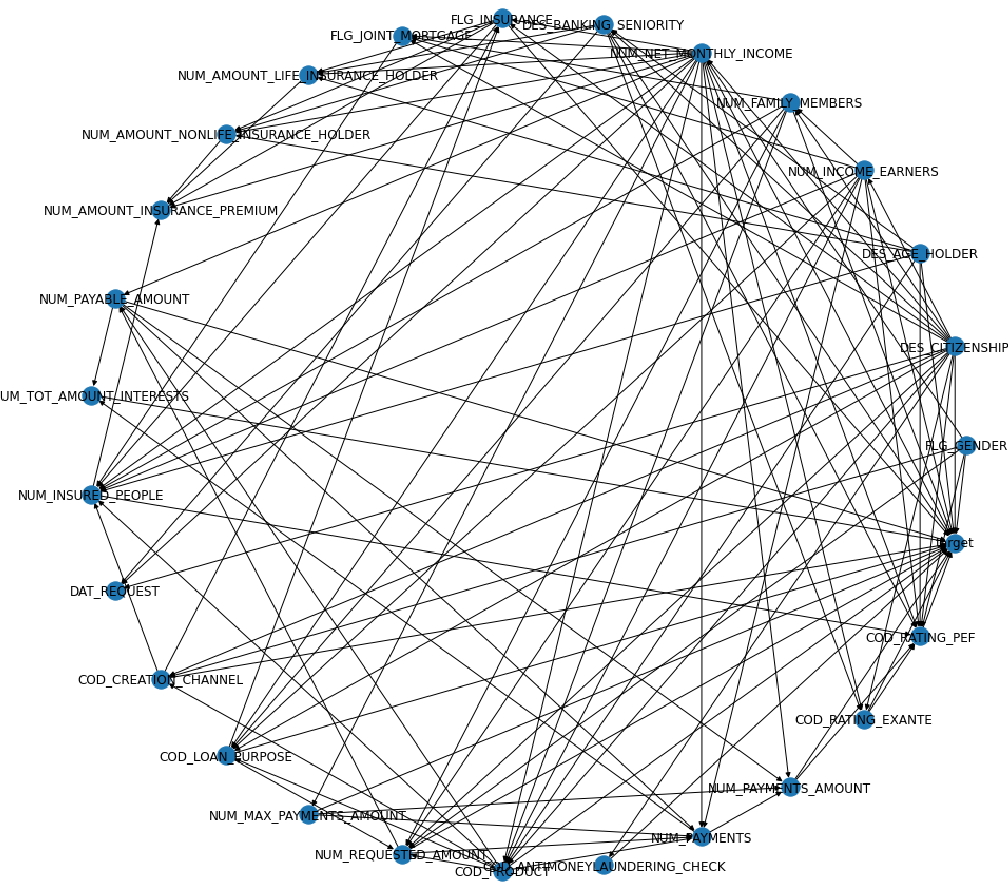 Fig 1. The causal graph used to determine how "Citizenship" indirectly affects "Income" and "Outcome".
Experimental Insights: Performance vs. Fairness
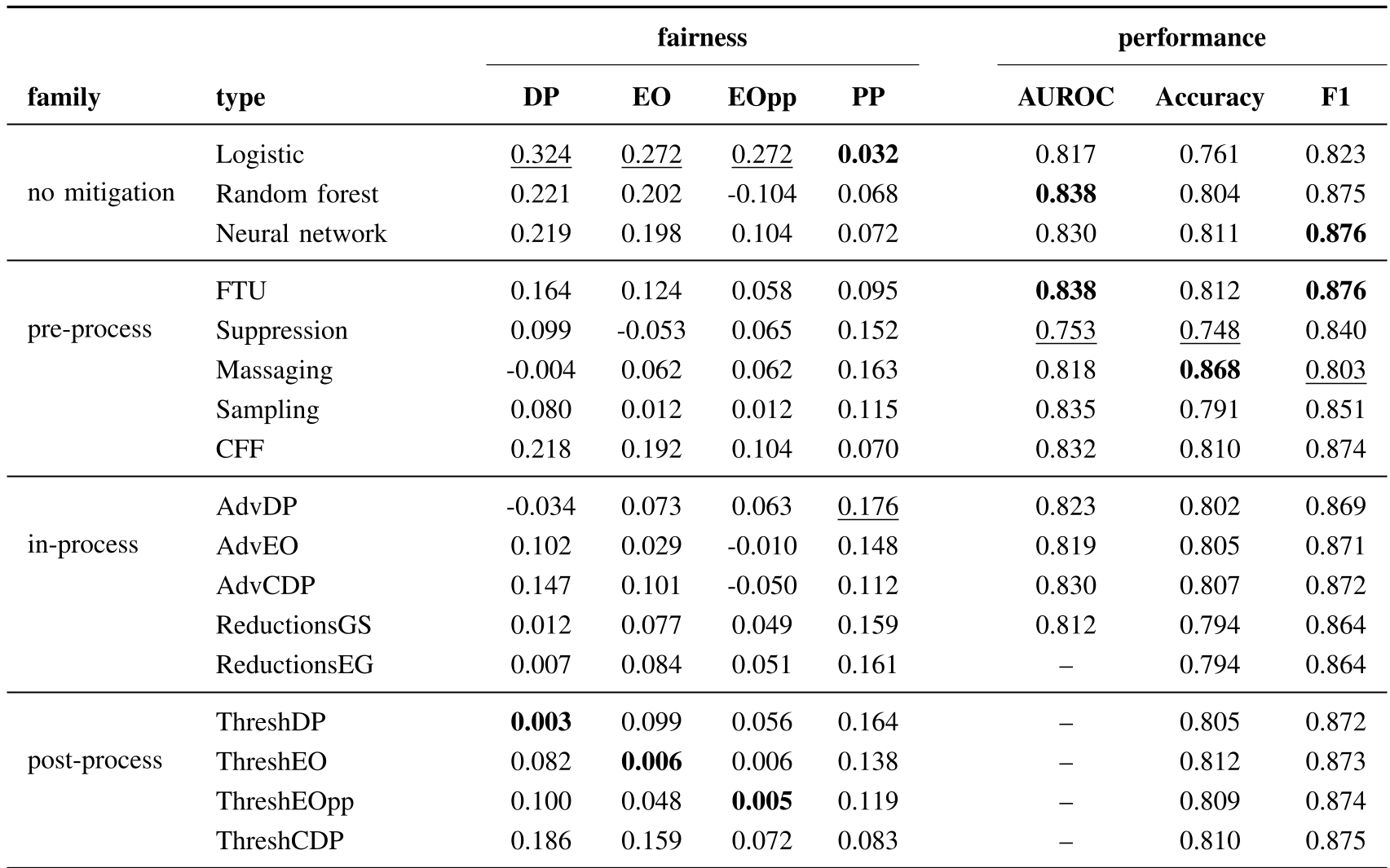
The authors tested these methods on an anonymized dataset of 105,000 loan applications. The results, summarized in the table below, provide a striking comparison of how different families of mitigation affect both the "Fairness Delta" and the "F1-Score".
Key Findings:
- Bias Amplification: Logistic Regression and Random Forests trained without mitigation showed Demographic Parity (DP) scores of 0.324 and 0.221, significantly higher than the bias present in the raw data.
- The Sweet Spot: "Massaging" (Pre-process) and "Reductions" (In-process) managed to bring DP close to zero while maintaining an F1-score above 0.80.
- The Trade-off: The authors introduced a "Constrained Performance" indicator to find the best model that stays under a specific fairness limit (e.g., the EEOC’s 80% rule).
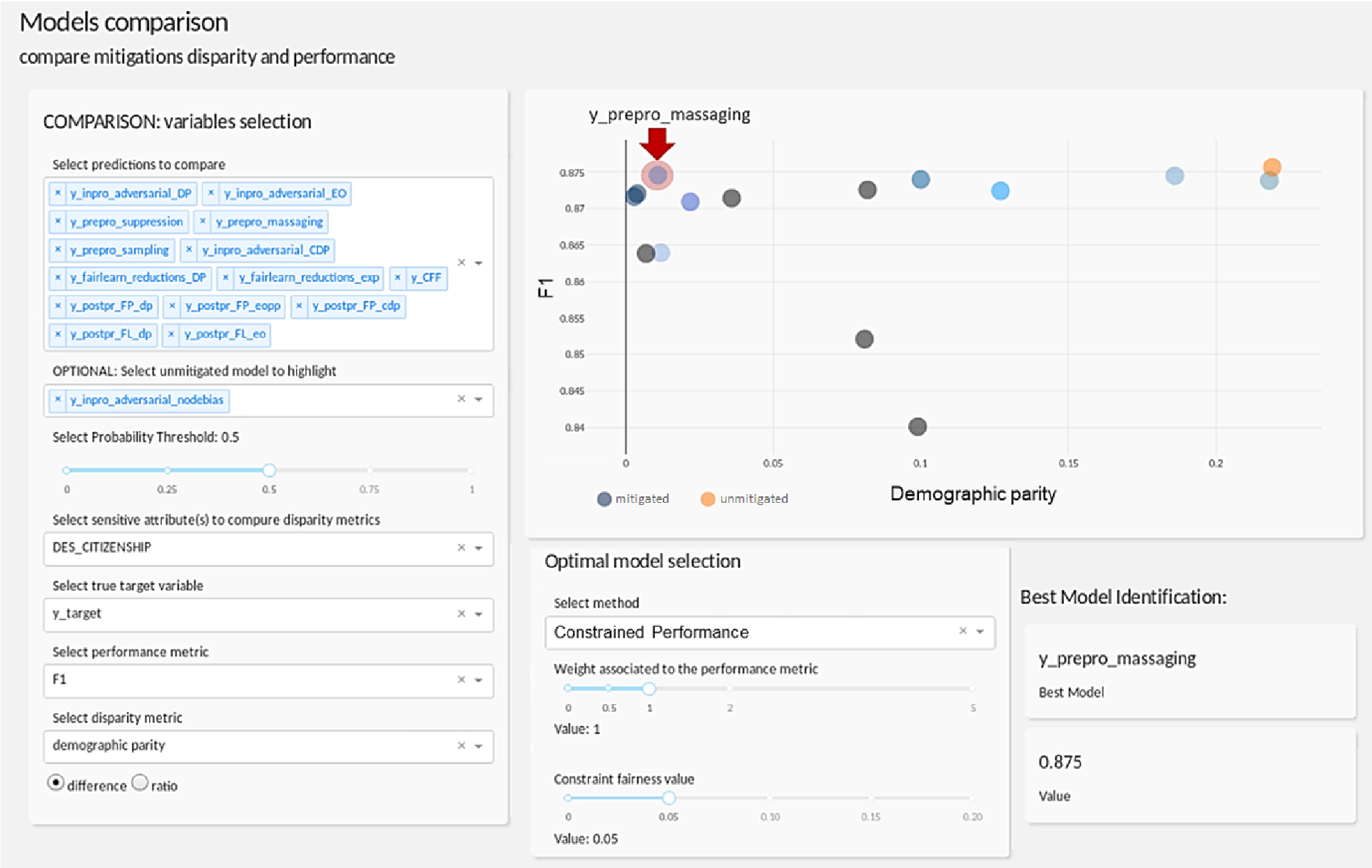 Fig 2. The BeFair UI allows data scientists to visualize the pareto-front of Fairness vs. Performance.
Critical Analysis & Takeaways
The paper's most salient point is that mathematical fairness is context-dependent. You cannot maximize every fairness metric simultaneously; for instance, "Predictive Parity" often worsens when you optimize for "Demographic Parity."
Limitations: The "Counterfactual Fairness" approach, while theoretically robust, is "unfalsifiable"—it depends entirely on the accuracy of the causal graph created by experts. If the graph is wrong, the "fairness" is an illusion.
Future Outlook: As the AI Act and other regulations loom over the financial sector, frameworks like BeFair will shift from "academic interest" to "compliance necessity." The future of Fintech lies not just in who has the most data, but in who can prove their data is being used equitably.