
[BEA 2025] Measuring the "Teacher Soul" of LLMs: Pedagogical Assessment of AI Tutors
Findings of the BEA 2025 Shared Task on Pedagogical Ability Assessment of AI-powered Tutors.pdf
The paper presents the findings of the BEA 2025 Shared Task, which focuses on evaluating the pedagogical abilities of LLM-based AI tutors in mistake remediation for mathematics. Across five tracks—including Mistake Identification, Location, Guidance, Actionability, and Tutor Identification—top-performing systems achieved macro F1 scores between 58.34 and 71.81 for pedagogy and 96.98 for identity detection.
TL;DR
The BEA 2025 Shared Task moves beyond simple dialogue-matching to evaluate whether LLMs can actually teach. By analyzing AI-generated responses in math dialogues across dimensions like "Mistake Identification" and "Actionability," the task revealed a significant gap: while AI is great at sounding like a tutor (96% identity detection), it still struggles to provide effective, non-revealing guidance (only 58% F1).
Background: Why "Good Chat" is "Bad Teaching"
In education, the goal isn't just a correct answer—it's learning. A chatbot that immediately provides the solution might have high "helpfulness" scores in a general context but fails as a tutor by violating the principle of Active Learning. Prior work lacked a standardized way to measure these "Pedagogical Abilities." This shared task introduces a rigorous framework to quantify the instructional quality of models like GPT-4, Gemini, and Llama-3.1.
Methodology: The Five Pillars of an AI Tutor
The organizers defined five tracks to assess tutor responses grounded in learning science:
- Mistake Identification: Did the tutor notice the error?
- Mistake Location: Can the tutor point to where it happened?
- Providing Guidance: Does the tutor offer a hint/explanation without giving away the answer?
- Actionability: Does the student know what to do next?
- Tutor Identification: Can we tell which model (or human) wrote the response?
System Architecture Trends
Top teams didn't just use vanilla prompting. As seen in the breakdown of winning strategies:
- LoRA Fine-tuning: Models like Mathstral-7B were fine-tuned specifically on educational tokens.
- Ensemble Scoring: Using "Disagreement-aware inference" to handle the ambiguity in "To some extent" labels.
- Reasoning-Based Models: Approaches like GRPO (Group Relative Policy Optimization) were used to force models to "think" about the pedagogy before generating a score.
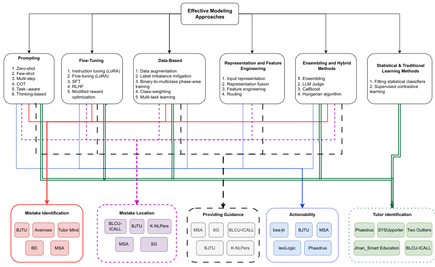 Figure 1: High-level overview of the architectures used by the winning teams (BJTU, MSA, and BLCU-ICALL).
Key Experimental Results
The competition results highlight a clear hierarchy of difficulty:
- Identification vs. Guidance: Models are relatively good at spotting that a mistake exists (71.81 F1), but they struggle significantly to provide "Providing Guidance" (58.34 F1). This suggests that the "how-to-teach" part is much harder than the "what-did-they-get-wrong" part.
- Model Predictability: GPT-4 and Phi-3 were the most "consistent" (easy to classify), whereas Llama-3.1 and Expert Human responses were high-variance, showing that humans are often more nuanced and less predictable than current LLM-alignment techniques.
Figure 2: An example of Mistake Identification. Note the 'To some extent' label where clarity issues arise—a major pain point for automated evaluators.
The "Turing Test" for Tutors
Track 5 showed that AI tutors have distinct "linguistic fingerprints." Some models are famously incoherent (Phi-3), while others are overly polite. Systems based on DeBERTa-v3 and Hungarian algorithms achieved nearly 97% accuracy in identifying which model generated a specific response.
Critical Analysis: Where AI Still Fails
The paper highlights a "Most Difficult Dialogue" where every single team failed. In this case, the student made a subtle error in a toothpaste-usage problem. Most AI tutors (and even some human experts) either ignored the error or gave confusing feedback.
The Verdict: AI tutors are currently "Polite Correctors" rather than "Insightful Mentors." They can tell you you're wrong, but they struggle to facilitate the "Aha!" moment without hand-holding.
Conclusion and Future Outlook
The BEA 2025 Shared Task demonstrates that evaluating pedagogical ability requires more than just checking for factual correctness. Future research must focus on:
- Long-form Context: Moving beyond single-turn responses to evaluate the entire tutoring trajectory.
- Cross-Domain Generalization: Testing these tutors in humanities or coding, where "mistakes" are less binary than in math.
For developers, the takeaway is clear: If you are building an AI tutor, don't just optimize for BLEU/ROUGE. Optimize for Actionability and Scaffolding, or your model will just be a glorified calculator.