
Beat the DIVa: Unmasking Sophisticated OSN Infiltration via Decentralized Correlation Learning
Beat the DIVa - decentralized identity validation for online social networks
This paper introduces "beatTheDiva," a gamified demonstration of the Decentralized Identity Validation (DIVa) system, designed to detect fake accounts in Online Social Networks (OSNs). DIVa utilizes decentralized learning to uncover Correlated Attribute Sets (CAS) within communities to validate the truthfulness of new profiles, achieving a 50% accuracy improvement over holistic profile evaluation.
TL;DR
The "beatTheDiva" project transforms academic fraud detection into a competitive game. It demonstrates a system called DIVa (Decentralized Identity Validation) that detects fake social media accounts by learning the "hidden DNA" of specific communities—mathematically referred to as Correlated Attribute Sets (CAS). By moving away from centralized, one-size-fits-all detection, it achieves a 50% boost in validation accuracy.
Background: The "Infiltration" Crisis
Gone are the days when fake accounts were easily spotted by their lack of friends or robotic posting schedules. Modern "Sybils" are sophisticated; they infiltrate honest communities to gain trust before launching attacks like astroturfing or data theft.
The core problem is Information Asymmetry. A human user looking at a friend request only sees a public profile. They can't see the complex web of correlations that define a real member of their specific social circle (e.g., the subtle link between a specific university, a graduation year, and a niche interest).
Methodology: How DIVa "Thinks"
The DIVa system operates on the intuition that identity is contextual. A "real" profile in a circle of software engineers looks different from one in a circle of local mountaineers.
The Three-Phase Architecture
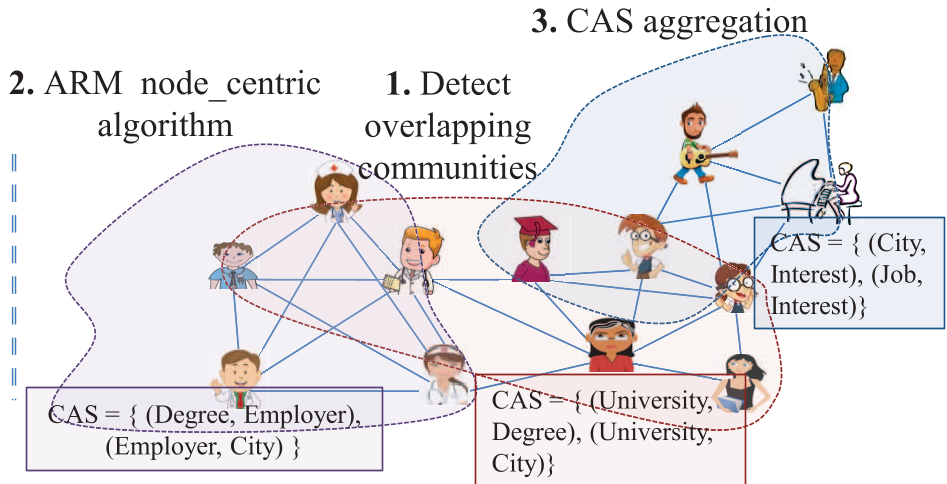
- Community Detection: The system first identifies social clusters based on graph topology.
- Local Learning: Each node (user) observes the attribute patterns of its immediate neighbors.
- Knowledge Convergence: Nodes exchange these patterns within their community to agree on a "Community Identity Pattern."
The Validation Math
When a player (the "attacker") submits a profile (), the game engine evaluates the request using three rigorous factors:
- CAS Factor: How well do the player's attributes correlate based on the community's known patterns?
- Infiltration Factor: Based on the Clustering Coefficient, how deeply has the player already penetrated this specific cluster?
- Behavioral Prior: A probabilistic factor based on Preferential Attachment—acknowledging that some users are naturally more "promiscuous" in accepting requests than others.
The Game: beatTheDiva
To prove the system's effectiveness and collect data on human adversary behavior, the authors developed a game. Players start with a blank profile and a limited score. They must:
- Target nodes in a simulated OSN.
- Use earned points to "spy" on community attributes.
- Iteratively refine their profile to match the hidden CAS of the target group.
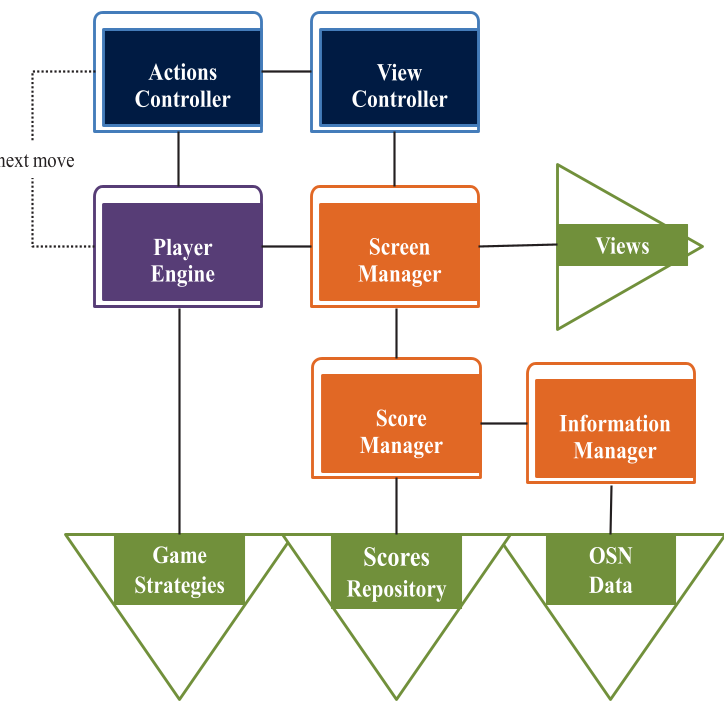
The game logic forces a trade-off: to increase your CAS Factor (and thus your chance of acceptance), you must spend points to learn about the community. If you guess poorly, the system denies the request, and you lose "energy."
Experimental Insights & Results
The implementation of DIVa shows that looking at correlated sets (e.g., [City + Interest] or [Employer + Education]) is 50% more accurate than looking at the profile as a single entity. The game demo further reveals that:
- Highly influential nodes (high clustering coefficient) are harder to "trick" because they have stricter validation requirements.
- Infiltration is a cumulative process—once a fake account gets a "foot in the door," the system's threshold shifts, mirroring the human tendency to trust someone who has mutual friends.
Critical Analysis & Conclusion
Takeaway: DIVa's strength lies in its decentralization. By not relying on a central authority to "verify" identities, it preserves privacy while capturing the nuanced social norms of digital micro-communities.
Limitations: The current model assumes that communities are topologically distinct. In highly "messy" real-world graphs with massive overlap, the CAS learning might become noisy. Additionally, an adversary with enough resources could eventually "brute force" the correlation patterns if they have enough initial "seed" accounts.
Future Outlook: This work paves the way for "Self-Sovereign Identity" (SSI) systems where your "trust score" isn't a badge from a corporation, but a mathematical proof of your fit within your chosen social circles.