
Beautiful and Damned: How Aesthetic Quality and Social Ties Shape Our Digital Lives
Beautiful and Damned. Combined Effect of Content Quality and Social Ties on User Engagement
This paper presents a large-scale study on Flickr (15B photos) using a fine-tuned Deep Learning model to quantify image aesthetics. It explores the interplay between content quality and social network dynamics, revealing that while quality is evenly distributed, social recognition is highly concentrated.
TL;DR
Is your Instagram feed making you a better photographer or driving you to quit? This large-scale study of 15 billion Flickr photos uses Deep Learning to prove that "beauty is a double-edged sword." While exposure to talented peers can improve your skills (influence), an overwhelming "beauty gap" between you and your friends actually accelerates user churn.
Context: This work bridges the gap between Computational Aesthetics and Social Network Analysis (SNA), moving beyond mere popularity metrics to understand the "Value of Content" in digital ecosystems.
The Problem: The Talent-Recognition Mismatch
In most social networks, popularity follows a power law: a tiny elite (the "Superstars") receives all the attention, while many talented creators remain in the shadows (the "Forlorn Beauty"). Traditional algorithms recommend who to follow based on popularity, which ignores the actual quality of the content.
The authors ask: Does being surrounded by "better" photographers inspire us to improve, or does it make us feel so inadequate that we stop posting?
Methodology: Measuring "Beauty" at Scale
To answer this, the researchers first had to teach a computer to see beauty.
1. Aesthetic Scoring via Deep Learning
They didn't just use handcrafted features (like the "rule of thirds"). Instead, they:
- Pre-trained a CNN on 14 million ImageNet images for object detection (semantic awareness).
- Fine-tuned it on Flickr data to classify images into Low, Medium, and High quality.
- The Logic: Different aesthetic rules apply to different subjects (e.g., a portrait vs. a landscape). By starting with object detection, the model "knows" what it's looking at before judging its beauty.
2. Causal Inference through Matching
Since they couldn't run a randomized controlled trial on all of Flickr, they used Matching Experiments. They compared "treated" users (who followed a high-quality user) with "control" users (who followed a lower-quality user) who were otherwise identical in terms of followers, activity, and history.
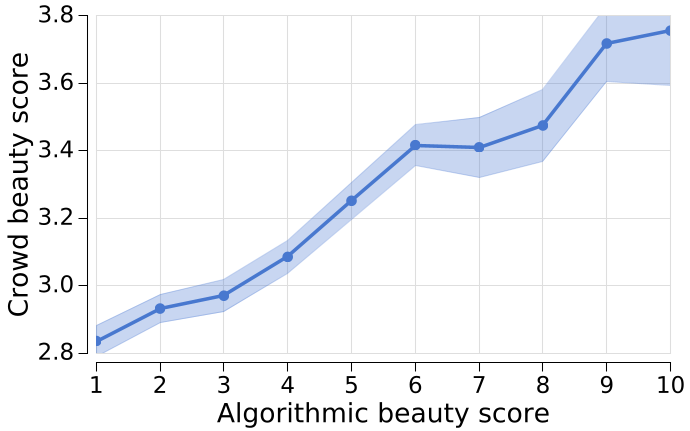 Figure: The AI's aesthetic score correlates linearly with human judgment, proving it serves as a reliable proxy for "beauty."
Core Insights: The Double-Edged Sword
The study revealed a fascinating interplay between the social graph and pixels:
- The Influence Effect (The Good): Users who followed "talented" creators saw a 2% increase in their own photo quality shortly after. Beauty is infectious.
- The Majority Illusion: Because high-quality users are often more connected, the average user perceives the world to be "prettier" than it actually is.
- The Imbalance Trap (The Bad): When the "beauty gap" (the difference between your quality and your neighbors' quality) exceeds 30%, social reciprocity fails. Users feel "forlorn" or "outclassed" and are 20% more likely to become inactive.
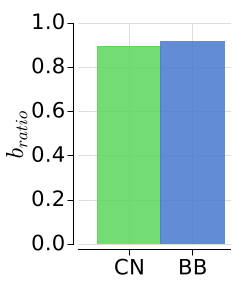 Figure: Probability of inactivity increases significantly when users are exposed to neighbors whose quality vastly outstrips their own.
A SANE Recommendation Strategy
Current link recommenders create "Flickr Superstars"—people who are already famous and talented. The authors propose a quality-oriented alternative:
- Recommend users from the "Forlorn Beauty" cluster (high talent, low followers).
- Ensure the quality gap is within ±10% of the recipient's ability.
This strategy increases social inclusion for talented creators while protecting regular users from the discouragement of the "beauty gap."
Critical Analysis & Conclusion
Takeaway
Social platforms shouldn't just optimize for "clicks" or "likes." Content quality is a fundamental driver of user behavior. By understanding the causal link between exposure and churn, we can build healthier communities that foster skill growth without inducing "imposter syndrome."
Limitations
- Explainability: The CNN doesn't tell us why an image is beautiful (is it the lighting? the composition?).
- Short-term Focus: The matching experiments measure immediate reactions; the long-term journey from a "Beginner" to a "Superstar" remains a topic for future longitudinal study.
Future Outlook: Integrating "Aesthetic Reciprocity" into AI-driven feeds could be the key to moving social media from a popularity contest to a platform for genuine creative growth.