
BEEINFO: Swarm Intelligence Meets Socially Aware Vehicular Networks
BEEINFO: Interest-Based Forwarding Using Artificial Bee Colony for Socially Aware Networking
This paper introduces BEEINFO, a suite of interest-based forwarding schemes (BEEINFO-D, BEEINFO-S, BEEINFO-D&S) for Socially Aware Networking (SAN). It leverages the Artificial Bee Colony (ABC) meta-heuristic to optimize data routing in dynamic vehicular social networks (VSNs) by mimicking food foraging behaviors.
TL;DR
BEEINFO is a biologically inspired routing framework that treats data packets like nectar and mobile nodes like bees. By leveraging the Artificial Bee Colony (ABC) algorithm, it allows vehicles and pedestrians to "sense" the environment—specifically interest-based communities—to achieve high delivery ratios with minimal network overhead. Unlike simple flooding, BEEINFO uses social ties and community density as navigational beacons.
Background: The Gap in Socially Aware Networking
In the realm of Socially Aware Networking (SAN), the "social" aspect is the anchor. While physical connections (Electronic Social Networks) are ephemeral due to high mobility in cities, our interests and social circles (Virtual Social Networks) remain stable.
The core challenge is adaptability. Most current protocols like Epidemic or PRoPHET either waste bandwidth by flooding or rely too heavily on past history that may no longer be relevant. BEEINFO addresses this by asking: Can we model a node's movement as a foraging behavior to find the most "rewarding" community for a packet?
Methodology: The Bee Foraging Metaphor
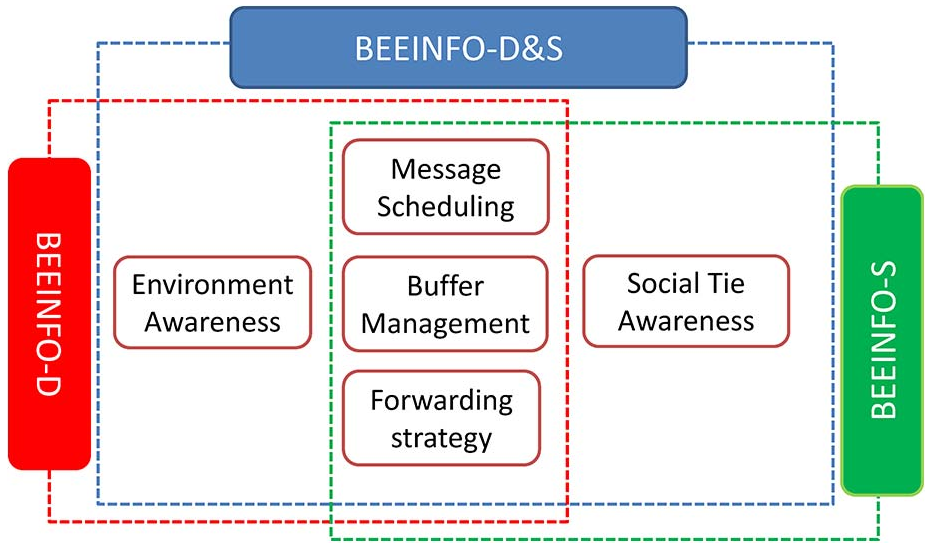
The researchers break down the forwarding process into two distinct phases, much like a bee's life cycle:
1. Environment Awareness (Scouting)
Nodes gather Community Density information. If a node frequently encounters people interested in "Politics," its density value for that community increases.
- Inter-community Forwarding: Nodes carry messages between different interest groups based on these density gradients.
2. Social Tie Awareness (Intracommunity)
Once a packet enters the correct "hive" (community), the protocol shifts to Social Tie metrics (contact frequency and duration) to find the specific destination node.
The Mathematical Intuition
The protocol uses a Prediction-Evaporation model.
- Prediction: Uses a factor to balance historical data with real-time encounters.
- Evaporation: Just like pheromones or scents fade, old density/social tie data is multiplied by an evaporation factor . This ensures the "bees" don't follow outdated trails.
Experimental Battleground: SOTA Comparison
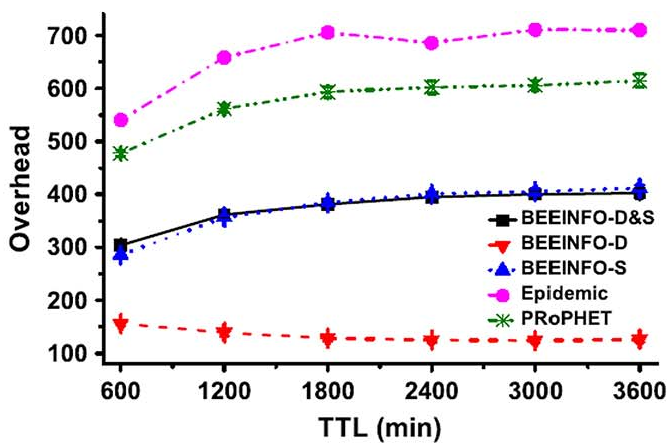
The authors tested three variants: BEEINFO-D (Density-focused), BEEINFO-S (Social-tie focused), and BEEINFO-D&S (Hybrid).
Key Performance Metrics:
- Delivery Ratio: BEEINFO-D achieved ~75% success, crushing PRoPHET and Epidemic.
- Overhead: By being "smart" about who to give the packet to, BEEINFO significantly reduced the number of redundant copies in the air.
- Latency Trade-off: Interestingly, BEEINFO has higher latency. This is the cost of "waiting for the right bee." In delay-tolerant applications (like news updates or non-urgent data sharing), this is a feature, not a bug—it saves battery and buffer space.
Critical Insight: Why Does It Work?
BEEINFO succeeds because it simplifies the "community" problem. Instead of complex graph-theoretic community detection that burns CPU cycles, it uses interest tags. By mapping interests to physical locations (e.g., people at a stadium are likely interested in sports), the "Interest-Location-Identity" triad becomes a powerful heuristic for routing.
Limitations & Future Work
While robust, BEEINFO assumes nodes are fully cooperative—a "honest bee" assumption that doesn't always hold in the real world where privacy and selfishness exist. The authors acknowledge that supporting multi-interest profiles (e.g., a node interested in both Sports and Tech) and addressing security/privacy are the next frontiers.
Conclusion
BEEINFO proves that social properties are not just metadata—they are the control plane for the next generation of intermittent networks. By mimicking the decentralized efficiency of a bee colony, we can build vehicular networks that are as resilient as nature itself.