
BEEINFO: Harnessing Swarm Intelligence for Adaptive Socially-Aware Networking
BEEINFO: data forwarding based on interest and swarm intelligence for socially-aware networking
BEEINFO is an interest-based data forwarding scheme for Socially-Aware Networking (SAN) that integrates Artificial Bee Colony (ABC) swarm intelligence. It utilizes environmental and social tie awareness to optimize message relaying in mobile social networks, achieving superior delivery ratios and significantly lower overhead compared to PROPHET and Epidemic protocols.
TL;DR
BEEINFO is a novel data forwarding scheme that brings the "intelligence of the hive" to mobile social networks. By mimicking the foraging behavior of bees, it enables mobile nodes to sense their environment and social ties dynamically. The result is a highly efficient routing protocol that slashes network overhead and improves delivery success rates by prioritizing communal interests.
Problem & Motivation: The Static Nature of Dynamic Networks
In the realm of Socially-Aware Networking (SAN), utilizing human social structures (like communities and interests) is key to solving the "intermittently connected" problem of mobile devices. However, most existing protocols treat these social properties as static or struggle to update them without massive computational overhead.
The authors identify a critical gap: Adaptability. Mobile environments are fluid—nodes move, densities shift, and social ties evolve. Previous SOTA methods like Epidemic (which floods the network) or PROPHET (probabilistic routing) often suffer from extreme message redundancy (overhead) or fail to adjust when the network topology changes rapidly.
Methodology: The "Bee" Logic of Forwarding
The core innovation of BEEINFO lies in its Inspiration from Artificial Bee Colony (ABC). In nature, bees balance random exploration (scouting) with exploited local knowledge (following). BEEINFO translates this into two primary awareness modules:
- Environment Awareness (Density): Measures the frequency of encountering nodes with different interests. This is used for Inter-community forwarding (finding the right "neighborhood").
- Social Tie Awareness: Measures the strength of relationships between nodes with the same interest. This is used for Intra-community forwarding (finding the specific "individual").
The Math of Memory
BEEINFO doesn't just record contacts; it "learns" and "forgets." It uses an exponentially weighted moving average to predict future encounters and an evaporation factor () to ensure that old, stale contact data doesn't skew current routing decisions.
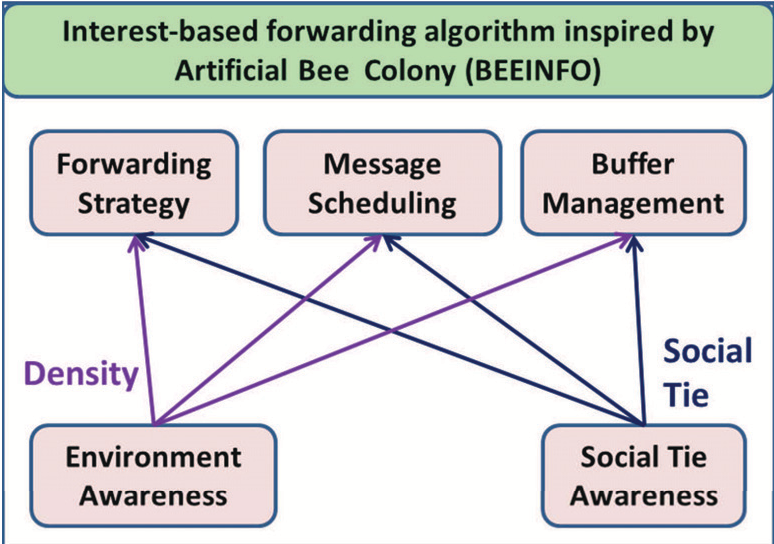
Forwarding Strategy
The protocol follows a hierarchical logic:
- Priority 1: Intra-community (Move the message to someone with a stronger social tie to the destination).
- Priority 2: Inter-community (Move the message to a high-density area where the target community is likely to be found).
Experiments & Results: Efficiency Over Velocity
The authors tested BEEINFO against PROPHET and Epidemic using the ONE (Opportunistic Network Environment) simulator.
Key Findings:
- Superior Delivery & Hops: BEEINFO consistently achieved the highest delivery ratio while keeping the hop count below 3. This indicates a very "direct" path to the destination.
- Radical Overhead Reduction: While Epidemic routing often "chokes" a network with copies, BEEINFO’s overhead remained stable and significantly lower (under 160).
- The Latency Trade-off: BEEINFO has higher average latency. Since it is highly selective—waiting for a "proper" forwarder rather than spraying messages—it takes longer to deliver, but does so with far fewer resources.
(Note: Experimental charts would typically show BEEINFO's horizontal stability across different buffer sizes compared to the fluctuating overhead of PROPHET.)
Critical Analysis & Conclusion
Takeaway: BEEINFO proves that "interest" is a powerful proxy for community. By avoiding complex community detection algorithms and using swarm-based heuristics, it creates a lightweight protocol ideal for resource-constrained mobile devices.
Limitations: The high latency is a significant hurdle for time-sensitive data. Furthermore, the current model assumes each node has a "one and only interest," which oversimplifies human behavior where multi-faceted interests are the norm.
Future Outlook: The next step for this research is testing against real-world mobility datasets (like Haggle or Infocom traces) and exploring how multiple interests per node might refine the "Density" calculation for even more precise routing.