
BCOSMN: Bridging Swarm Intelligence and Semantics for Robust Community Detection
Bees Colonies for Meaningfull Communities Detection in Social Medias Network
2016-07-01
Summary
Problem
Method
Results
Takeaways
Abstract
This paper introduces BCOSMN, a community detection framework for social media that combines topological structure with semantic content. It utilizes a Bee Colony Optimization (BCO) meta-heuristic to optimize a novel objective function that integrates Jaccard similarity and community density.
## TL;DR
State-of-the-art community detection often ignores the "why" behind user interactions. This paper presents **BCOSMN**, an algorithm that uses **Bee Colony Optimization** to find social clusters by balancing network topology with the semantic topics users discuss. By optimizing a dual-similarity objective function, it achieves superior community accuracy (NMI up to 0.905) compared to traditional structural-only methods.
## Problem & Motivation: Beyond the Graph
Most traditional algorithms treat social networks as "naked" graphs—nodes and edges without context. However, in platforms like Twitter, relationships are driven by shared interests.
The authors identify two major gaps:
1. **Topology Only**: Methods like Hierarchical Clustering or Betweenness Centrality miss the "meaning" of the connection.
2. **Topic Only**: Pure NLP approaches (like standard LDA) cluster users who talk about the same things but may not actually interact, lacking structural validity.
The core **Insight** of this work is that a "meaningful" community must exhibit both high **network density** and high **thematic overlap**.
## Methodology: The Bee's Perspective
The proposed BCOSMN (Bee Colony Optimization for Social Medias Network) operates in two distinct phases:
### 1. Representation & Weighting
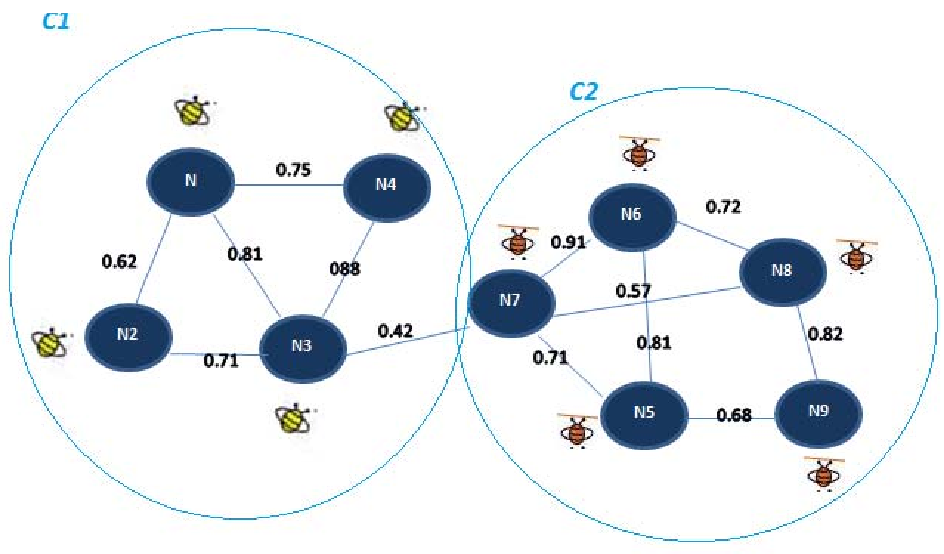
The network is modeled as a graph $G = (V, E, T)$.
- **Nodes ($V$)**: Users.
- **Edges ($E$)**: Interactions.
- **Topics ($T$)**: Extracted using **LDA (Latent Dirichlet Allocation)** from user tweets.
The strength of a relationship between two users $V_i$ and $V_j$ is calculated using a hybrid Jaccard Similarity ($JS$):
$$JS(V_i, V_j) = \frac{J(N_i, N_j) + J(T_i, T_j)}{2}$$
Where $J(N)$ is the similarity of neighbors (Structure) and $J(T)$ is the similarity of interests (Semantics).
### 2. Swarm Optimization
Instead of a global calculation, the authors use an artificial Bee Colony:
- **Scout Bees**: Positioned at influential nodes (high connectivity).
- **Food Sources**: Potential community members.
- **Pheromones**: Used to communicate structural changes to the "Queen" (the global state).
- **Fitness Function**: The bees aim to maximize the $DSim(C)$ function, which measures the average similarity within the community.
*NMI performance across different network sizes.*
## Experiments & Results
The researchers tested the model on both synthetic and real-world datasets:
- **LFR Benchmarks**: On artificial graphs, the model regained the ground truth structure with high precision. As network size increased from 5,000 to 10,000 nodes, the **NMI improved from 0.841 to 0.905**, suggesting the algorithm scales well and becomes more accurate in denser environments.
- **Twitter Dataset**: Using a week of data from 500 relevant users (over 2500 tweets each), BCOSMN was compared against **AutoSCAN**.
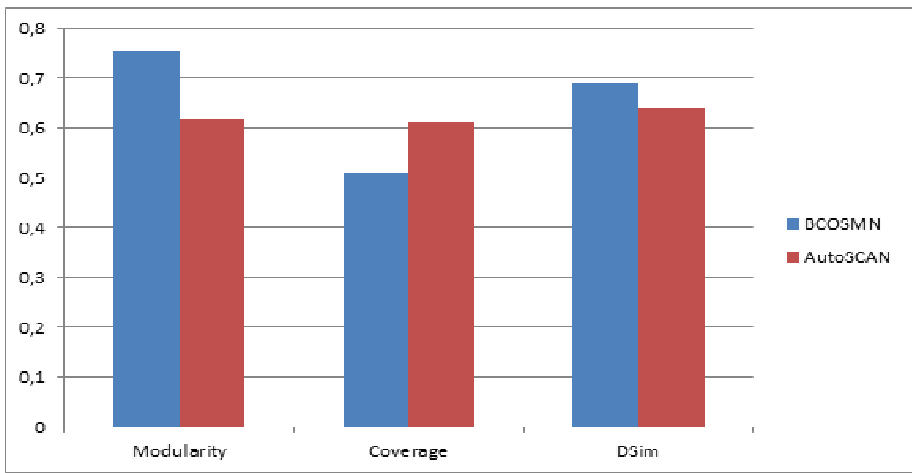
*Quality metrics comparing BCOSMN and AutoSCAN on real Twitter data.*
**Key Finding**: BCOSMN consistently produced communities with higher **Modularity** and **Coverage** than the baseline, proving that topic integration doesn't just add "flavor"—it fundamentally improves the structural quality of the partitions.
## Critical Analysis & Conclusion
### Takeaway
BCOSMN bridges the gap between Swarm Intelligence and Social Analytics. By defining "meaningful" as a mathematical trade-off between topology and semantics, it avoids the pitfalls of noise in micro-blogging content.
### Limitations
1. **Computational Cost**: While meta-heuristics are robust, the initial LDA topic extraction and Jaccard calculations for every edge can be expensive for massive graphs (millions of users).
2. **Static Nature**: The current model treats the network as a snapshot, whereas social interests evolve over time.
### Future Outlook
The authors hint at tracking **evolutionary communities**—watching how topics and structures shift over months. For practitioners, this method offers a blueprint for building more accurate recommendation engines and identifying influential "interest-based" hubs rather than just "popular" nodes.