
Behavior Forensics: Using Side Information to Weaponize the Detector in Social Networks
19088_Behavior forensics with side information for multimedia fingerprinting social networks.
This paper proposes a behavior forensics framework utilizing side information and game theory to enhance collusion resistance in multimedia fingerprinting social networks. It introduces a self-probing detector that extracts collusion parameters from the colluded copy to achieve performance levels nearly identical to an optimal correlation-based detector.
TL;DR
In the high-stakes game of digital forensics, this paper introduces a "Self-Probing" detector that turns the colluders' own strategies against them. By extracting side information (statistical means of detection data) from a leaked video, the detector can dynamically choose the best mathematical lens to identify traitors. This game-theoretic approach pushes detection performance to near-optimal levels, leaving colluders with no incentive to deviate from a specific, predictable risk profile.
The "Fairness" Problem: Why Collusion Works
In a multimedia social network (like YouTube or Napster), colluders work together to mask their unique IDs (fingerprints) by averaging multiple copies of the same content. Previous SOTA methods assumed the detector was "blind" to the collusion strategy. This allowed attackers to reach a state of collective fairness, where the risk of being caught was distributed so thinly that the system became toothless.
The fundamental challenge in scalable video (where users receive different qualities) is that the fingerprint energy is unevenly distributed across layers (Base Layer vs. Enhancement Layers). If a detector treats all layers as equal, it misses the concentrated evidence hidden in specific frames.
Methodology: The Self-Probing Loop & Game Theory
The authors break the "blindness" of the detector by treating the forensic process as a Two-Stage Stackelberg Game.
1. Probing Side Information
Instead of relying on a fixed formula, the detector analyzes the colluded copy to estimate the "mean value" of detection statistics. By applying four different detectors (Collective, Base-only, E1-only, and E2-only), it identifies which layer contains the "loudest" signal of collusion.
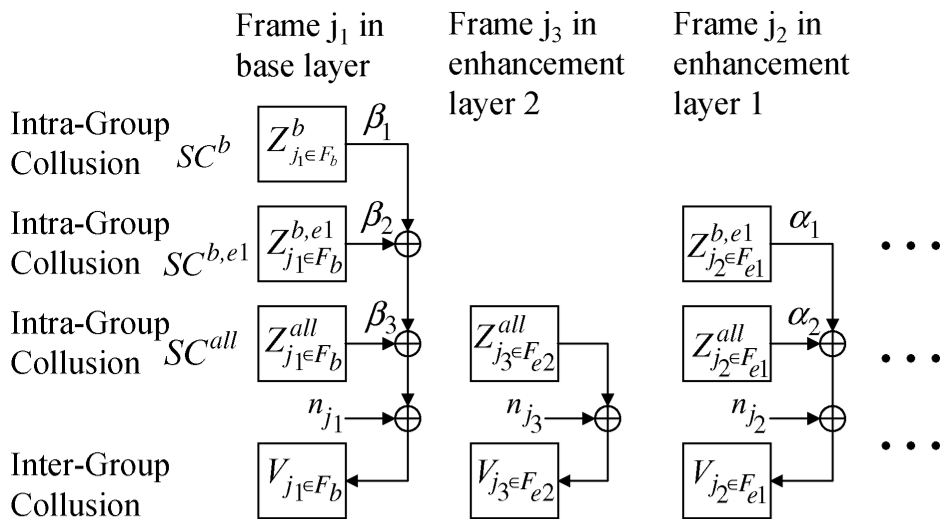 Fig 1: The two-stage collusion model where different user groups (Sc1, Sc2, Sc3) combine layers.
2. The Min-Max Equilibrium
Using Backward Induction, the authors prove that:
- The detector will always choose the strategy that maximizes detection probability.
- The colluders, knowing this, must choose collusion parameters () that minimize their maximum risk.
This results in a Nash Equilibrium. At this point, the system reaches a "Min-Max" state where no player can improve their outcome by changing their strategy alone.
Experimental Results: Closing the Gap
The research tested the framework on standard sequences like "carphone" and "tennis." The results are striking:
- Performance Gain: The self-probing detector increased the probability of capture by 12% to 17%.
- Optimality: The performance gap between this "blind" self-probing method and a theoretical "all-knowing" detector was less than 0.005, effectively closing the gap to the theoretical limit.
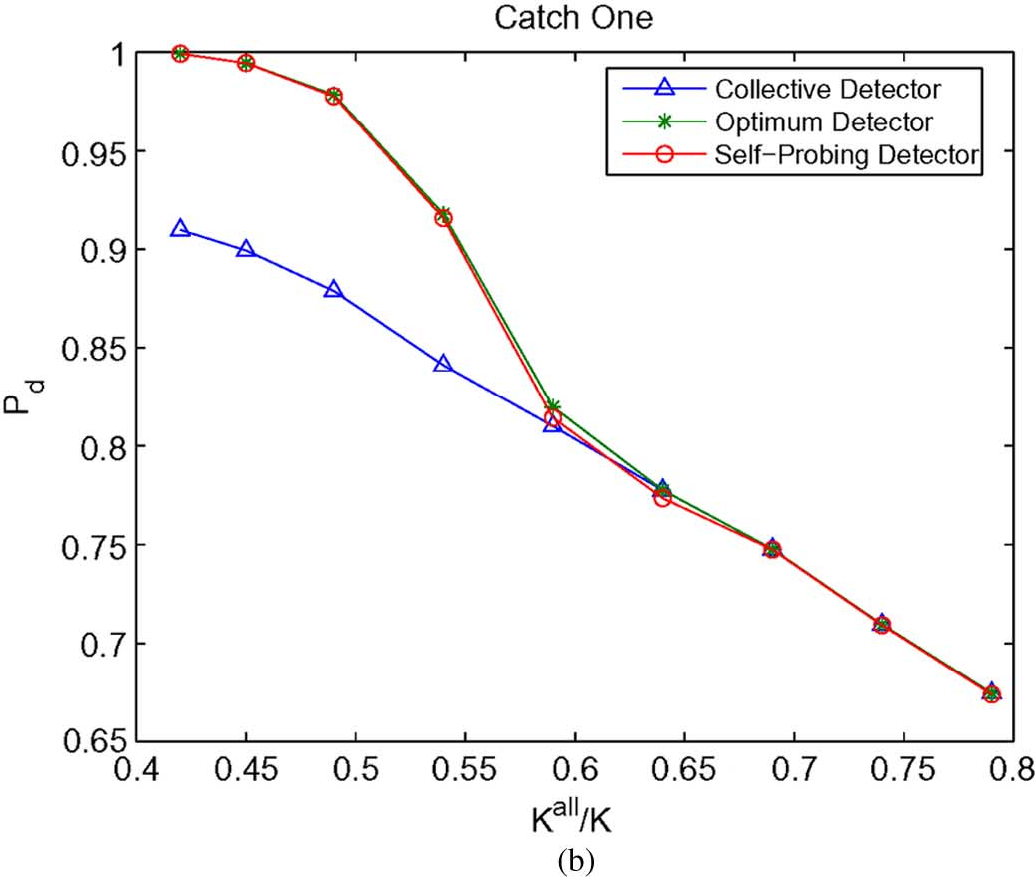 Fig 2: Comparison showing the self-probing detector (triangle) tracking the optimal detector (diamond) perfectly.
Critical Insight: The End of Secret Collusion
The most profound takeaway is that any fingerprint code can be improved by leveraging side information. This work demonstrates that the detector does not need a "side channel" to get extra info; the "side information" is already latent within the attack itself.
Limitations & Future Work
While the Gaussian noise model is mathematically robust, real-world social networks often involve non-linear compression or adversarial post-processing that might skew statistical means. Future research could explore Deep Reinforcement Learning to navigate the game-theoretic tree when the noise distribution is unknown.
Conclusion
By integrating behavior forensics with game theory, Lin et al. have shifted the advantage back to the content owners. In the era of massive multimedia sharing, this "self-probing" logic ensures that as collusion techniques get smarter, the forensic detectors can automatically recalibrate to remain lethal.