
Beyond Watermarking: Decoding Human Behavior in Multimedia Forensics
Behavior modeling and forensics for multimedia social networks
This paper presents a comprehensive framework for Behavior Modeling and Forensics in multimedia social networks, specifically focusing on traitor-tracing in fingerprinted scalable video. It utilizes Game Theory and signal processing to manage user dynamics, achieving robust identification of colluders even in heterogeneous network environments.
TL;DR
In the digital age, multimedia social networks are the primary battlegrounds for copyright protection. This paper shifts the focus from simple signal-level watermarking to Behavior Forensics. By modeling colluders as strategic agents using Game Theory, the researchers provide a framework for "traitor-tracing" that can detect not only the initial pirates but also "selfish colluders" who cheat their own accomplices.
Background Positioning
While traditional signal processing treats attacks as random noise or deterministic transforms, this work treats forensics as a Social Game. It is a foundational piece in the interdisciplinary area of human and social dynamics, bridging the gap between sociology, economics, and information security.
The Core Conflict: Fairness vs. Piracy
When a group of users colludes to remove a digital fingerprint, they form a "shadow social network." They must agree on two things:
- The Reward: The profit or access gained from the illegal copy.
- The Risk: The probability of being caught by the rights enforcer.
The problem arises in Scalable Video Coding (SVC). If Alice has a low-res copy and Carl has a high-res copy, how do they merge them? If they just average them, Carl (who contributed more data layers) faces a significantly higher risk of being detected. This creates a "Fairness Crisis" among thieves.
Methodology: The Strategic Framework
1. Modeling Fair Collusion
The authors propose a two-stage collusion model to achieve "Equal-Risk Absolute Fairness."
- Intra-group: Colluders with the same resolution average their copies.
- Inter-group: Different resolution groups are weighted such that the final detection probability is mathematically identical for all participants.
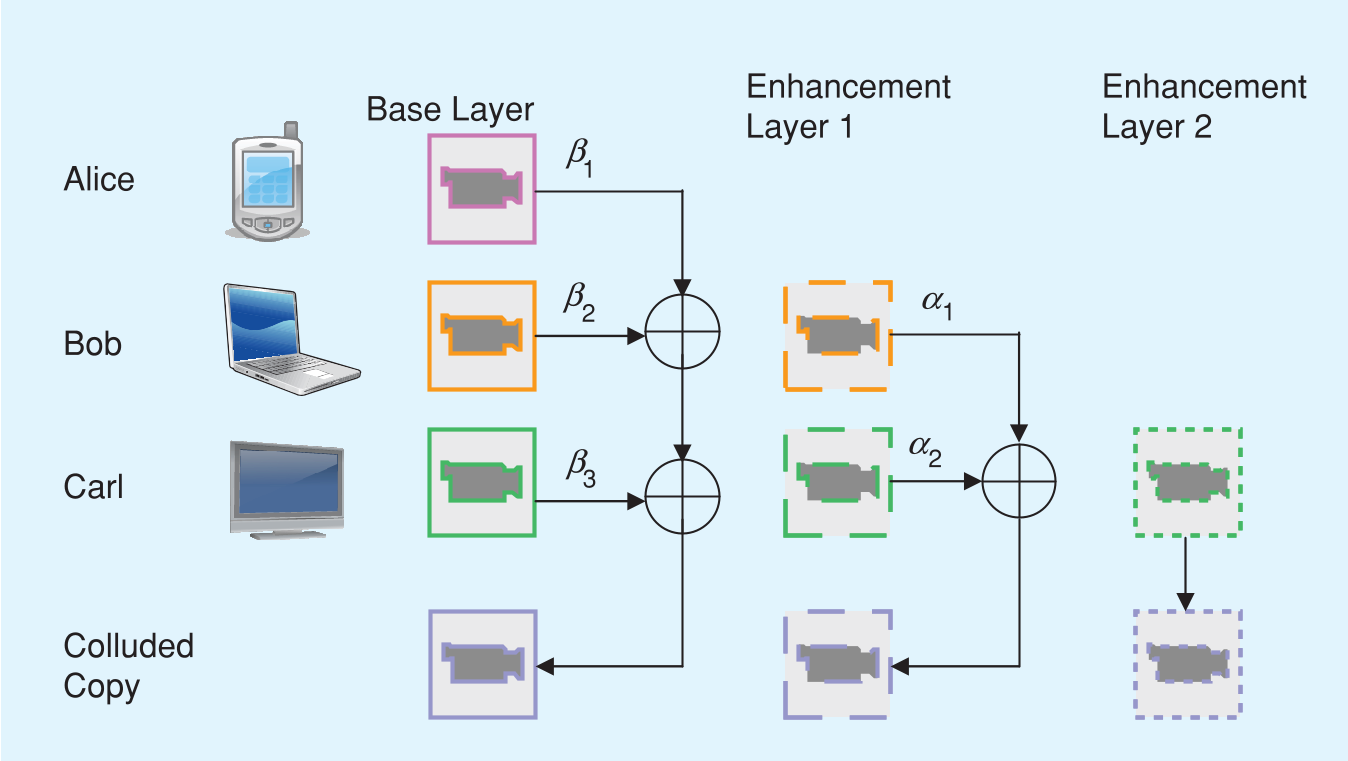 Figure 1: The architecture of intra-group and inter-group collusion attacks used to balance risk.
2. Traitor-Within-Traitor (The Selfish Agent)
The most intriguing part of the paper is the "selfish colluder." A user might lie to their group, saying they have a low-res copy when they actually have high-res, or they might temporally filter their frames before contributing to the group. This reduces their individual risk while potentially increasing the risk for their "partners in crime."
3. The Self-Probing Detector
To counter these strategies, the enforcer uses a Self-Probing Detector. Instead of using a fixed detection algorithm, the detector "probes" the colluded copy to estimate the attackers' parameters and then adaptively selects the detection statistic with the highest statistical mean.
Experimental Insights & Results
The paper demonstrates that when the detector utilizes side information, it reaches a Stackelberg Equilibrium. The detector (the follower) observes the colluded copy and optimizes its strategy, forcing the colluders (the leader) to face higher risks regardless of their weighted averaging.
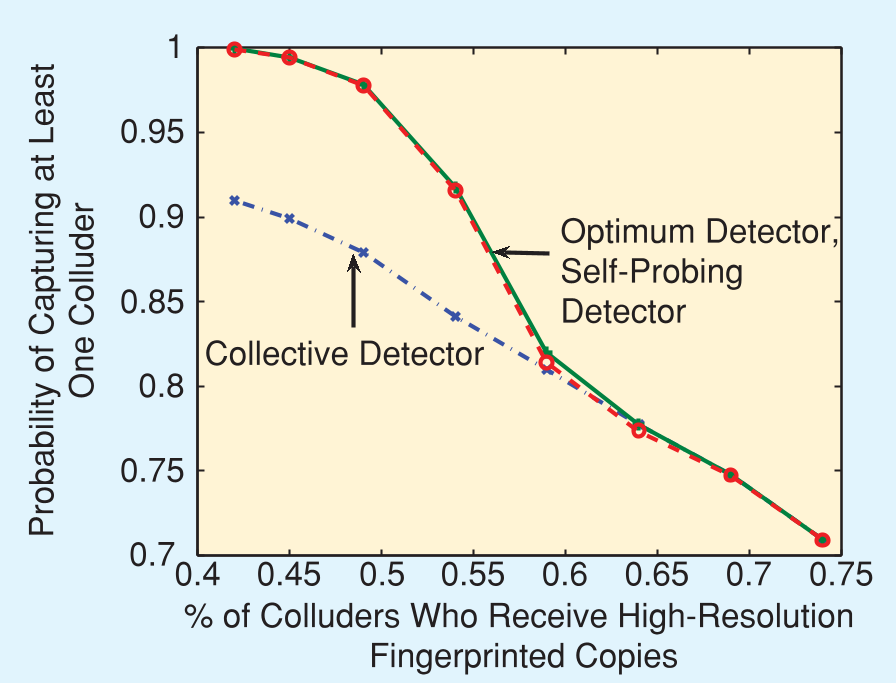 Figure 2: Performance comparison showing that Self-Probing Detectors (black circles) achieve near-optimal (dashed line) collusion resistance compared to the static collective detector.
Key finding: In distributed networks without a central authority, the "Autonomous Identification" scheme can identify selfish users by having sub-groups cross-check the Mean Square Error (MSE) of each other’s copies in an encrypted domain, protecting honest participants from "framing."
Critical Analysis & Conclusion
Takeaway
The genius of this work lies in recognizing that Pirates are Rational Actors. By applying the Nash Bargaining solution and Stackelberg games, forensics moves from a cat-and-mouse chase to a predictable mathematical optimization problem.
Limitations
- Computational Complexity: The autonomous identification requires multiple rounds of encryption and cross-checking, which might be heavy for real-time social networks.
- Sophisticated Malice: The model assumes a degree of rationality; completely irrational malicious actors intended only on "pollution attacks" might break the bargaining assumptions.
Future Outlook
As we move toward decentralized platforms (Web3), the mechanisms described here—autonomous identification and game-theoretic fairness—will be essential for maintaining trust and protecting intellectual property in unregulated environments.