
Beyond Signals: Modeling the Human Game in Multimedia Forensics
Behavior modeling and forensics for multimedia social networks
This paper establishes a comprehensive framework for "Behavior Forensics" in multimedia social networks, focusing on traitor-tracing via digital fingerprinting. It introduces game-theoretic models to analyze the dynamics between colluders and rights enforcers, specifically addressing fairness, cheating strategies, and the leverage of side information in scalable video coding (SVC) environments.
TL;DR
Modern multimedia forensics is no longer just a signal processing problem; it is a strategic game. This paper shifts the focus from "what" was done to a signal to "why" users behave the way they do. By applying Game Theory and Behavior Modeling, the authors provide a framework to trace "traitors" in social networks, even when those traitors try to cheat their own co-conspirators.
The Shift: From Pixels to People
In the last decade, Internet traffic transitioned from static text to massive multimedia sharing. This shift brought a nightmare for copyright holders: Multiuser Collusion. A group of attackers (colluders) can combine their uniquely fingerprinted copies of a movie to "average out" the identifiers, making it impossible to trace the source.
The authors argue that previous signal processing methods failed because they treated attackers as static noise. In reality, colluders form a social network with their own dynamics, risks, and rewards.
The Scalability Challenge: Fairness in a Heterogeneous World
In a world of diverse devices, not everyone gets the same video quality. Some receive a High-Definition (HD) copy, others a Low-Definition (LD) base layer. This creates a "Fairness Gap" during collusion:
- If an HD user and an LD user collude, who takes more risk?
- How do you distribute the risk so every attacker feels "safe" enough to participate?
Two-Stage Collusion Framework
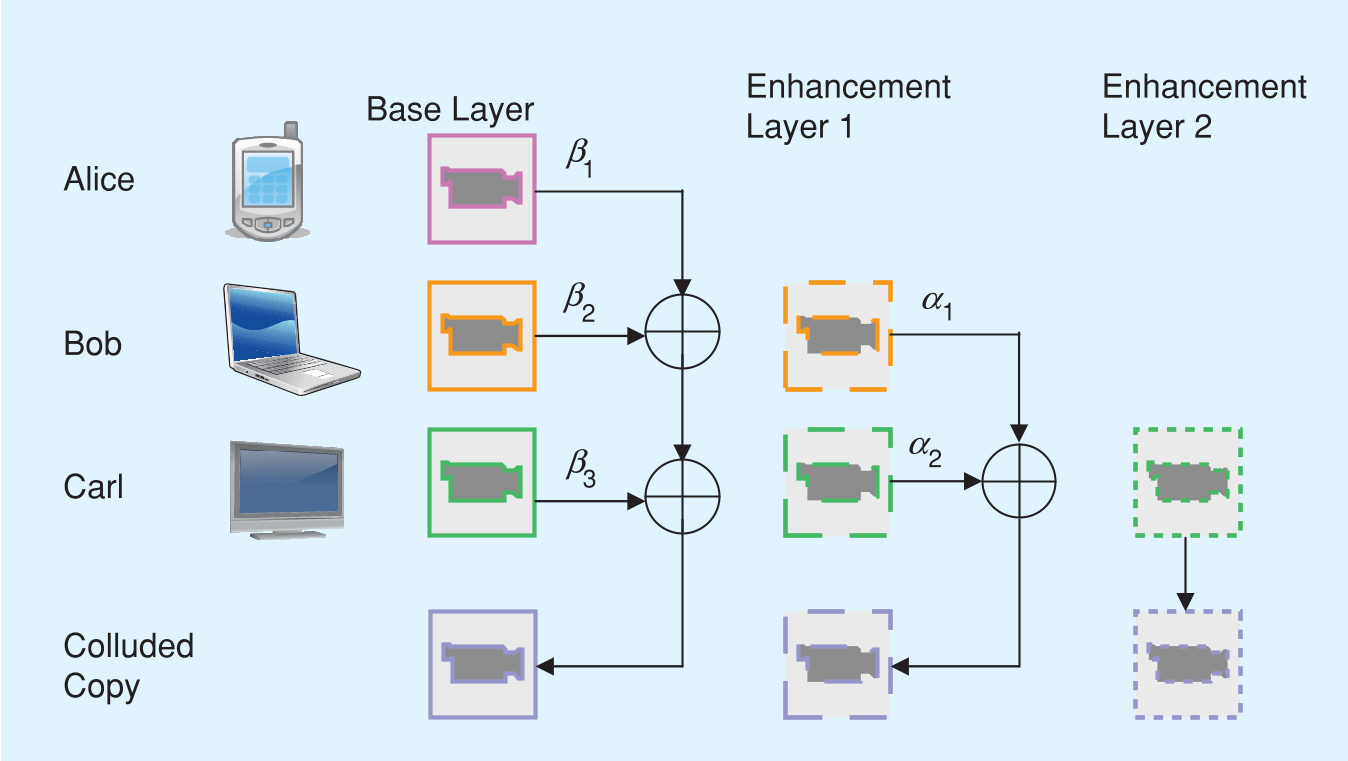
To solve this, the paper proposes a two-stage model:
- Intra-group Collusion: Users with the same resolution average their copies.
- Inter-group Collusion: Different groups average their results using specific weights () to ensure Equal-Risk Absolute Fairness.
Traitors Within Traitors: The Dishonest Colluder
Human nature is selfish. Even within a band of pirates, someone will try to cheat. The paper identifies a "Traitor-within-Traitor" scenario where a selfish colluder:
- Temporal Filtering: Smooths their copy before collusion to further reduce their fingerprint energy.
- Resolution Lying: Forges higher resolution frames via interpolation to trick fellow colluders into taking more risk.
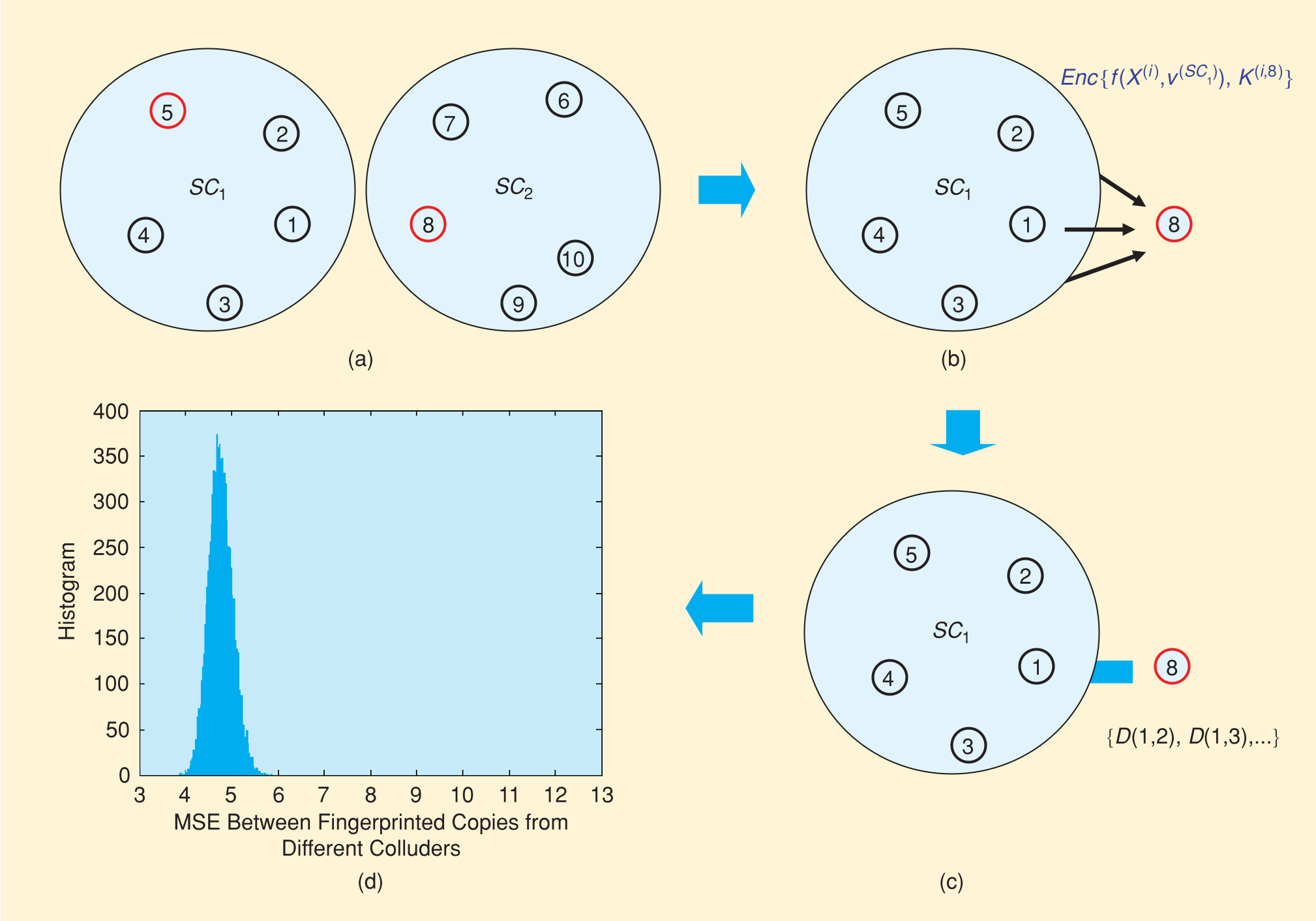
The authors counter this with Autonomous Selfish Colluder Identification. By analyzing the Mean Square Error (MSE) between pairs of copies in a distributed network using encrypted protocols, honest colluders can identify and boot out the selfish ones without ever seeing the raw content of each other's files.
The Game-Theoretic Equilibrium
The battle between the Rights Enforcer (Detector) and the Colluders is modeled as a Stackelberg Game.
- Colluders (Leader): Move first to minimize the maximum probability of detection.
- Detector (Follower): Probes the colluded copy for "Side Information" to adaptively choose the best detection statistic (Base layer vs. Enhancement layers).
Experimental Insight
The "Self-Probing Detector" introduced in the paper is a game-changer. It doesn't just look for a fingerprint; it first "interrogates" the copy to estimate how the collusion was performed.
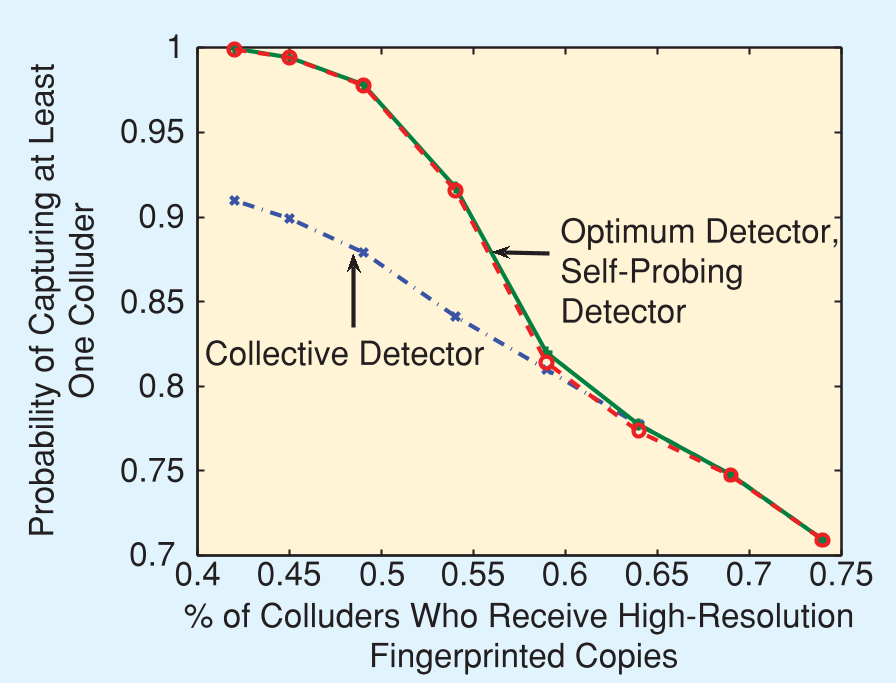 As seen in the chart, the Self-Probing Detector (red line) tracks the theoretical optimum almost perfectly, significantly outperforming traditional methods (blue line).
Conclusion: A New Frontier
This research proves that the future of multimedia security lies at the intersection of Signal Processing, Game Theory, and Sociology. By understanding the "Human Factor," we can design systems that aren't just robust against noise, but are robust against the strategic nature of human behavior itself.
Key Takeaway: In the "Cat-and-Mouse" game of forensics, the side that better models the other's psychology wins.