
Beyond Predation: Fixation and the Paradox of Voting in Symmetric Cyclic systems
Behavior of Social Dynamical Models I: Fixation in the Symmetric Cyclic System (with Paradoxical Effect in the Six-Color Automaton)
The paper investigates the "Symmetric Cyclic Particle System," a social dynamics model where neighboring nodes on a lattice adopt opinions if they are adjacent on an -color cycle. The author proves that for , the system undergoes "fixation" (reaches a stable state) on a 1D lattice, a result that mirrors the behavior of deterministic cyclic automata.
TL;DR
This research bridges the gap between statistical physics and social science by proving that a 1D social network with "symmetric" cyclic interactions will eventually freeze (fixate) if there are at least 5 possible opinions (). Furthermore, the study links these frozen states to a higher frequency of Condorcet's Paradox, where collective preferences become cyclical even when individual ones are not.
Background: The Social Shift
Traditional cyclic particle systems, introduced by Bramson and Griffeath, describe a "predatory" world—think Rock-Paper-Scissors—where color eats , eats , and eats . While mathematically fascinating, this doesn't capture social reality. In a social network, if you and I have similar but slightly different opinions, we might influence each other symmetrically.
The author modifies this rule: an interaction occurs only if opinions are adjacent on a cycle , and the change happens with equal probability (1/2) in either direction. This is a step toward making these models more realistic reflections of Homophily (the tendency to interact with similar others) and Social Influence.
The Fixation Problem: Will It Ever Stop?
A central question in interacting particle systems is whether a site will change its state infinitely often (fluctuation) or eventually stay the same (fixation).
The author proves Theorem 1: In a 1D symmetric cyclic system, if , every site fixates.
The Intuition: Active Edges and Blockades
To prove this, the author tracks "edges" rather than site colors.
- Active Edges: Boundaries between colors that can interact (distance = 1).
- Blockades: Boundaries between colors that are too different to interact (distance > 1).
Active edges move like random walks. When an active edge hits a blockade, it can either "annihilate" (making the blockade smaller) or "coalesce" (making the blockade larger). By constructing a comparison function and using the Law of Large Numbers (specifically Cramer’s Theorem for Large Deviations), the author shows that the "population" of active edges is insufficient to eliminate all blockades when is large enough.
 Equation (2): The confidence condition governing whether two colors can interact.
Paradox in the Machine: Condorcet's Voting Paradox
The most striking part of the paper is the experimental link to political science. Condorcet's Paradox occurs when a group prefers A over B, B over C, and C over A, leading to no clear winner.
Using a 6-color automaton (representing 3 alternatives and their permutations), the author found that:
- Fragmentation: When the confidence threshold is low, the system fixates into many small clusters.
- Paradox Surge: In these frozen, fragmented states, the probability of encountering a Condorcet Paradox is higher than at the start of the simulation.
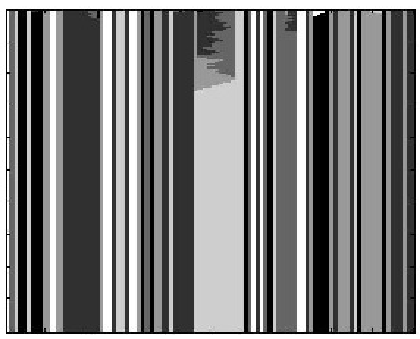 Figure 1: Spatio-temporal evolution of the six-color automaton for different confidence thresholds (). Lower leads to higher fragmentation.
Deep Insights & Critical Analysis
The value of this paper lies in its rigorous treatment of the threshold. It echoes the findings of deterministic cellular automata but proves them for stochastic systems, showing that the "noise" of randomness doesn't change the fundamental phase transition.
Limitations:
- The proof is strictly one-dimensional. In higher dimensions (2D or 3D), the geometry of "blockades" becomes much more complex, and fixation is not guaranteed.
- The model assumes a fixed cycle of opinions, which might be too rigid for real-world political landscapes where opinions can shift along multiple axes.
Conclusion
The study provides a robust mathematical foundation for why diverse societies with high "homophily" (low interaction thresholds) tend to become polarized and frozen. Most importantly, it suggests that such polarized states are breeding grounds for logical inconsistencies in collective decision-making, such as the paradox of voting.
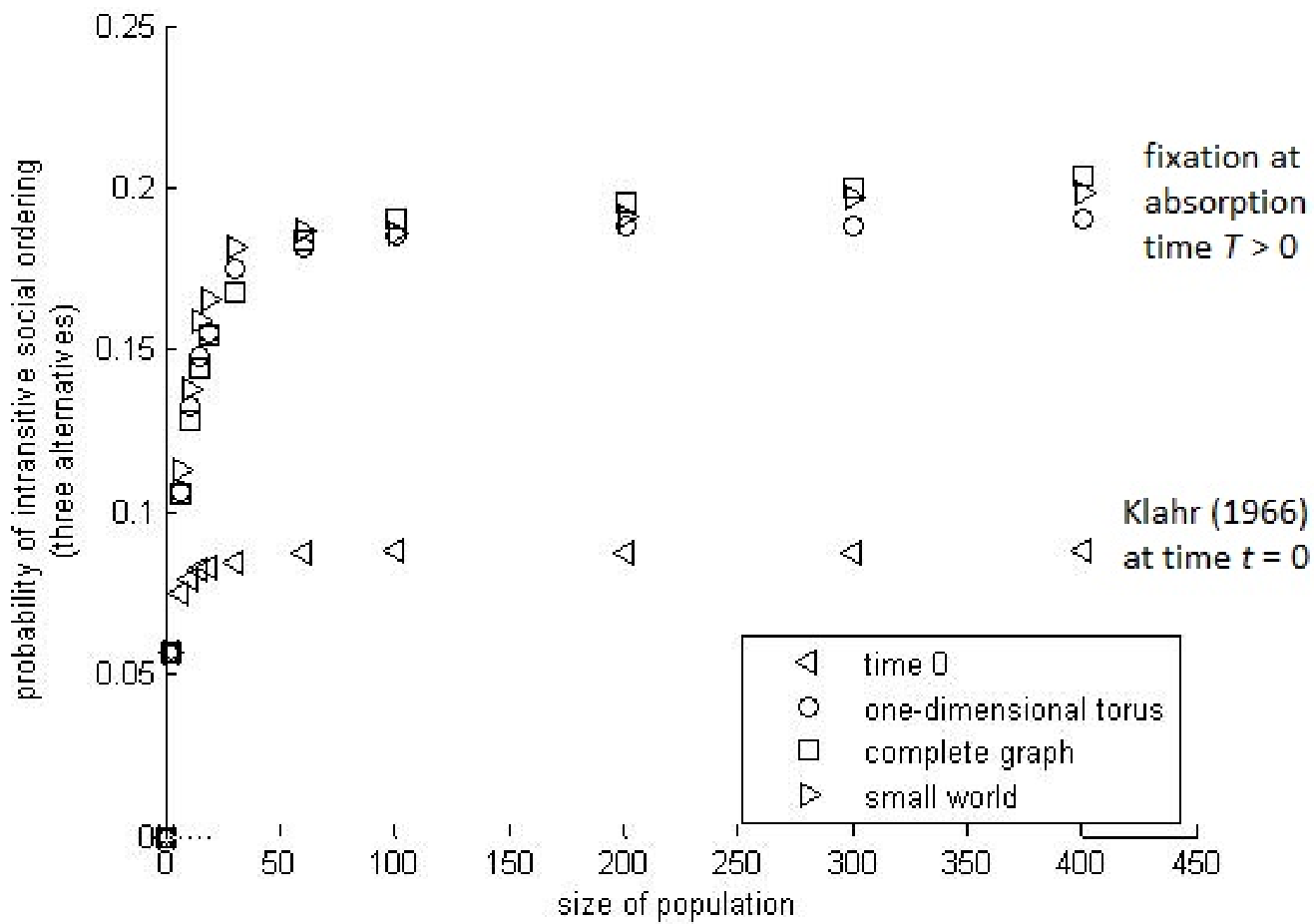 Figure 2: Probability of the Condorcet Paradox across different network topologies (Complete, Torus, Small-World).