
The Hidden Cost of Radiation Immunity: When Redundancy Conflicts with Testability
Behavior of a radiation-immune CMOS logic family under resistive shorts
This paper investigates the manufacturing testability and defect sensitivity of a specialized Single Event Upset Immune (SEU-I) CMOS logic family designed for space applications. While the SEU-I architecture uses redundant feedback transistors to mitigate radiation-induced glitches, the authors demonstrate that this same redundancy significantly increases vulnerability to resistive transistor shorts and complicates IDDQ testing.
TL;DR
Designing electronics for space requires "hardening" against Single Event Upsets (SEUs)—radiation-induced glitches. While the SEU-Immune (SEU-I) logic family succeeds at this using weak feedback transistors, this paper reveals a catch: these same transistors make the chips significantly harder to test and more sensitive to manufacturing defects (resistive shorts), potentially lowering yields and hiding failures.
Background: Hardening for the Stars
In space-borne applications, high-energy particles can cause momentary shorts in diffusion regions, leading to logic errors. To counter this, researchers developed the SEU-I logic family. Unlike resistive or capacitive hardening, this family uses redundant feedback transistors to hold a logic state during a radiation hit. It’s a clever solution that works on standard commercial CMOS processes—but as this study proves, there is no "free lunch" in VLSI design.
The Core Conflict: Why "Hardened" means "Sensitive"
The study focuses on resistive transistor shorts (Drain-Source, Gate-Source, Gate-Drain). In theory, redundancy should help. In practice, the SEU-I architecture hinders:
- Feedback Amplification: The weak feedback transistors, by design, create a loop. If a defect causes a slight voltage shift, the feedback path can actually "intensify" the error, pulling output nodes into indeterminate logic regions much faster than in conventional CMOS.
- Weak Drive Strengths: SEU-I gates are often driven by "weak" transistors from preceding stages. This high channel resistance means even a high-resistance short (which a strong conventional gate would ignore) can easily overpower the intended signal.
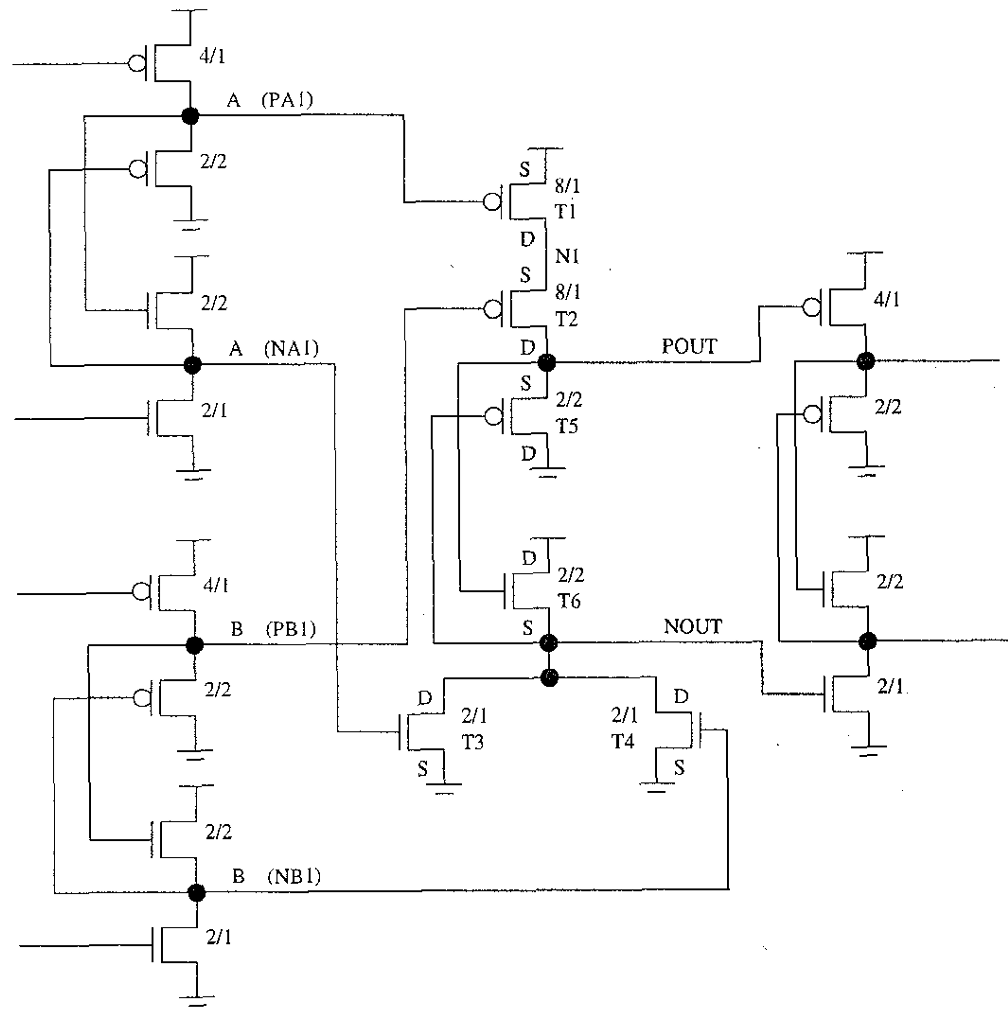 Figure 1: The SEU-I NOR gate and Inverters. Note the cross-coupled feedback transistors designed to suppress transients.
Methodology and Performance Degradation
The researchers compared a 2-input NOR gate in both conventional and SEU-I flavors using a 0.8 process. They measured Critical Resistance ()—the maximum resistance of a short that still causes a logic failure.
Key Findings:
- Higher Sensitivity: SEU-I circuits failed at much higher resistance levels. For instance, a Drain-Source short on a pull-up transistor in SEU-I had an of 140 , whereas conventional CMOS was only sensitive to very low values.
- Timing Penalties: Even if the logic stayed "correct," the delay () skyrocketed. Fault-free SEU-I gates are already slower, but a defect can increase transition times by up to 1500%.
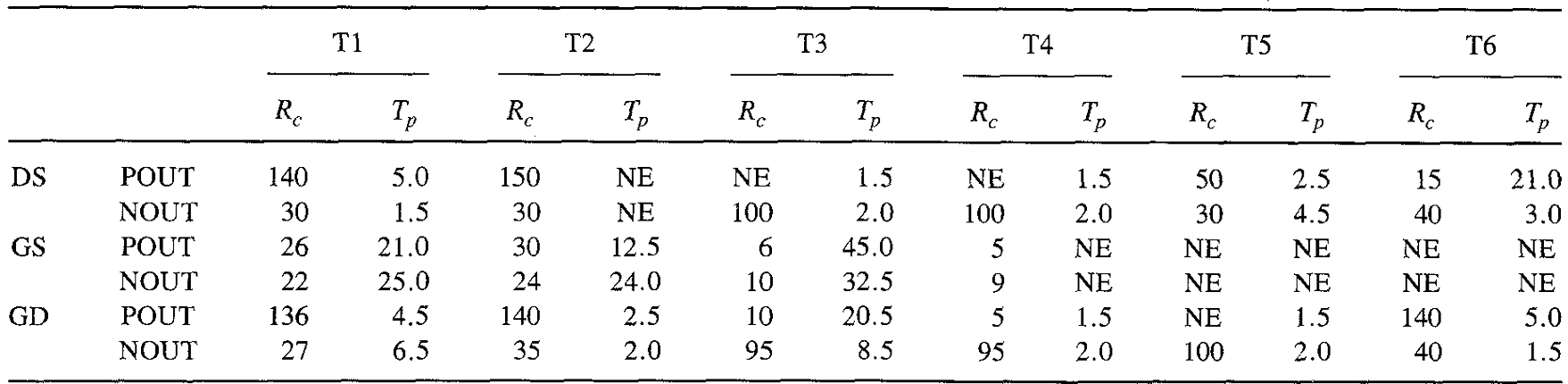 Table: Comparison of Critical Resistance () and Delay () showing SEU-I's extreme vulnerability to shorts.
The Death of IDDQ Testing?
One of the most powerful tools for CMOS testing is IDDQ (Quiescent Current) testing. It works because CMOS typically draws almost zero current when "quiet." A spike in IDDQ usually signals a defect.
However, SEU-I transistors are never fully off. The gates are driven by "weak" signals (e.g., 3.6V instead of 5V), leaving transistors in a slightly conductive state.
- Background Noise: A fault-free SEU-I full adder draws ~48 .
- Masking Effect: If a defect adds 192 , but the "normal" current fluctuates due to process variations or circuit size, the defect gets lost in the noise.
- The 11-Gate Limit: The authors calculate that for a single-threshold IDDQ test to work, the circuit can have no more than 11 gates. Beyond that, the quiescent current is too high to distinguish a "good" chip from a "bad" one.
Deep Insight & Conclusion
This research highlights a critical trade-off in high-reliability systems: Reliability vs. Observability. By adding internal feedback to "self-correct" against radiation, we effectively mask the very signals (like current spikes and voltage levels) that we use to ensure the chip was manufactured correctly.
Takeaways for Engineers:
- Yield Concerns: Manufacturers should expect lower yields with SEU-I logic due to its intolerance of minor defects.
- Advanced Testing: Standard IDDQ is insufficient. Designers must use Built-in Current (BIC) testing or partition the design into tiny sub-blocks.
- Future Outlook: While this study used 0.8 technology, the fundamental logic of "redundancy-induced sensitivity" remains a vital lesson for modern radiation-hardened-by-design (RHBD) specialists.