
Digital Persona vs. Real-Life Presence: Unveiling the Behavior Unconformity in Social Networks
An empirical study of behavior unconformity in web-based and non-web-based social networks
This empirical study explores the phenomenon of "behavior unconformity" between web-based (Renren.com) and non-web-based (real-life) social networks among university students. Utilizing Non-negative Matrix Factorization (NMF) for online clustering and graph visualization for offline ties, the paper identifies a lack of overlap between online activists and real-life social hubs.
TL;DR
Do the "influencers" on your screen hold the same power in your physical social circle? This study investigates the friction between online and offline social personas. By applying Non-negative Matrix Factorization (NMF) to student data, researchers found that the "hubs" of real life and the "activists" of the web are rarely the same people, and interestingly, this mismatch actually makes social communities stronger.
Problem & Motivation: The "Imperfect Lap"
For years, sociologists have debated whether the internet alienates us or brings us closer. While we know that online tools can support physical relationships, we often ignore the Behavior Unconformity—the fact that people adopt different social roles depending on the medium.
The authors point out that previous studies often used simple metrics like the number of "top friends" to measure this. However, to truly understand social dynamics, one must look at the link-patterns: how connections are formed and who acts as a bridge between groups.
Methodology: Decomposing Social Structures
The researchers focused on a group of 35 female sophomore students, mapping their interactions on Renren.com (a popular Chinese SNS) and their real-life familiarity rankings.
1. Online Clustering via NMF
To handle the online data, the team created a "mutual friends" matrix. They utilized Non-negative Matrix Factorization (NMF), a powerful dimensionality reduction technique, to decompose the complex friendship matrix into a compressed format. This allowed them to cluster students into three distinct latent categories based on their "Internet-surfing habits":
- Group 1: Active
- Group 2: Less Active
- Group 3: Least Active
2. Offline Visualization
In real life, measuring "closeness" is subjective and nonlinear. The authors used a clever mathematical transformation: where is the rank of familiarity. This ensures that the difference between the 1st and 2nd closest friend is weighted more heavily than the difference between the 9th and 10th.
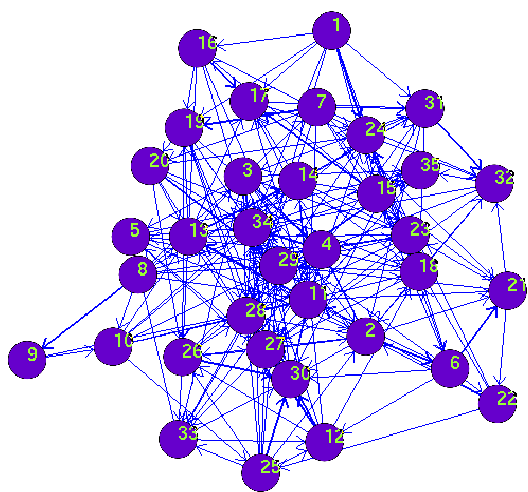 Above: The weighted, directed graph of real-life social ties. Note the varying thickness of edges representing relationship strength.
Experimental Results: The Weakness of the "Hub"
The study produced a striking revelation through the comparison of the NMF results and the graph visualization.
- The Mismatch: Students who were "Active" online (e.g., A19, A20) often lacked central positions in the real-world graph. Conversely, student A28, labeled as "Least Active" online, was identified as a critical "hub" in real life, connecting various clusters of people.
- The Hidden Benefit: This unconformity is a feature, not a bug. Because individuals belong to different "groups" in different worlds, the boundaries of these groups become blurred. A real-life hub might pull their online "inactive" friends into the wider community, effectively strengthening the overall ties of the entire network.
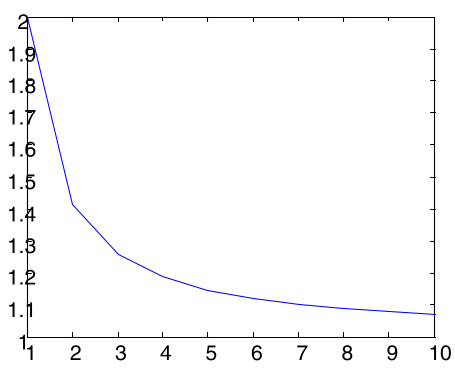 Above: The function f(k) shows how the perceived difference in closeness diminishes as the rank increases, modeling human social intuition.
Critical Analysis & Conclusion
This work provides a crucial quantitative anchor for the intuition that we are "different people" online. From an academic standpoint, using NMF for social role identification is a robust choice, as it captures the "additive" nature of latent social features.
Takeaway
The value of a social network isn't just in the sum of its parts, but in the inconsistency of its members. Behavior unconformity acts as a cross-pollinator, ensuring that social clusters remain open and interconnected across physical and digital spaces.
Limitations
The sample size (n=35) is relatively small and demographic-specific (female sophomore statistics students). Future work should examine if these patterns hold in more diverse, larger populations or in professional vs. casual contexts.