
The Price of Unfairness: How Tipping Boosts Efficiency in Social Networks
Behavioral Conflict and Fairness in Social Networks.
This paper presents a behavioral study on the King-Pawn game played over various social network topologies, where 36 human subjects must coordinate to maximize payoffs. The core contribution is documenting how "fairness" drives social welfare, specifically showing that allowing dominant players (Kings) to provide "tips" to submissive neighbors (Pawns) significantly reduces behavioral conflict and increases overall social efficiency.
TL;DR
Why do we fight even when it costs us money? A study by researchers at the University of Pennsylvania reveals that in networked games, perceived unfairness is the primary driver of conflict. By introducing a simple "tipping" mechanism, dominant players were able to buy peace, significantly increasing the total social welfare of the network. This research bridges the gap between game theory and behavioral economics, proving that "fairness" isn't just a moral virtue—it's a coordination tool.
Background: The King-Pawn Dilemma
In the complex world of human interaction, we often find ourselves in "local monopolies." Only one person can be the "boss" or the "King" of a specific domain. The authors model this using a King-Pawn game:
- Kings earn $1.00/min but only if none of their neighbors are also Kings.
- Pawns earn a safe $0.50/min regardless of their neighbors.
- Conflict occurs if two neighbors both choose to be Kings; they both earn $0.00.
From a computer science perspective, maximizing the total wealth in this game is equivalent to solving the Maximum Independent Set (MIS) problem—an NP-hard task.
The "Irrational" Human: Why We Fight
Standard game theory suggests that if you are a Pawn and your neighbor is a King, you should stay a Pawn. Why? Because 0.00 you get if you challenge them.
However, humans aren't cold calculators. The experiments showed that Pawns often switched to King roles purely to "punish" the high-earning neighbor, effectively saying: "If I can't have the high wage, neither can you." This leads to a lose-lose scenario where social welfare plummets.
Methodology: Testing the "Tip" Factor
The researchers tested 36 subjects across various topologies, from simple pairs to complex "Clique Chains." The breakthrough came in the second set of experiments where Kings could offer Tips (0-100% of their earnings) to their Pawn neighbors.
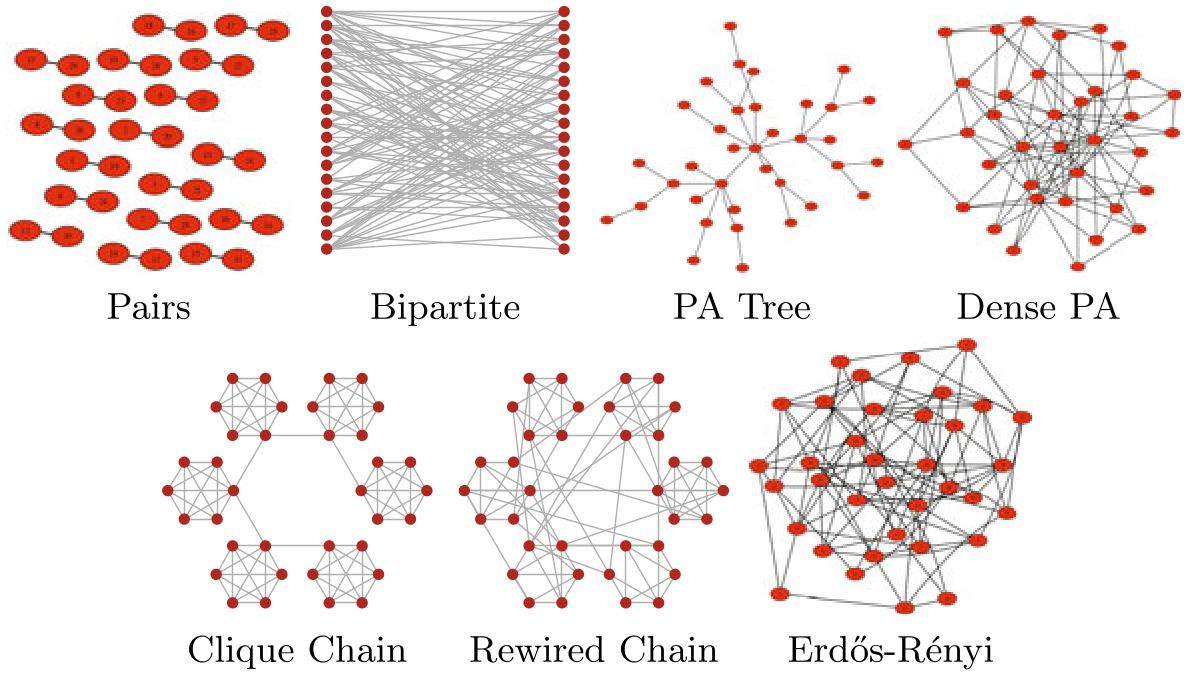 Figure: The diverse network architectures used to test behavioral dynamics.
Key Insights
1. The Fairness Premium
When tips were allowed, social welfare (total wealth) increased across all 19 individual network configurations. By sharing a small portion of their wealth (typically around 20%), Kings reduced the "envy" of their neighbors, which in turn stopped the neighbors from initiating costly conflicts.
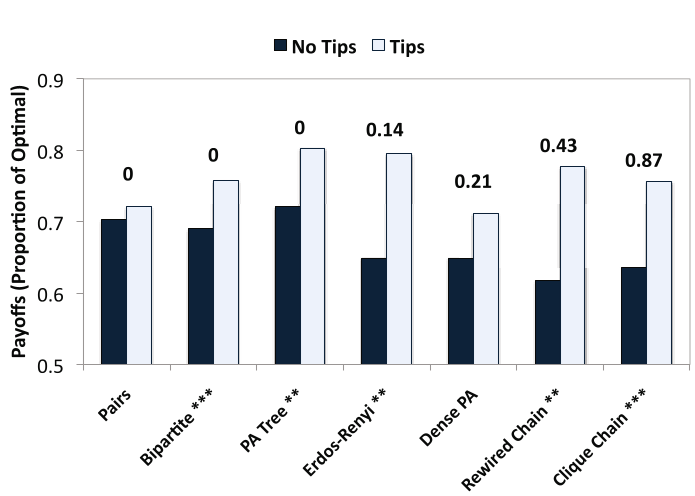 Figure: Comparison of social efficiency. The white bars (tips) consistently outperform the black bars (no-tips).
2. Downward Rigidity (The "Pay Cut" Effect)
The study discovered a fascinating macroeconomic parallel: Downward Wage Rigidity. Players were relatively okay with low tips, but they became extremely aggressive if a King reduced an existing tip. Even if the resulting income was the same as another group's, the act of "taking away" was perceived as a grave insult, triggering intense conflict.
3. Clustering and Conflict
Networks with high Clustering Coefficients (where your neighbors are also neighbors with each other) saw the most significant benefits from tipping. In these "tight" social circles, the pressure to maintain fairness is higher, and the potential for cascading conflict is greater.
Critical Analysis: Tipping as a Coordination Device
This paper offers a profound lesson for organizational design and policy: Inequality is a tax on productivity.
The authors demonstrate that "conflict doesn't pay." Every second spent in conflict to secure a higher tip cost players roughly 1.2 cents, while only gaining them 0.2 cents in tip improvements. Yet, humans do it anyway. The "Kings" who understood this and proactively shared wealth were the ones who ultimately sustained their dominant status and maximized their long-term income.
Summary & Future Outlook
The King-Pawn experiments prove that human coordination is not just about solving an optimization problem; it's about managing social friction.
- Takeaway: If you want a system (or a company) to run efficiently, you must address the perceived fairness of its rewards.
- Limitation: The experiment used a fixed time limit and a relatively small group (36 people). How these dynamics scale to thousands of players in a decentralized "gig economy" remains an open question for future researchers.
By bridging the gap between NP-hard graph problems and human psychology, Judd et al. have provided a blueprint for more stable, "fairer," and ultimately wealthier social architectures.