
Beyond Cold Rationality: Building Cooperative Social Networks via Altruism
Analysis for Behavioral Economics in Social Networks: An Altruism-Based Dynamic Cooperation Model
The paper proposes the Altruism-Based Dynamic Model (ABDM) to enhance cooperation in social networks. By integrating reciprocal altruism theory into an N-player Prisoner’s Dilemma (NPD) framework, the model achieves a 100% cooperation rate at equilibrium, significantly outperforming traditional utility-based models.
TL;DR
Researchers have developed the Altruism-Based Dynamic Model (ABDM), a decentralized framework that solves the "free-rider" problem in social networks. Unlike traditional models that assume users are purely selfish (rational actors), ABDM introduces Reciprocal Altruism. By factoring in "psychological payoffs"—the feeling of fairness and the desire to punish cheaters—the system drives the entire network toward 100% cooperation, even as the network scales.
The "Rationality" Trap in Social Networks
Most current social network protocols are designed around the Homo Economicus hypothesis: the idea that every node will act to maximize its own utility. However, this narrow view is exactly why platforms struggle with free-riding (consuming resources without contributing) and Sybil attacks (creating fake identities to exploit rewards).
The authors argue that traditional models are broken because they ignore Bounded Rationality. In the real world, humans aren't just calculating machines; they are driven by a sense of fairness. If a system doesn't allow for "Altruistic Punishment"—where a node is willing to pay a cost just to penalize a defector—the "bad actors" eventually dominate.
Methodology: The ABDM Engine
ABDM re-engineers the N-player Prisoner’s Dilemma (NPD) by injecting behavioral economics into the loop.
1. The Triad of Node Behavior
The model identifies three distinct types of participants:
- ALL-C: The "Saints" who always cooperate.
- ALL-D: The "Predators" who always betray.
- Reciprocal Altruists: The "Regulators" who cooperate based on the network's local health and their inherent sense of fairness.
2. Redefining Utility
The core breakthrough is the new utility function: Where is the traditional economic gain and is the Psychological Payoff. This psychological component rewards cooperative clusters and, crucially, subtracts utility from defectors when they are "punished" by altruistic nodes.
3. Dynamic Structural Evolution
The network isn't static. It uses a "SetLinks" mechanism:
- Successful Cooperation: Connection weight .
- Betrayal: Connection weight .

Experimental Showdown: ABDM vs. Traditional MIX
The researchers compared ABDM against the standard "MIX" model (a common dynamic adjustment baseline).
The Group Size Paradox
In traditional models, as group size () increases, cooperation usually collapses because it becomes easier for "free-riders" to hide. However, ABDM flips this. As grows, the probability of encountering a Reciprocal Altruist increases, leading to more "policing" and faster convergence to total cooperation.
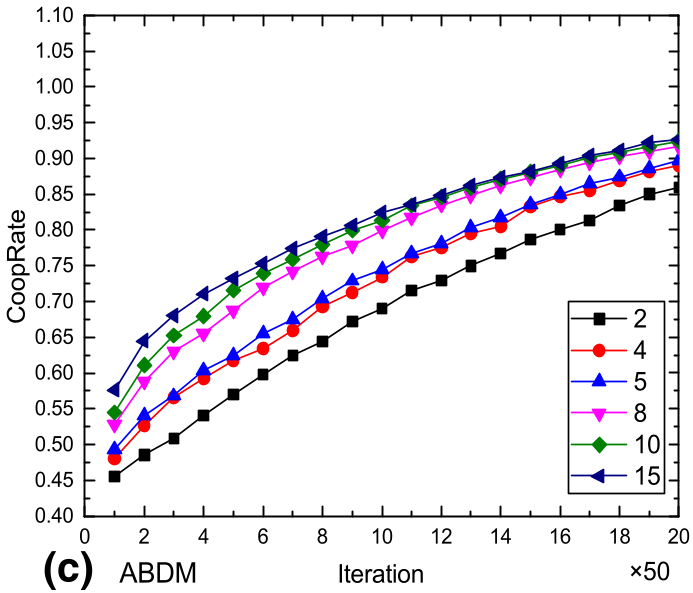 Figure: ABDM (Right) maintains a 1.0 cooperation rate as group size N increases, while the MIX model (Left) fails.
Resilience to Turmoil
The model was tested for Scalability and Robustness. Even when the population was expanded to 5,000 nodes or when 50% of the nodes suddenly exited (simulating a network failure), the ABDM maintained a high level of cooperation. The "psychological cost" of betrayal served as an invisible immune system, protecting the network's integrity.
Critical Insight & Future Outlook
The ABDM proves that altruism is not a weakness; it is a structural necessity. For architects of future social networks, P2P file-sharing systems, or parallel processing grids, the takeaway is clear:
Don't just build better rewards; build better social sensors. By allowing nodes to track "Fairness Coefficients" and adjust connection weights based on historical behavior, we can create self-healing digital ecosystems.
Limitations: The current model assumes a fixed "punishment rate." In reality, the cost of punishing others might vary, and "malicious altruists" could theoretically exist. Future research should explore the co-evolution of different altruistic strategies in more hostile, adversarial environments.