
Beyond Clicks: Maximizing Opinion through Behavioral Insights and the BIC Model
Behavioral Information Diffusion for Opinion Maximization in Online Social Networks
This paper introduces the Behavioral Independent Cascade (BIC) model, a novel information diffusion framework that incorporates the "Big Five" personality traits (FFM) and individual opinions into propagation probabilities. It targets the Opinion Maximization (OM) problem, achieving superior performance in uniform distributions and revealing that activating more nodes can paradoxically decrease total opinion in polarized networks.
TL;DR
Researchers have moved beyond simple "Influence Maximization" (counting shares/clicks) to Opinion Maximization (OM). By integrating the "Big Five" personality traits into a new Behavioral Independent Cascade (BIC) model, this study proves that in polarized social networks, traditional "viral" strategies can backfire, actually decreasing positive sentiment. They propose a new linear-time algorithm that balances influence gain against behavioral risk.
Contextualizing the Shift: From IM to OM
In the traditional Influence Maximization (IM) paradigm, a node is a light switch: either On (activated) or Off (inactive). However, real human behavior is a spectrum. A marketing campaign that reaches 1 million people but leaves them annoyed is a failure. This paper tackles Opinion Maximization, where the goal is to maximize the sum of positive sentiment across a network.
The authors argue that current models lack psychological realism. They bridge the gap between social science and network theory by ascribing each node with "OCEAN" personality traits (Openness, Conscientiousness, Extroversion, Agreeableness, Neuroticism) and a continuous opinion value between 0 and 1.
The BIC Model: How Personality Drives Diffusion
The core contribution is the Behavioral Independent Cascade (BIC) model. Unlike the standard IC model where activation logic is "black-boxed," BIC defines propagation probability as a dynamic product of:
- The Behavioral Term (): Derived from the user's personality traits. For example, highly extroverted users have a higher baseline probability of spreading information.
- The Opinion Term (): Based on homophily—users are more likely to be influenced by those who share similar initial views.
Architectural Logic
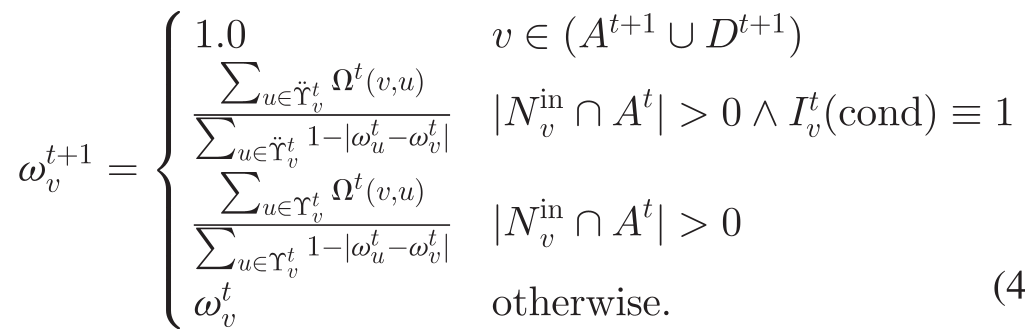
The model introduces a "Penalized Update." When a node fails to be activated by a neighbor, its opinion doesn't just stay the same—it can actually decrease. This captures the real-world Phenomenon where exposure to "correctional" information can strengthen a person's original misinformation.
Algorithm: Balancing Influence and Risk
One of the paper's most significant theoretical findings is that the OM objective function is non-submodular. In plain English: the "law of diminishing returns" doesn't apply here; sometimes, adding a seed node can actually result in a negative net change for the network.
To solve this, the authors adapt the FastLAIM algorithm. The adaptation is clever: it doesn't just look for "high-degree" nodes. Instead, it maintains a Penalty Matrix.
- Impact Matrix (): Approximates the potential increase in opinion.
- Penalty Matrix (): Approximates the "risk" of triggering a negative opinion shift in the neighborhood.
The algorithm selects seeds that maximize , favoring nodes that provide high conversion potential with low "rejection" risk.
Experimental Insights: The Danger of Polarized Echo Chambers
The authors tested their approach against SOTA algorithms like TIM+ and FastLAIM across several datasets, including Twitter and Facebook.
Key Result 1: Uniform vs. Polarized Distributions
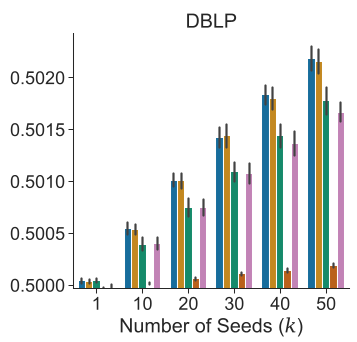
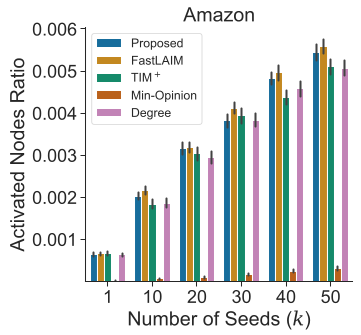
In Uniform distributions (where opinions are scattered), the BIC-adapted algorithm consistently wins. It activates fewer nodes than FastLAIM but achieves a higher Total Opinion Ratio.
Key Result 2: The Failure of Viral Growth in Polarized Networks
In Polarized and Community-Aware scenarios (echo chambers), a shocking trend emerged: the "Min-Opinion" heuristic (picking people with the lowest opinions) often outperformed sophisticated influence algorithms. Why? Because excessive activation in these clusters triggered the "rejection" mechanism so frequently that it tanked the overall community sentiment.
Final Thoughts and Future Directions
This paper serves as a warning to digital marketers and policymakers: Aggressive information diffusion in polarized environments is counter-productive.
The BIC model provides a more nuanced lens for understanding social networks. However, its effectiveness relies on accurately knowing a user's "Big Five" traits—a data privacy challenge in real-world applications. Future work will likely look at "Staggered Diffusion," where information is released in waves to navigate the non-submodular landscape of human opinion.
Takeaway: Successful influence is not about the number of people you reach, but the psychological receptivity of the people you choose to engage.