
B2IM: Beyond Reach — Maximizing Consumer Intent Amidst Rumors and Social Pressure
Behavioral Intentions Maximization for Multiple Products and Rumors in Online Social Networks
The paper introduces the Budgeted Behavioral Intentions Maximization (B2IM) problem, a novel variant of influence maximization that accounts for multiple products, rumor interference, and social psychology factors. It proposes an approximation algorithm based on the Extended Fishbein Model (EFM) and partial enumeration, achieving a provable (1 - 1/e) approximation ratio.
TL;DR
Classic "Influence Maximization" is getting a psychological makeover. This paper moves beyond just counting how many people see an ad. It introduces the Budgeted Behavioral Intentions Maximization (B2IM) problem, which uses the Extended Fishbein Model (EFM) to calculate the actual desire of a consumer to adopt a product while simultaneously fighting off negative rumors and accounting for peer pressure—all under a strict financial budget.
Academic Positioning: This work bridges Social Psychology and Discrete Optimization, moving from binary "active/inactive" states to a continuous "intention value" framework in a multi-product setting.
Problem & Motivation: The "Empty Reach" Fallacy
In the previous SOTA (State Of The Art) works like PM2A or early IM models, a user is either "influenced" or not. However, the authors argue this is unrealistic. Why?
- Multiple Products: A company like Huawei markets both budget and flagships simultaneously; they compete for the same user attention.
- Rumor Interference: Competitors spread negative information that "erodes" a consumer's intention.
- Social Beliefs: Your intention to buy a product isn't just your own; it’s a weighted sum of what your neighbors think.
Previous methods ignored these psychological nuances, leading to suboptimal seed selection where "reached" users had zero actual intention to buy.
Methodology: The Core of B2IM
The authors define the behavioral intention of a consumer as a function of their own belief and the weighted influence of their neighbors :
1. The Extended Fishbein Model (EFM) Integration
The model uses scales (from +6 to 0) to quantify belief and peer impact. This transforms the network from a simple graph into a rich psychological landscape.
2. Algorithmic Approach
Since B2IM is NP-hard, the authors proved that the objective function is non-negative, monotone, and submodular. This allows the use of a Partial Enumeration Technique.
 Note: The algorithm combines exhaustive search for small seed sets (size y) with a greedy expansion strategy for larger budgets.
The algorithm (Algorithm 1) works by:
- Estimating behavioral intentions thru random Monte Carlo simulations.
- Using a greedy ratio: .
- Providing a theoretical guarantee of approximation.
Experiments & Results
The authors tested their approach using real traces from Facebook, BlogCatalog, and NetS, combined with consumer music profiles from Last.fm.
SOTA Comparison
B2IM was compared against:
- GCA/GBA: Greedy algorithms focusing only on cost or intention.
- PMCE: A modern SOTA for profit maximization.
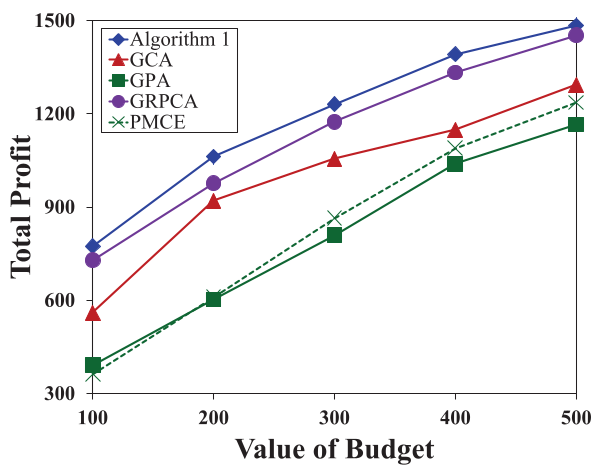 Fig 1: Impact of budget on total behavioral intentions across NetS, BlogCatalog, and Facebook.
Key Findings:
- BlogCatalog showed the highest intention values due to high contact probability.
- Efficiency: The B2IM algorithm consistently found better seed sets because it "sees" the rumors early and avoids users whose intentions are easily tanked by negative info.
- Cost-Effectiveness: Even with a small budget increase, the intention-to-cost ratio of B2IM remains superior to PMCE.
Critical Analysis & Conclusion
Takeaway
The shift from "Influence" (binary) to "Intention" (continuous/psychological) is a major leap toward real-world application. By integrating EFM, this work provides a framework that marketing departments can actually use with survey data.
Limitations
- Fixed Rumors: The paper assumes rumors () are fixed. In reality, rumors are dynamic and reactive to marketing campaigns.
- Computational Complexity: While the approximation is good, the partial enumeration () and simulations are computationally expensive for massive-scale networks with millions of nodes.
Future Work
The next frontier is likely Adversarial Influence Maximization, where rumors are not static but are controlled by an active adversary (a "Game Theory" extension of B2IM).