
Adapting the Fogg Behavior Model: Why Motivation is the Default in Social Media
Behavioral Model of Online Social Network Users: an Adaptation of Fogg's Behavior Model
This paper proposes an adaptation of the Fogg Behavior Model (FBM) specifically for Online Social Networks (OSN). It argues that in the context of platforms like Facebook, user motivation is an intrinsic variable, simplifying the behavioral product from three factors to just two: Ability and Trigger.
TL;DR
Most persuasive design frameworks assume you need to convince a user to act. This paper argues that in Online Social Networks (OSNs) like Facebook, the user is already convinced. By analyzing user intent, the authors simplify the classic Fogg Behavior Model (FBM) from a three-factor equation (Motivation + Ability + Trigger) into a more streamlined version where Ability and Triggers are the only active variables.
Perspective: The Context of Persuasion
In the world of Human-Computer Interaction (HCI), the Fogg Behavior Model is a cornerstone. It states that Behavior = Motivation x Ability x Trigger. If any of these is zero, the behavior won't happen.
However, this paper identifies a unique "Inductive Bias" in social networks: the act of establishing a connection (following a page or friending a person) is an explicit manifestation of intent. In these environments, the "Motivation" axis is almost always at its peak.
Problem: The Redundancy of Motivation
The authors argue that many persuasive tools fail because they try to solve the wrong problem. They treat motivation as a fluctuating variable. In reality:
- If you follow a news page, you want to read news.
- If you friend a family member, you want to see their updates.
The struggle isn't making you want to do it; the struggle is making it easy enough (Ability) and reminding you at the right time (Trigger).
Methodology: The Simplified OSN Model
The authors propose a refinement of Fogg's original model. In the OSN-adapted model, the dimension of Motivation is treated as a baseline constant.
1. The Architecture of Action
The model focuses on two primary scenarios based on the user's Ability:
- Low Ability + Facilitator Trigger: If a task is complex (e.g., setting up a private group), the system must use "Reduction" strategies to make it simple.
- High Ability + Signal Trigger: If the task is simple (e.g., "Liking" a post), the system needs only a "Signal" (a notification) to prompt action.
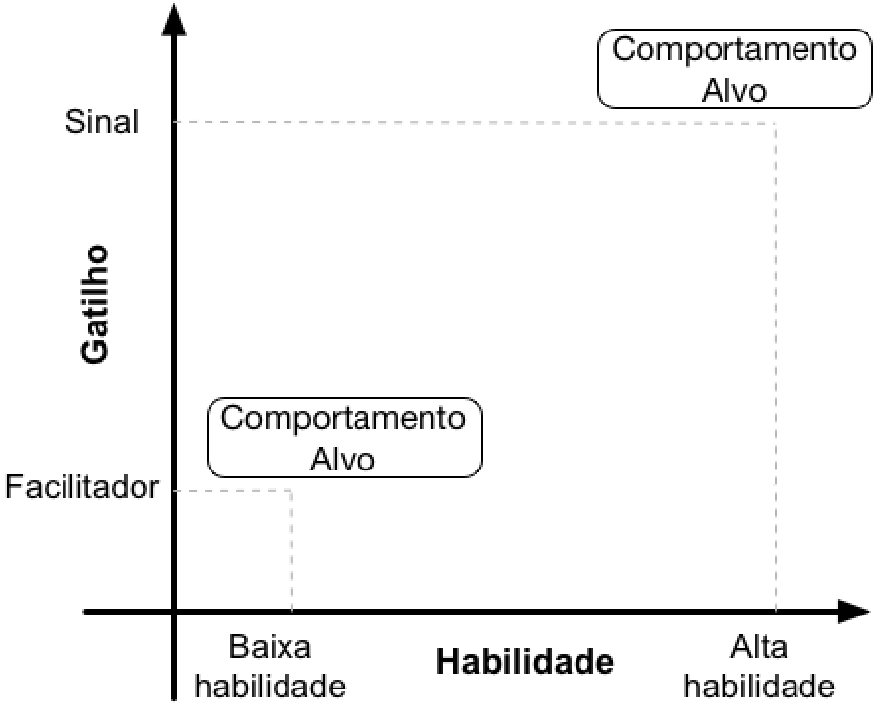 Figure: The adapted model for Social Networks, emphasizing the relationship between Ability and the specific type of Trigger.
Experiments: Validating the "Motivated User"
To prove that motivation is intrinsic, the authors surveyed 686 Facebook users.
Key Findings:
- Concentrated Intent: 87.9% of users reported their primary goals were:
- Communicating with family/friends (37.9%)
- Getting news updates (18.51%)
- Following daily lives of contacts (17.78%)
- Reading about personal interests (13.7%)
- Statistical Rigor: Using a Chi-square (χ2) fitness test, they found that user goals were not randomly distributed but heavily skewed toward behaviors that require pre-existing social bonds.
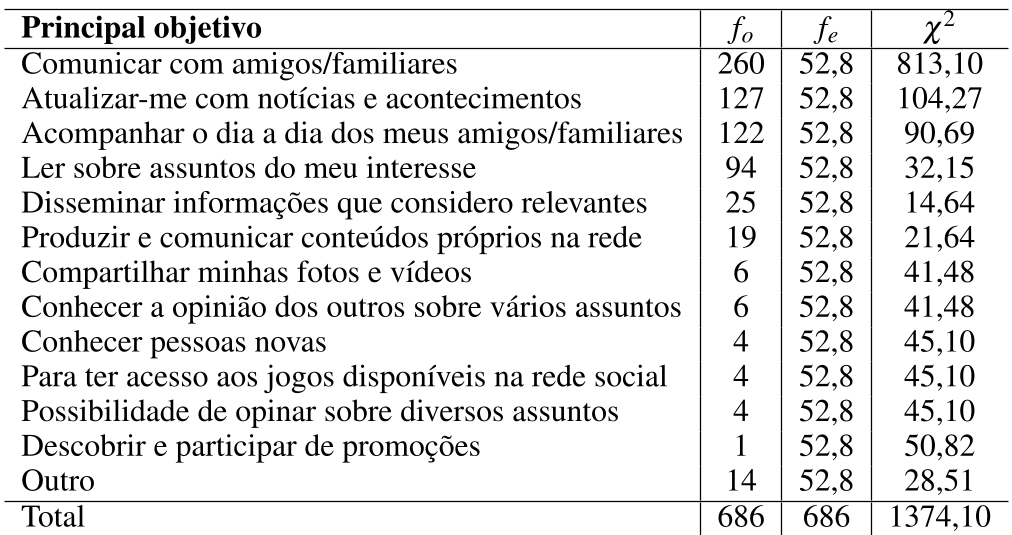 Table: Observed frequency (f0) vs. Expected frequency (fe) of user objectives, showing a massive deviation that confirms behavioral trends.
Critical Insight & Conclusion
The core takeaway is a shift in design philosophy: Stop selling, start enabling.
If you are building a social or community-based product:
- Assume Motivation: If the user has opted-in, don't waste their "cognitive cycles" with "Spark" triggers (trying to motivate them).
- Focus on Reduction: Spend your engineering effort on "Facilitators." If a user wants to share a photo but the upload button is buried, high motivation won't save you.
Limitations: While this model holds for established connections, it may not apply to discovery phases (like the "Explore" or "For You" pages), where motivation for new content is not yet established. Future research should explore if this model holds for Algorithmic Feeds where the user hasn't explicitly "opted-in" to every piece of content.