
Building a Society of Robots: Formalizing Coexistence, Security, and Consensus
Behaviors, Misbehaviors, and Security
The paper proposes a formal framework for a "society of robots" where heterogeneous agents with independent goals coexist using motion cooperation protocols. Key contributions include the use of Hybrid Automata for verifiable safety and a set-valued consensus algorithm for decentralized Intrusion Detection Systems (IDS).
TL;DR
As we transition from industrial manipulators to ubiquitous service robots, the challenge shifts from isolated task execution to complex robot-robot interaction. This paper outlines a framework for a "Society of Robots"—heterogeneous agents with independent goals. By modeling social rules as Hybrid Automata and utilizing a set-valued consensus algorithm, the authors provide a pathway for robots to detect "misbehaviors" (malice or faults) and coexist safely in shared environments like highways or shopping malls.
Background: Beyond the Team Paradigm
Historically, multi-robot research has focused on teams or swarms—groups working toward a unified goal (e.g., formation control or foraging). However, the future likely involves a "society" where robots from different manufacturers, with different purposes, must share physical resources. In such a scenario, the core problem is not just coordination, but fair competition and security.
The Problem: The Fog of Local Visibility
The primary obstacle to a secure robot society is partial observability. In a decentralized system, an individual robot (the observer) cannot see everything its neighbor sees.
- The Dilemma: Is that car ahead of me slowing down because it has a mechanical failure (misbehavior), or is it avoiding a small obstacle that is currently out of my line of sight?
- The Risk: Overly aggressive security might flag innocent robots as threats, while weak security allows malicious agents to cause deadlocks or collisions.
Methodology: Social Behaviors as Hybrid Automata
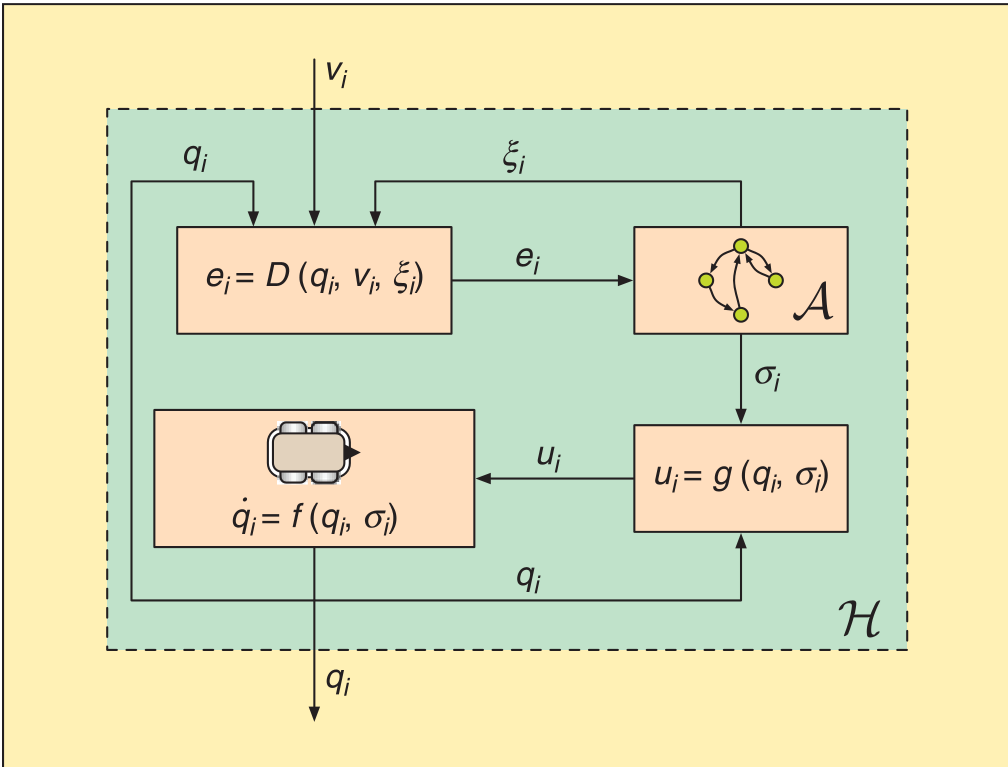
The authors propose that all acceptable social behaviors be codified in a set of rules represented by Hybrid Automata. This allows for the modeling of both discrete decisions (e.g., "Change Lane") and continuous dynamics (e.g., "Velocity Control").
1. The Local Monitor
Each agent runs an Intrusion Detection System (IDS). It simulates the possible states of its neighbors. If the neighbor's observed movement doesn't match the simulated "legal" behaviors, it is flagged.
2. Set-Valued Consensus
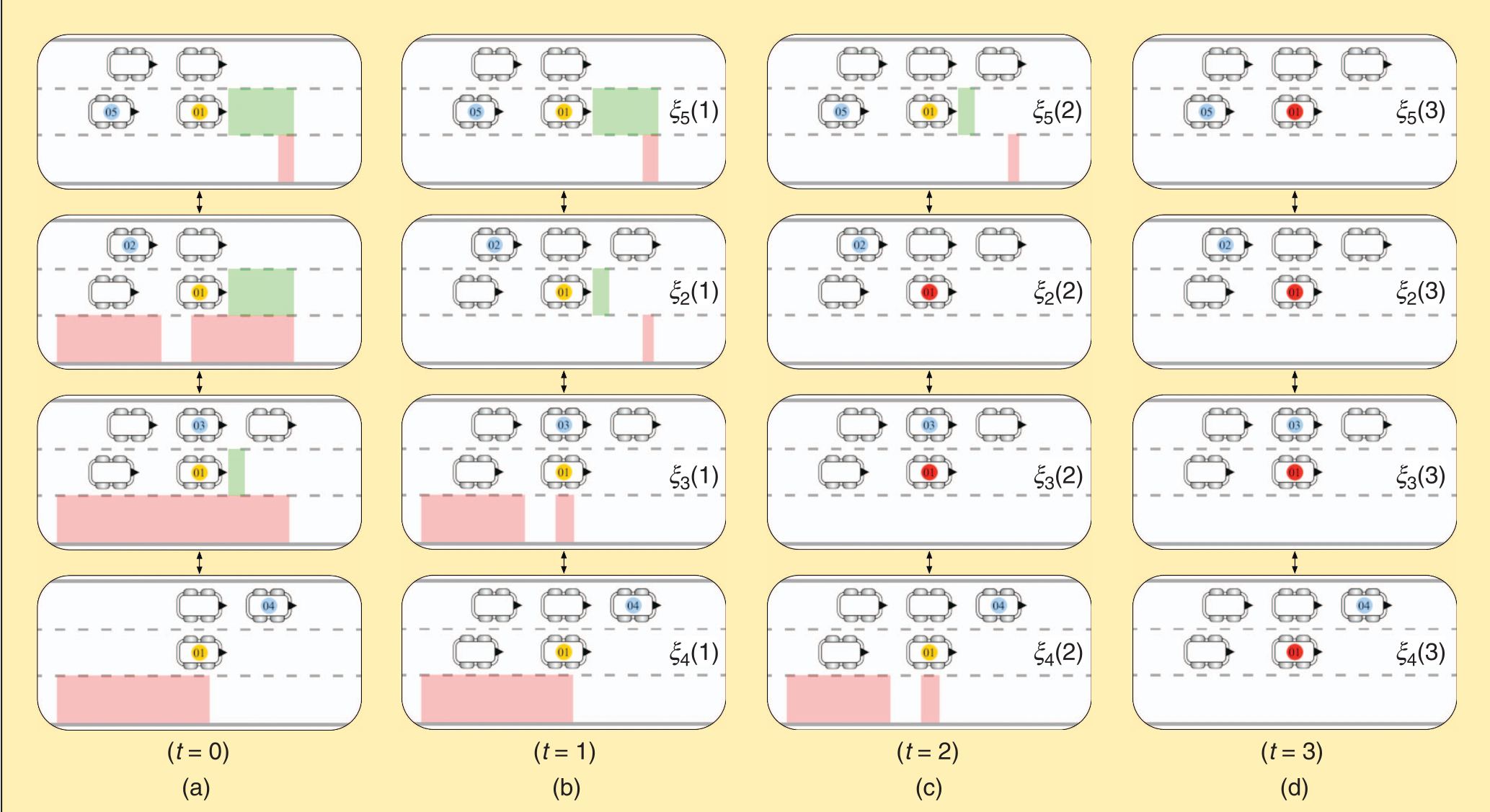
To solve the "partial visibility" problem, the authors introduce a nonlinear consensus mechanism. Robots share their occupancy maps (sets of where they think obstacles/robots are).
- Instead of "averaging" values, they use set-theoretic intersection.
- This allows the group to mathematically "filter out" uncertainty. If one robot sees a clear path and another sees a clear path, the consensus confirms the absence of obstacles that might have justified a neighbor's strange behavior.
Experiments and Species Classification
The paper extends this logic to Behavior Classification. Similar to how different ant colonies recognize "nestmates," robots can distinguish between "species" (e.g., an emergency vehicle vs. a standard car) by checking which set of Hybrid Automata rules the observed agent is following.
In a highway simulation with a "misbehaving" car (01) that refuses to stay in the slow lane:
- Initial Phase: No single neighbor can be sure if car 01 is malicious because they can't see the entire road.
- Consensus Phase: After 3 rounds of information exchange, the aggregated "occupancy map" proves that there was no reason for car 01 to stay in the fast lane.
- Result: The society detects the intruder and can take corrective action.
Critical Insight: The Future of Distributed Security
The brilliance of this work lies in treating security as a byproduct of cooperation. By proving that local set-valued observers can converge to the same conclusion as a "hypothetical centralized monitor," the authors provide a mathematical guarantee for decentralized safety.
Limitations: The current model assumes that information exchange itself is honest (no "collusion" between a misbehaving robot and a lying observer). Future research must address information-level misbehavior, where robots might lie about their occupancy maps to mask their physical transgressions.
Conclusion
As we move toward a world of 13 million+ service robots, the "Wild West" of uncoordinated machines is not an option. The use of Hybrid Automata and distributed consensus provides the necessary "legal framework" and "police force" for a functioning robot society.