
Behind the Mask: Why Hiding Your Degree Isn't Enough for Graph Privacy
Behind the Mask: Understanding the Structural Forces That Make Social Graphs Vulnerable to Deanonymization
This paper presents a comprehensive framework for quantifying the vulnerability of social graphs to deanonymization attacks. Using a machine-learning-based attack model (Random Forest with Neighborhood Degree Distribution features) on thousands of synthetic and real graphs, it identifies specific structural properties—beyond simple degree distributions—that compromise privacy.
TL;DR
Releasing "anonymized" social network data is a minefield. While we once believed that scrubbing names or perturbing node degrees was enough, this paper reveals that the intrinsic architecture of a graph—specifically its clustering (transitivity) and how similar nodes connect (assortativity)—serves as a structural fingerprint that can be exploited by Machine Learning to strip away anonymity.
Background: The Illusion of Anonymity
In the era of big data, social graphs are goldmines for researchers. However, scandals like the AOL search leak have shown that "naive anonymization" (just removing names) is useless. Modern techniques attempt structural anonymization, but they face a brutal tradeoff between Utility (how useful the data remains) and Privacy. This paper shifts the focus from "how to anonymize" to a more fundamental question: What specific forces within a graph make it inherently vulnerable?
The Structural Vulnerability Framework
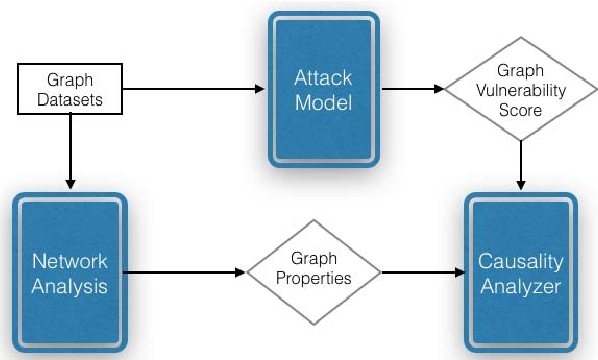
The authors propose a modular framework to diagnose graph "leakiness." It consists of:
- The Attack Model: A sophisticated Random Forest classifier using Neighborhood Degree Distribution (NDD). It learns the "shape" of a node's local community to match it across different datasets.
- Synthetic Probing: Using tools like dK-graphs and ERGMs (Exponential Random Graph Models), the researchers generated thousands of variations of real networks (like Facebook and Google+) to isolate specific metrics.
- Causality Analyzer: Moving beyond simple correlation, they used Pearlian Directed Acyclic Graphs (DAGs) to identify which metrics cause vulnerability.
Key Insights: The Hidden Traitors
The study’s empirical results provide a "wake-up call" for data practitioners:
1. The Power of Transitivity and Assortativity
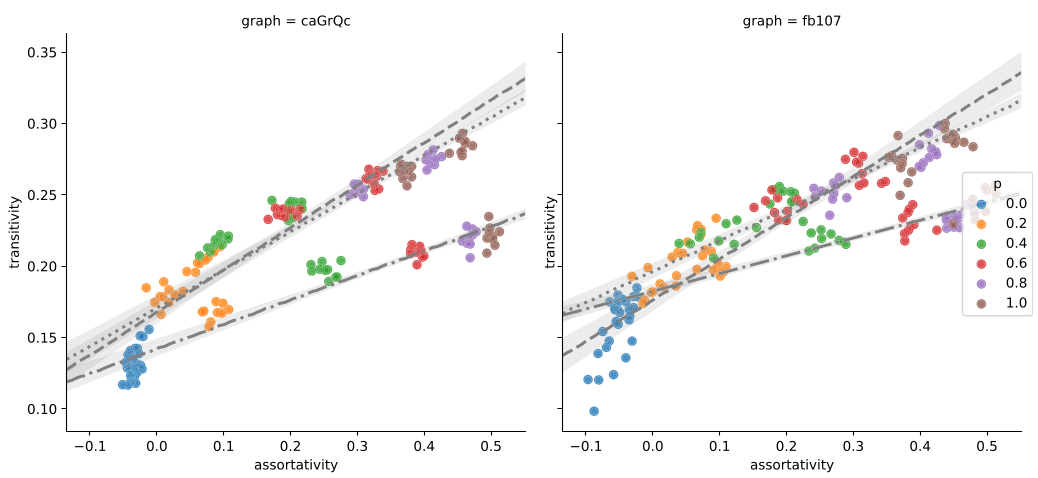
The experiments suggest that Transitivity (the tendency of "friends of friends" to be friends) and Assortativity (the tendency of similar nodes to connect) are massive security holes. Even if you change every node's degree, if you preserve a network's clustering pattern, an ML model can still reidentify individuals with high accuracy.
2. The Fallacy of Degree-Distribution Perturbation
Previous SOTA work emphasized that degree distribution is the primary source of leakage. However, this paper found cases (e.g., the soc-anybeat network) where graphs with completely different degree distributions remained highly vulnerable because their clustering coefficients (captured via ERGM-cc) remained intact.
3. Causal Pathways to Exposure
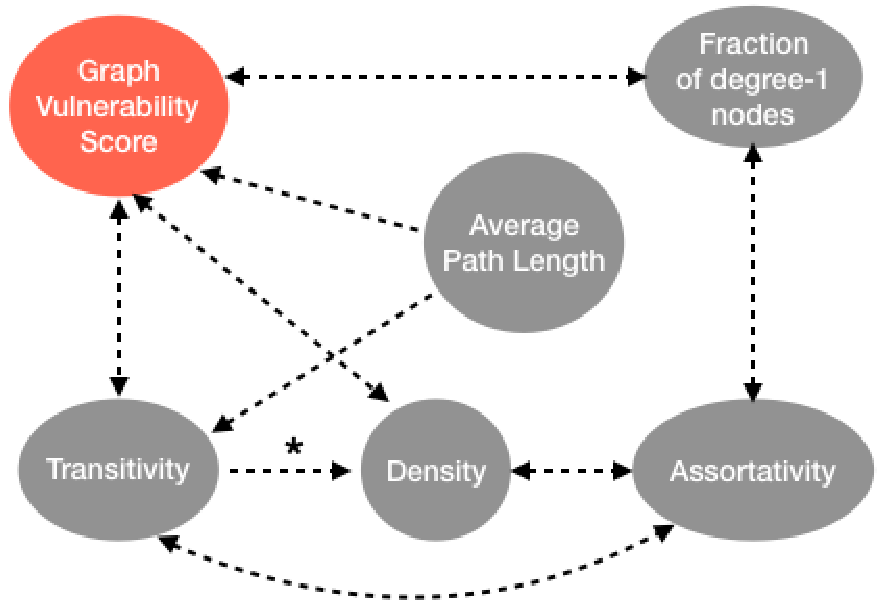
Through the Pearlian DAG, the authors discovered that while many metrics correlate with vulnerability, Transitivity and Average Path Length have direct statistical dependencies on the vulnerability score. Assortativity acts as a "confounding" force—it influences transitivity, which then exposes the node identities.
Critical Analysis & Takeaways
The most "disturbing" finding (in the authors' words) is that protecting privacy is much harder than we thought.
- For Researchers: This work proves that "utility-preserving" anonymization is often an oxymoron. If you keep the "social science" value of the graph (clustering, communities), you are essentially keeping the road map for an attacker.
- For Practitioners: When publishing data, you must choose: either explicitly perturb higher-order structures like transitivity or accept that the data is fundamentally de-anonymizable.
Future Outlook
The framework is now open-source (hosted on GitHub), allowing others to test different attack models. The next frontier involves extending this to dynamic graphs—where the arrival of new edges over time might create even more unique "temporal signatures" than static structures.
Final Summary: Anonymity isn't just about hiding who you are; it's about hiding who you're near and how you cluster. In the world of social graphs, your community is your identity.