
BELFIS: Mimicking the Brain’s Emotional Loop to Predict Solar Storms
Brain Emotional Learning Based Fuzzy Inference System (BELFIS) for Solar Activity Forecasting
The paper introduces BELFIS (Brain Emotional Learning Based Fuzzy Inference System), an AI architecture combining neuro-fuzzy systems with bio-inspired models of the brain's limbic system. It achieves state-of-the-art accuracy in predicting chaotic solar activity (sunspot numbers), crucial for protecting satellite and telecommunication infrastructure.
TL;DR
Predicting solar activity—specifically sunspots—is critical for modern infrastructure but notoriously difficult due to its chaotic nature. This paper introduces BELFIS, a hybrid architecture that fuses Neuro-Fuzzy Inference with the biological logic of the brain's limbic system. By imitating how the amygdala learns from rewards and punishments, BELFIS achieves SOTA long-term prediction accuracy with 40x faster convergence than traditional adaptive fuzzy systems.
Background: Why "Emotional" Learning?
Traditional AI models are often "cold" data-crunchers. However, humans process information through an emotional lens that prioritizes certain stimuli based on reinforcement. In the brain, the Amygdala and the Orbitofrontal Cortex work in tandem to evaluate stimulus-response associations.
The authors argue that chaotic time series, like sunspot cycles, benefit from this "emotional" architecture because it allows the model to better weight reinforcement signals (prediction errors) and adjust internal mappings more dynamically than standard backpropagation.
Methodology: The Architecture of BELFIS
BELFIS is structured into four functional components that mirror the limbic system:
- Thalamus (TH): Filters and provides high-level information about the stimulus.
- Sensory Cortex (CX): Distributes signals between the processing units.
- Amygdala (AMYG): The core learning unit that forms stimulus-response associations using fuzzy rules.
- Orbitofrontal Cortex (ORBI): Acts as a regulator, preventing the Amygdala from providing inappropriate responses by evaluating reinforcement signals.
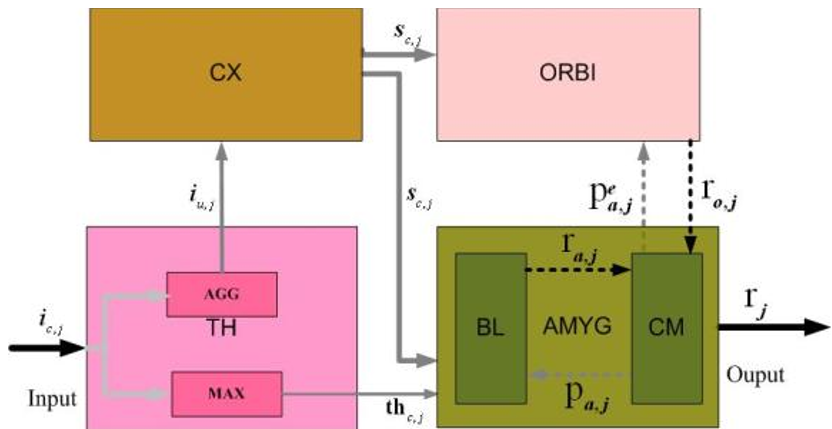 Figure 1: The structural flow of BELFIS, showing the bidirectional connection between the Amygdala and Orbitofrontal components.
Technically, each component is implemented as an Adaptive Neuro-Fuzzy Inference System (ANFIS). The model uses a Sugeno-style fuzzy if-then rule set, but with a unique dual-phase learning algorithm that updates nonlinear parameters through a reinforcement-based loss function.
Empirical Results: Outperforming the Baselines
The researchers tested BELFIS against the standard ANFIS, Radial Basis Functions (RBF), and Locally Linear Model Trees (LoLiMoT).
1. Solar Cycle 19 Peak Prediction
One of the hardest tests for any solar model is predicting the peak of a cycle. During Solar Cycle 19, BELFIS successfully predicted a peak of 240.093, remarkably close to the actual observed value of 250.
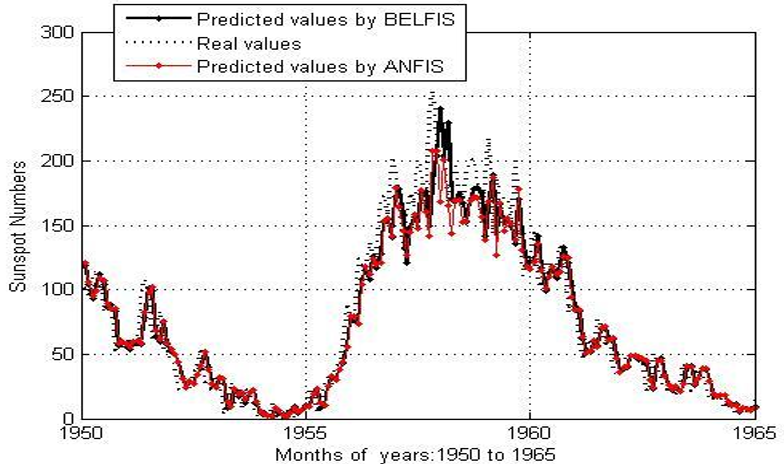 Figure 2: Monthly sunspot prediction compared to ground truth. BELFIS tracks the extreme peak of Cycle 19 more effectively than ANFIS.
2. Efficiency Gains
The most striking result is the computational efficiency:
- Convergence: For smoothed monthly sunspots, BELFIS required less than 100 iterations, whereas ANFIS needed over 4000 to reach comparable accuracy.
- Long-term Horizon: In 18-month ahead predictions, BELFIS maintained an MSE of 0.007, while competitors drifted toward 0.015.
Deep Insight: Why Does It Work?
The secret sauce of BELFIS is its Two-Phase Learning.
- Phase 1: Uses training samples to set the baseline weights.
- Phase 2: Uses an "incremental" update where the reinforcement signal becomes the primary driver.
This mimics how a brain adapts to new experiences without forgetting old ones, effectively solving the "catastrophic forgetting" or overfitting issues often seen in black-box neural networks. By using the Orbitofrontal cortex to "inhibit" the Amygdala, the model avoids overreacting to noise in the chaotic sunspot data.
Critical Analysis & Conclusion
The Takeaway: BELFIS is a powerful "gray-box" model. It isn't just a purely mathematical regression; it carries an architectural bias inspired by mammalian biology that makes it robust for long-term chaotic forecasting.
Limitations: The authors admit to the "curse of dimensionality." Because it relies on fuzzy inference rules, the number of rules grows exponentially with the number of input variables, making it less suitable for high-dimensional data without prior feature reduction.
Future Work: The next logical step is integrating Genetic Algorithms to optimize the initial membership functions and combining the model with SSA (Singular Spectrum Analysis) to further refine long-term signal decomposition.