
The Belief Social Network: Decoding Uncertainty in Information Exchange
Belief Approach for Social Networks
The paper introduces the "Belief Social Network" (BSN) model, which leverages the Theory of Belief Functions (Dempster-Shafer Theory) to model social networks under uncertainty. It treats nodes, edges, and messages as evidential entities, achieving more robust message classification through information fusion and pignistic probability.
TL;DR
This research proposes the Belief Social Network (BSN), a novel framework that applies the Theory of Belief Functions to handle uncertainty in social interactions. By treating nodes, links, and messages as sources of "evidence" rather than static data points, the model can more accurately categorize the nature of information even when sources are contradictory or reliable information is scarce.
Problem & Motivation: The Fog of Social Data
In a world of information overload, social networks are no longer just graphs of "who knows whom." They are complex ecosystems where a single message might be personal, commercial, or even malicious. Traditional graph models (Nodes , Edges ) are deterministic; they assume we know exactly what a node represents or how strong a link is.
However, human relationships are rarely that clear. Is a contact a "friend" or a "professional colleague"? Is a message truly "personal"? The authors argue that failing to model this uncertainty leads to poor decision-making and an inability to filter noise effectively.
Methodology: Fusing Network Structure with Evidence
The core innovation lies in the Evidential Graph structure. Unlike a standard graph, each component in a BSN carries a Mass Function (), which quantifies the degree of belief assigned to various hypotheses.
1. The Architecture of Belief
The model operates through a multi-step fusion process:
- Node & Edge Attribution: Every person (Node) and relationship (Edge) is assigned a mass function on their respective frames of discernment (, ).
- Vacuous Extension: To combine these different "types" of evidence, the authors extend them into a joint space ().
- The Mapping: A specialized mapping function translates the context (e.g., a "Person" sending via a "Friendly" link) into a message expectation (e.g., "Personal Non-Commercial").
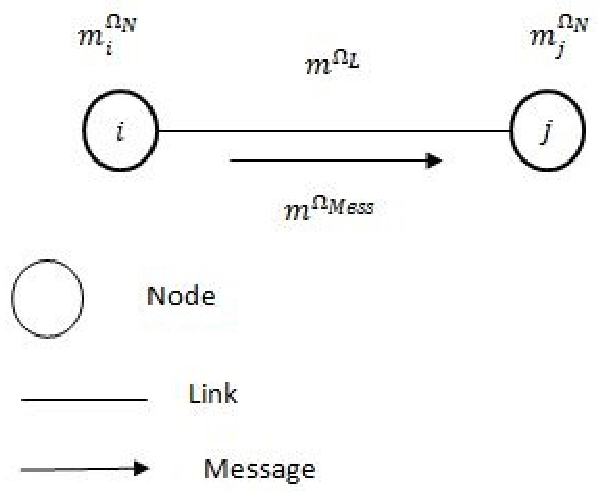 Figure 1: The architecture of information fusion in a BSN, showing the intersection of node/link beliefs with message content.
2. Decision Making
Once all evidence (from the sender, the link, and the message content itself) is fused using the Conjunctive Combination Rule, the system uses Pignistic Probability (BetP) to make a final hard decision. This allows the model to output a probability distribution across categories like Personal Commercial (PC), Impersonal Commercial (IC), etc.
Experiments & Results
The authors validated the model through scenarios involving different levels of conflict.
Scenario A: Reinforcement
When the message content aligns with the network context (e.g., a "Friend" sending a "Non-Commercial" message), the belief is reinforced. The probability of the correct classification jumped significantly compared to analyzing the message in isolation.
Scenario B: Conflict Detection
When a "Friend" (usually non-commercial) sends a "Commercial" message, the model generates a mass for the empty set (), indicating Conflict. This is a crucial feature: the model doesn't just guess; it signals that something is wrong or suspicious.
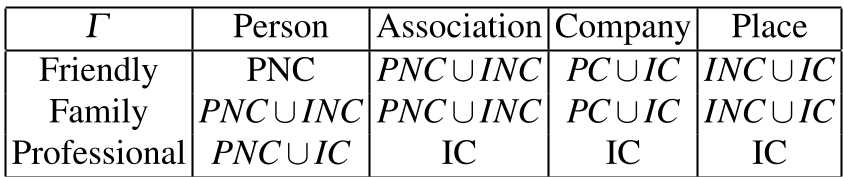 Table 1: The mapping function (Gamma) used to bridge the gap between social context and message nature.
Critical Analysis & Conclusion
Takeaway
The Belief Social Network demonstrates that the topology of the network acts as a filter. By mathematically fusing the "Who" and "How" with the "What," we can resolve ambiguities that text-only classifiers would struggle with.
Limitations & Future Work
- Scalability: The computational complexity of Dempster's rule can be high in massive networks.
- Mass Assignment: The current paper assumes mass functions are "given." Future work needs to focus on how to automatically generate these masses from raw behavioral data (e.g., using NLP to assign masses to messages).
- Dynamic Updating: Relationships change over time. The authors plan to extend this into a dynamic model to track evolving network behaviors.
In summary, this paper provides a rigorous mathematical bridge between graph theory and uncertainty reasoning, offering a more nuanced way to understand the complex flow of information in our digital lives.