
Maximizing Influence via Belief Propagation: From Monte-Carlo Chaos to Bayesian Precision
Influence Spread in Large-Scale Social Networks - A Belief Propagation Approach
The paper introduces a Belief Propagation (BP)-based framework for the Influence Maximization (IM) problem in social networks. By mapping influence spread under the Independent Cascade (IC) model to marginal probability inference in a Bayesian network, the authors propose two Directed Acyclic Graph (DAG) construction heuristics and leverage Loopy Belief Propagation (LBP) to achieve high-accuracy influence estimation across large-scale networks.
TL;DR
Influence Maximization (IM) has long been held hostage by the computational cost of Monte-Carlo simulations. This paper breaks the deadlock by treating influence spread as a Bayesian Inference problem. By pruning social networks into Directed Acyclic Graphs (DAGs) and applying Belief Propagation (BP), the authors achieve near-optimal results (equivalent to the Greedy algorithm) on networks with millions of edges, while drastically reducing the brute-force search space.
Background: The Cost of Viral Success
The goal of IM is simple: pick "seed" nodes to trigger the largest possible "word-of-mouth" cascade. However, the standard Greedy algorithm—while providing a approximation guarantee—is notoriously slow. It requires an "incremental oracle" that uses thousands of Monte-Carlo (MC) trials for every potential candidate. In a world of million-user social networks, MC is the bottleneck that makes real-time viral marketing impossible.
The Core Insight: Influence as a Bayesian Network
The authors identify a fundamental structural link: in the Independent Cascade (IC) model, the activation of a node is a probabilistic event depending on its parents. On a DAG, this is exactly the joint distribution of a Bayesian Network:
While it sounds simple, the authors prove that computing influence spread even on a DAG is #P-complete. However, this formalization allows us to borrow a powerful tool from the graphical models community: Belief Propagation.
Methodology: Pruning and Passing Messages
The proposed framework consists of two main pillars: DAG construction and Accelerated Seed Selection.
1. From General Graphs to DAGs
Social networks are loopy, but influence usually flows along "Maximum Influence Paths" (MIP). The authors propose two ways to extract the "influence skeleton" of a graph:
- DAG-1: Uses a virtual super-root and Dijkstra rankings to include any edge that flows from a "closer" node to a "further" node relative to the seeds.
- DAG-2: A leaner version that only takes the union of localized trees (MIOAs) for each seed.
2. The BP Heuristics
Instead of rolling dice (Monte-Carlo), they use Loopy Belief Propagation (LBP) and a Single-Pass BP (SPBP). SPBP is particularly clever—it ignores parent correlation to achieve complexity, providing an exact solution for singly-connected structures.
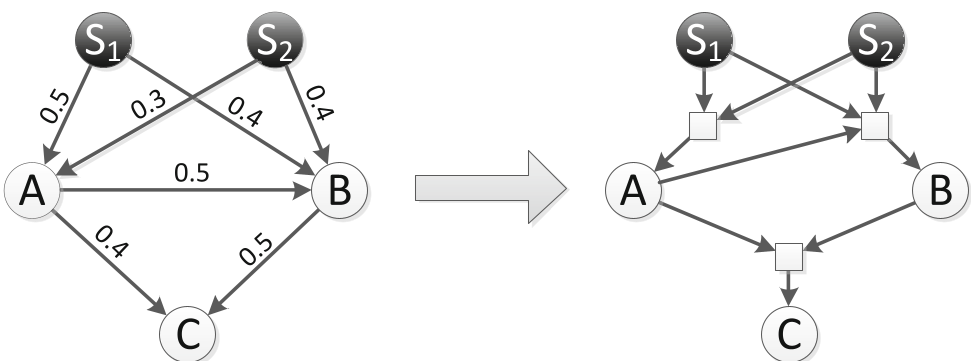 Figure 1: Transformation of an influence subgraph into a factor graph for message passing.
Experiments: Scalability Meets Accuracy
The authors tested their approach on diverse datasets, from small email networks to the 1.2M-edge Amazon purchasing graph.
Key Findings:
- Accuracy: On the Email dataset, DAG1–LBP was indistinguishable from the gold-standard Greedy algorithm.
- Efficiency: The "Accelerated Greedy" loop uses a "Peer Seeds" concept—if a node is added, only nodes whose influence regions overlap with need their marginal gains recalculated.
- Scalability: While Greedy fails to run on large datasets, the BP methods finish in reasonable time, outperforming simple heuristics like "Weighted Degree" which fail in dense scenarios.
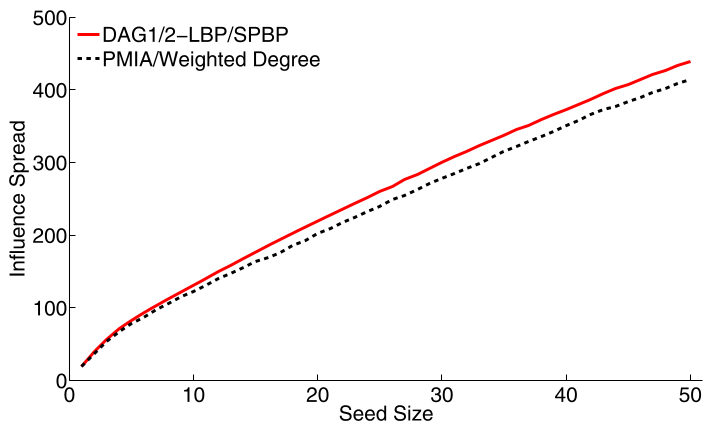 Figure 2: Performance comparison on the p2p-Gnutella network showing BP methods matching Greedy performance.
Critical Analysis & Conclusion
Takeaway
The shift from simulation-based estimation to inference-based calculation is a major step forward for social network analysis. By exploiting the submodularity of the influence function and the efficiency of message passing, this approach provides a flexible trade-off: use DAG1–LBP for max accuracy on static networks, or DAG2–SPBP for rapid results on dynamic ones.
Limitations
Despite the speedup, constructing CPTs (Conditional Probability Tables) remains expensive for nodes with very high in-degrees (the "celebrity problem"). The authors mitigated this by capping parents at 10, but this approximation might miss subtle long-tail influence effects in hyper-dense clusters.
Future Outlook
This work paves the way for integrating more complex "belief" states in social networks—such as the propagation of negative opinions or competing rumors—where simple MC simulations become even more exponentially complex.