
Beyond Precision: Navigating the Landscape of Social Image Diversification
Benchmarking Image Retrieval Diversification Techniques for Social Media
This paper presents a comprehensive benchmarking framework and longitudinal study of the "Retrieving Diverse Social Images Task" from the MediaEval campaign (2013-2016). It introduces four large-scale datasets (Div400, Div150Cred, Div150Multi, Div150Adhoc) and evaluates 180 systems to establish SOTA methodologies for balancing relevance and visual diversity in social media image retrieval.
TL;DR
Relevancy is easy, but variety is hard. This paper summarizes four years of the MediaEval "Retrieving Diverse Social Images" task, providing the definitive benchmark for social media image search. By analyzing 180 systems, the authors demonstrate that while traditional engines are great at finding what you asked for, they fail at showing you the different ways that thing exists. The solution? A mix of CNN features, social metadata, and "user credibility."
The "Eiffel Tower" Problem: Why Relevance Isn't Enough
In the early days of Content-Based Image Retrieval (CBIR), the goal was simple: if a user searches for "London," show them London. However, in the era of Social Media (Flickr, Instagram), a simple relevance search often returns 100 photos of the Big Ben from the exact same angle.
The authors argue that a truly "intelligent" system should recognize sub-topics: London at night, London's parks, London's street art, etc. Existing systems failed here because they treated queries as single-topic entities.
Methodology: The Multimodal Arsenal
The paper introduces a shift from purely visual or purely textual search to a Social-Aware Multimodal approach.
1. User Tagging Credibility
One of the paper's most unique contributions is the "Credibility" descriptor. It doesn't just look at the image; it looks at the user.
- VisualScore: Does the user's tag usually match the CNN-predicted concept?
- BulkProportion: Is the user a "serial tagger" who copy-pastes tags across unrelated images?
- TagSpecificity: Does the user use meaningful tags or just generic ones?
2. The Benchmarking Framework
The authors provided participants with pre-computed features to lower the entry barrier, allowing researchers to focus on the diversification algorithm rather than just feature extraction.
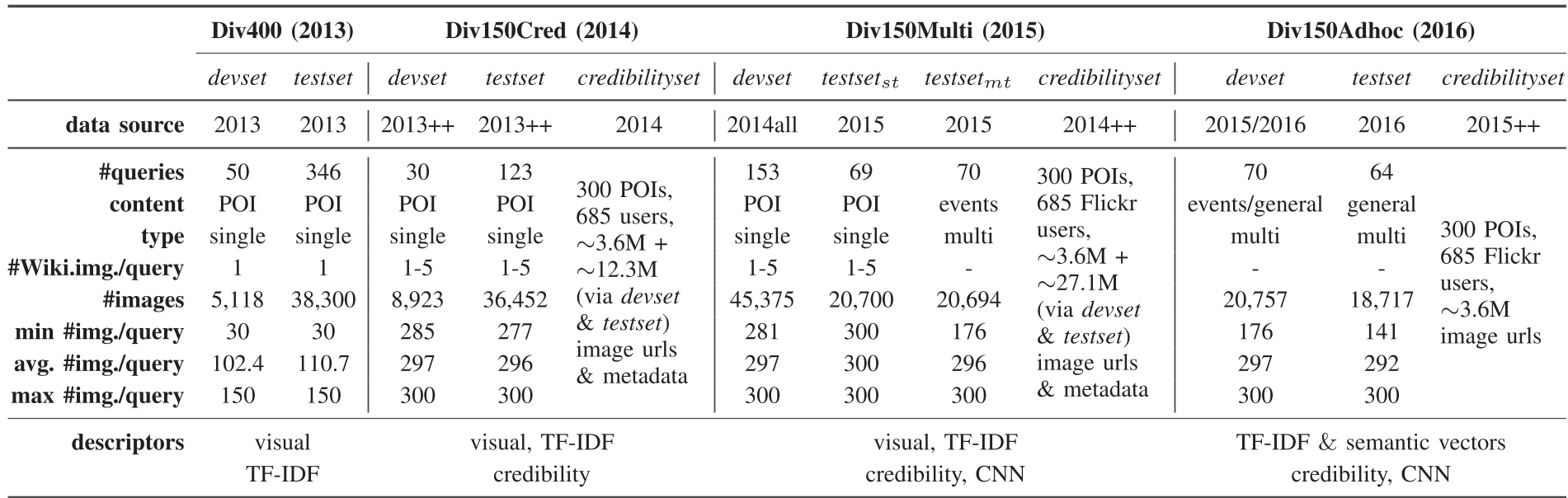 Table 1: Evolution of the Diversification Tasks (2013-2016), showing the shift from single-topic POIs to complex Multi-topic and Ad-hoc queries.
Battle-Tested Techniques: What Actually Works?
After analyzing 180 submitted systems, several trends emerged:
- Multimodal is King: Systems combining text, visual (CNN), and social signals consistently outperformed single-modality systems.
- Clustering Dominates: 64% of participants used clustering (e.g., Agglomerative Hierarchical Clustering) to group relevant images and then picked representative items from each group.
- The Deep Learning Edge: While CNNs didn't necessarily make the results more relevant (Flickr was already good at that), they were vastly superior at identifying visual diversity (Cluster Recall).
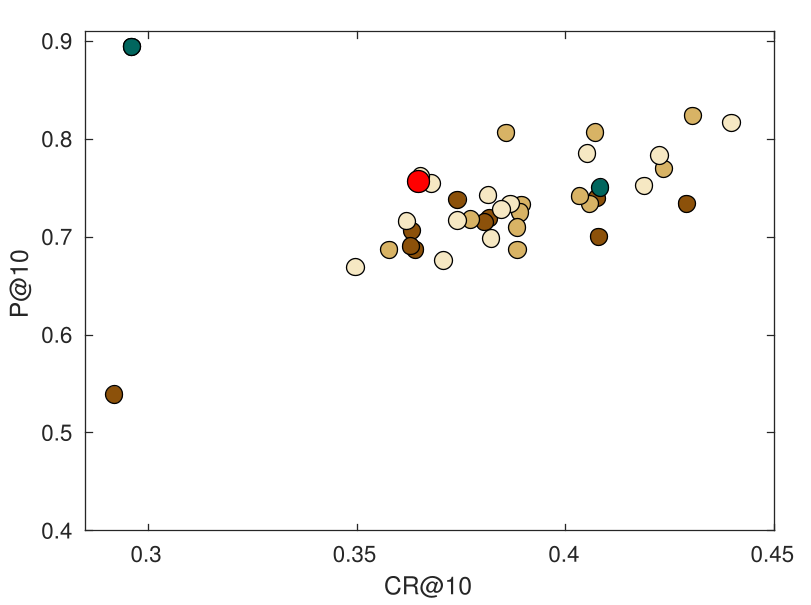 Figure 2: Performance analysis (P for Precision, CR for Cluster Recall). Note how systems generally improve Cluster Recall over the Flickr baseline while struggling to maintain the same peak Precision.
Critical Insight: The "Ad-hoc" Wall
The paper reveals a significant performance drop when moving from "Tourism" queries (e.g., "Big Ben") to "Ad-hoc" queries (e.g., "flying planes on blue sky"). Landmark queries have limited visual variance, but general queries are infinitely diverse. Most current SOTA methods still struggle with this transition, highlighting a major gap for future research in general-purpose AI search.
Conclusion & Future Outlook
The study concludes that diversification is not just a technical challenge but a "user perception" challenge.
- CNNs as Descriptors: In this task, Deep Learning is best used as a feature extractor rather than a direct classifier.
- Late Fusion: Combining different rankings (text ranking + visual ranking) works just as well as complex early-stage integration.
- The Next Frontier: Future systems must integrate "Visual Interestingness" and "Memorability" to pick not just diverse images, but quality diverse images.
This benchmark remains a cornerstone for anyone building search engines that aim to break the "sameness" of social media results.