
Beyond the Feed: Strategic Benefits of Network Externality in Modern SNS
The Benefits of Network Externality by Social Network Site
This study develops an Structural Equation Modeling (SEM) based prediction model to analyze the impact of network externality on Social Network Sites (SNS). By examining three dimensions of network externality, it successfully demonstrates that increased user scale leads to higher functional, social, and hedonic benefits, which in turn drive behavioral intention to use.
TL;DR
Why do we stay on Facebook or Instagram even when we complain about them? This study reveals that the "Network Externality"—the value generated by the sheer volume of other users—directly translates into functional, social, and hedonic benefits. These benefits create a self-reinforcing loop that drives our behavioral intention to keep using these platforms, regardless of the technology's basic utility.
Background & Motivation: The "Critical Mass" Problem
In traditional technology adoption, we look at how "easy" a tool is to use. But Social Network Sites (SNS) are different. A social network with one person is useless; a network with 800 million (as Facebook was during this study) is a powerhouse.
The authors identified a gap: while we know network effects exist, we didn't fully understand how they transform into specific user advantages. They moved beyond the standard Technology Acceptance Model (TAM) to explore the "why" behind user loyalty through the lens of Network Externality.
Methodology: Mapping the Value Chain
The research breaks down Network Externality into two sources:
- Direct Externality: The value of being able to communicate with more people (the "Telephone" effect).
- Indirect Externality: The availability of complementary products—apps, games, and third-party integrations—that flourish when a platform grows.
By surveying 350 active users and using Structural Equation Modeling (SEM), the researchers mapped these externalities to three core benefit types:
- Functional: Efficiency in communication and information searching.
- Social: Interpersonal bonding and identity.
- Hedonic: Pure entertainment and enjoyment.
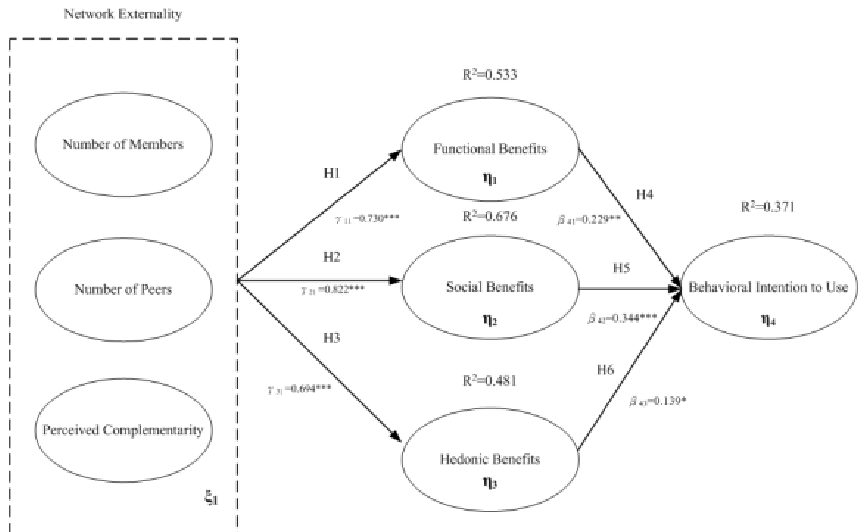 Fig 1. The structural model showing the flow from Network Externality to Behavioral Intention via the three benefit pillars.
Key Insights from the Data
The study’s findings were clear:
- The Multiplier Effect: More members mean more "complementary products" (like apps and games). This diversity significantly boosts the Hedonic Benefits, making the platform a "stay-in" destination rather than just a tool.
- The Social Glue: Network scale reduces the "distance" between friends. The research confirms that as the social graph densifies, the Social Benefits (social support and thought exchange) increase significantly.
- Intention via Value: The study proved that users don't just use SNS because of a "habit"; they do so because the platform provides a distinct set of perceived values that scale with the user base.
Critical Analysis & Future Outlook
The core takeaway is that for any SNS, the "Network Size" is not just a vanity metric—it is the engine that generates functional and emotional value.
What’s missing? The study was conducted in a specific geographic context (Taiwan) and during a specific era of Facebook's dominance. Today, we might see different weights for "Social Benefits" versus "Hedonic Benefits" given the rise of TikTok-style algorithmic entertainment vs. traditional social bonding.
Future Directions: As suggested by the authors, integrating Flow Theory (the state of being "absorbed" in an activity) or Media Richness Theory could further explain why some platforms (like video-heavy SNS) create more "Hedonic" value than text-based ones.
Conclusion
This paper serves as a foundational reminder for product managers and researchers: technology is not just about the interface; it’s about the ecosystem. When your network reaches "critical mass," the value you provide to your users stops being linear and starts being exponential.